Build vs. Buy: The Real Cost of DIY Conversational Analytics
Should your SaaS company build conversational analytics in-house or embed a white-label solution? We break down the real costs, timelines, and trade-offs — based on what we've seen from engineering teams in the trenches.

You're a SaaS company. Your customers are asking for better data visibility — ad-hoc reporting, natural language querying, maybe even a chat interface where they can just ask their data a question. The question is: do you build it yourself, or do you embed a 3rd party product?
It's a fair question. While you could use your engineering team to build in-house, for most data-centric SaaS products, the build path is longer, more expensive, and more risky than it looks on a whiteboard. Here's what we've seen — and what you should consider before committing either way.
The Case for Building
Let's be honest. There are legitimate reasons a product team might invest in building conversational analytics in-house.
Deep integration with your core product. If the analytics experience is inextricable from your product's core workflow — if the data interaction is the product — building in-house gives you total control over every interaction and every edge case. You have the opportunity to shape the experience exactly the way your users need it.
Proprietary data logic. Some industries have domain-specific data transformations that are so specialized, so tightly wound into the product's value proposition, that it's hard to imagine outsourcing them. If the analytical logic is your intellectual property, keeping it close makes sense. That said, there's an important distinction: the logic that makes your product special and the interface your users see are usually two separate things. In most cases, you can keep your proprietary processes locked down in the background and still use a white-label tool for everything your users interact with.
Long-term cost control (in theory). At massive scale, owning the infrastructure can eventually be cheaper than paying a vendor per-seat or per-query. If you're a large engineering organization with spare capacity and a multi-year horizon, the math can potentially work.
Organizational learning. Building AI capabilities in-house develops internal expertise. Your team learns what works, what doesn't, and you own that knowledge going forward.
These are real advantages. But they come with assumptions — that you have the team, the time, the budget, and the appetite to maintain what you build for years to come.
The Case for Buying (And What Building Actually Costs)
Here's where the conversation gets uncomfortable. Because what we hear from prospects — consistently — is that the build path looked a lot more manageable from the outside than it does twelve months in.
The team tax is real
We recently spoke with the CTO of a PE-backed SaaS company that decided to build their own conversational analytics experience. They allocated six to eight full-time engineers to the effort. Six months later, they had a bare-bones beta — and another 12–18 months of roadmap left to go before it would be ready for their customers.
Six to eight engineers, fully loaded, for six months. That's somewhere between $500K and $1M in salary alone — before you count opportunity cost, management overhead, or the features those engineers aren't building for your core product.
And this wasn't a team that was fumbling around. They're API-first, their data is clean and well-structured, and they had real engineering talent on it. A bare-bones beta after six months, with over a year still ahead — that's not a people problem. The work is just genuinely hard.
"Not core to our business" is the quiet part
This CTO said something that stuck with us. Their company has two AI initiatives: one for proprietary data extraction (core IP, directly tied to their product's value), and one for ad-hoc analytics and reporting. On the first, they're investing everything — as they should, since it's core to their differentiation and the value they deliver to customers. On the second, they were struggling to justify continued investment, knowing those engineering hours would be better spent on the things that actually set their product apart.
That's the crux of build vs. buy. Ad-hoc reporting and conversational data exploration are table-stakes features for your customers, but they're not why your customers chose you. You're not an analytics company. You're a SaaS company with unique IP in your niche — fintech, supply chain, procurement, or something else entirely — and your engineering hours are most valuable when they're pointed at the thing only you can do.
Hallucination isn't a minor bug
When we asked this CTO about their AI's accuracy, the response was candid: "Our AI hallucinates." That's not a reflection of their engineering skill — it's a reflection of the problem's difficulty.
Building an intelligent conversational AI layer on top of production databases is fundamentally different from integrating an off-the-shelf chatbot. When you build it yourself, you're taking on schema interpretation, query generation, result validation, and multi-turn context management — along with the constant risk that your AI confidently presents wrong numbers to your customers. Wrong numbers that your customers then use to make business decisions.
That accuracy problem doesn't go away on its own. For a company like Querri, whose entire business is data analytics, solving hallucination is an existential priority — every engineering sprint, every research investment, every quality benchmark is aimed at trustworthy answers. For a SaaS company where analytics is a feature rather than the product, it's a bug you'll get to when you can — somewhere between the twelve other priorities competing for your team's attention.
Scope creep is the silent killer
What starts as "let's add a chat interface" quickly becomes: Can users save their reports? Can they schedule reports to run automatically? Can they share dashboards with teammates? Can they export to Excel? PowerPoint? Can they set up email alerts? Can we control permissions per user? Per customer?
That same CTO told us they were just starting to explore report saving, scheduling, and sharing. "Just playing around with what's possible there." Meanwhile, every one of those features already exists in Querri — fully built, battle-tested, and ready to deploy. Not in twelve months. Tomorrow.
This is the scope problem. Conversational analytics isn't a feature — it's a product. And products need ongoing investment in UX, performance, security, compliance, new data source connectors, and the relentless march of AI model improvements. You're not building a feature. You're signing up to maintain an entire product line, indefinitely.
And unlike a licensed solution, which keeps pace with AI advances without any additional investment from your team — a homegrown tool requires continuous reinvestment just to stay current. Given how fast AI is moving right now, "keeping up" isn't a maintenance task. It's a full-time strategic commitment.
The API paradox
Here's a pattern we see repeatedly. Companies that are API-first — the ones with the best-structured data — actually face a unique challenge when building AI analytics. This CTO's company has access to roughly 1,000 APIs. But making all of those APIs available to an AI layer is a fundamentally different problem than making them available to developers.
Their observation: "The more APIs you give the tool, the more the AI starts to hallucinate." This is a well-understood problem in AI system design. More context doesn't automatically mean better answers — it means more opportunities for the model to get confused, conflate schemas, or generate plausible-but-wrong queries. Solving this requires careful context management, retrieval architecture, and ongoing tuning. It's a full-time job for a specialized team.
What the Math Actually Looks Like
Let's put rough numbers on it.
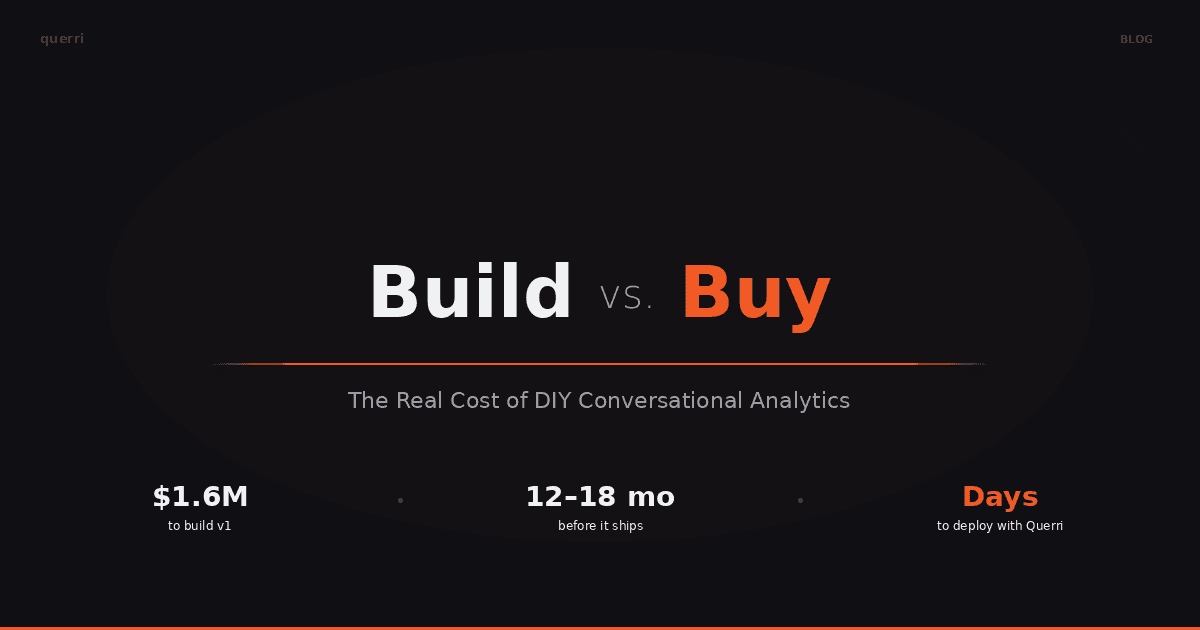
Building in-house: 6-8 engineers × 12-18 months to reach feature parity with a mature embedded conversational AI-first analytics product. At fully-loaded costs of $150K-$200K per engineer per year, that's $900K to $1.6M before you have a v1. Then add ongoing maintenance: at least 2-3 engineers dedicated to keeping it running, improving it, and responding to customer requests. That's $300K-$600K per year, every year, forever.
Buying a white-label solution: A fraction of a single engineer's salary. Ready to deploy in days, not months. Updates, improvements, and new capabilities included. And, while it's hard to quantify this, the real value is that your engineering team stays focused on the product your customers actually value and pay you for.
The CTO put it simply: Querri would cost less than half the annual salary of one engineer on his team — and have their ten clients up and running tomorrow. 'This is exactly what we're building,' he told us, 'but we're 12–18 months out. To have this ready to go live tomorrow would be a huge acceleration of our roadmap.'
The Integration Question
One common concern: "How hard is it to actually integrate a white-label solution into our product?"
This is where the landscape has changed dramatically. Modern embedded AI analytics platforms aren't the clunky iframes of 2015. The best ones offer SDK-level integration — a lightweight JavaScript library that drops into your existing frontend, handles authentication and permissions, and renders a fully branded experience inside your product. Your users never know it's there.
For teams building in Angular, React, Vue, or any modern framework, the integration path looks a lot like integrating Stripe for payments: add the SDK, configure authentication, customize the look and feel, and you're live. The heavy lifting — data connectivity, query generation, visualization, caching, permissioning — happens behind the scenes.
Your customers see your brand, your colors, your domain. Their data stays in your databases. You control who sees what. And the whole thing deploys in a sprint, not a quarter.
When Building Actually Makes Sense
We'll say it plainly: if data analytics is your core product — if it's the reason your customers pay you — you should probably build it. You need the control, the IP ownership, and the deep integration that only comes from owning every layer of the stack.
But if analytics is a capability your product needs to offer, not the product itself? If your customers expect data visibility but it's not why they chose you? Building from scratch is an expensive, risky detour from the work that actually grows your business.
The Question Worth Asking
The CTO we spoke with put it this way: their team is 12-18 months away from having what a white-label partner could deliver tomorrow for their entire customer base. That's 12-18 months of engineering salaries, 12-18 months of customers waiting, and 12-18 months of competitive exposure — all for a feature that's outside their core competency.
So the question isn't really "build or buy?" The question is: where does your engineering team create the most value?
If the answer is "building analytics infrastructure," build away. But if the answer is "building the thing only we can build" — and it usually is — then buying the analytics layer and shipping it under your own brand might be the most strategic engineering decision you make this year.
Querri's white-label embed gives data-centric SaaS products a fully branded conversational analytics experience — from chat-based querying to saved dashboards to scheduled reports — deployable in days, not months. Learn more about embedding Querri into your product.
Tags