Pipeline Coverage Report: The RevOps Guide to Forecasting with Confidence
Learn what pipeline coverage is, why it matters, what makes a great pipeline coverage report, and why most RevOps teams struggle to build one they can actually trust — and how to fix it.

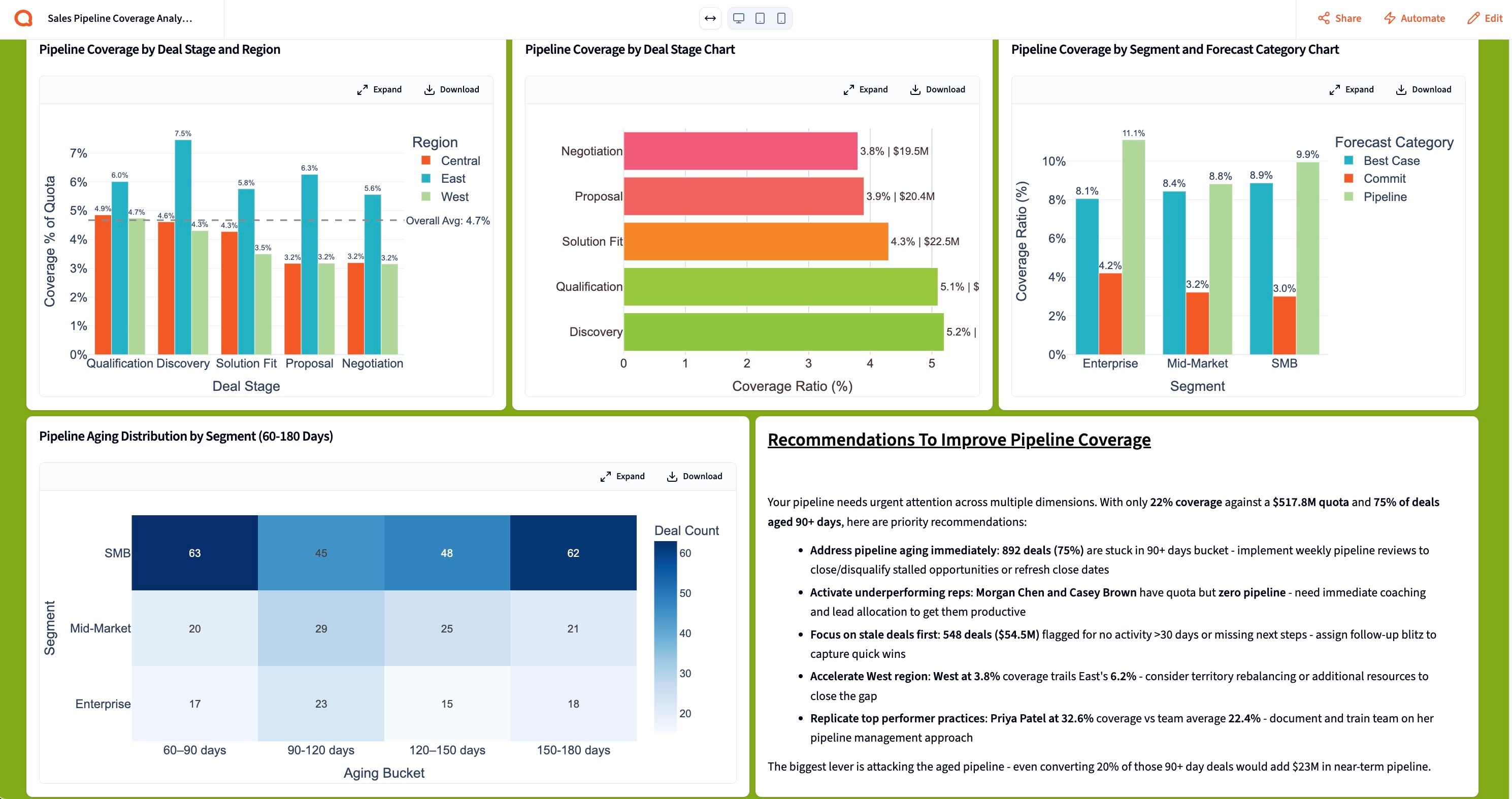
The Pipeline Coverage Problem No One Talks About
Every quarter, revenue teams stare at the same dashboard and tell themselves the same story: "We have 3x pipeline. We're in good shape."
Then the quarter closes, and the number isn't there.
The problem isn't the math. It's the data underneath it. Stale deals inflating the total. Amounts padded by optimistic reps. Opportunities that haven't moved in 90 days still sitting in "mid-funnel." Pipeline coverage is one of the most widely cited metrics in Revenue Operations — and one of the least trusted.
This guide breaks down what pipeline coverage actually is, why it's essential, who depends on it, what a good report looks like, and why generating an accurate one is harder than most people expect.
What Is Pipeline Coverage?
Pipeline coverage is the ratio of open pipeline value to your revenue target for a given period. It answers a simple but critical question: Do we have enough deals in play to hit our number?
The formula is straightforward:
Pipeline Coverage Ratio = Total Open Pipeline Value ÷ Revenue Target
If your Q3 quota is $1 million and you have $3 million in active pipeline, your coverage ratio is 3x.
Most organizations benchmark 3x as a minimum threshold — the assumption being that, accounting for typical win rates, deal slippage, and late-stage losses, a 3x pipeline gives you a reasonable probability of hitting quota. But that benchmark only holds if the pipeline underneath it is real.
A pipeline coverage report is the periodic analysis — typically weekly — that tracks this ratio across your revenue organization, segmented by rep, region, quarter, and deal stage. Done well, it's the single most important document a RevOps team produces. Done poorly, it becomes a political artifact that gives leadership false confidence while actual performance erodes in silence.
Why Pipeline Coverage Matters
Pipeline coverage sits at the intersection of sales strategy, financial forecasting, and operational execution. Here's why it's so consequential:
1. It Drives Revenue Forecasts
Every CFO, CRO, and board member wants to know the same thing: are we going to hit the number? Pipeline coverage is the foundational input to that answer. Without a reliable coverage view, your forecast is speculation dressed up in spreadsheets.
2. It Surfaces Problems Early — When You Can Still Act
A well-constructed coverage report doesn't just tell you where you stand today; it tells you where you're headed. If Q4 coverage drops from 3.2x to 2.4x in the span of two weeks, something has changed — and you need to know what and why while there's still time to respond. That might mean accelerating deals, pulling in new pipeline, or resetting expectations with leadership before the quarter closes.
3. It Informs Resource Allocation
Coverage gaps don't happen uniformly. One region might be sitting at 4x while another is at 1.8x. One rep might have an overflowing pipeline while a peer is starving for deals. Pipeline coverage at the aggregate level tells you the average. Pipeline coverage segmented by rep, region, and stage tells you the truth — and where to direct your attention.
4. It Enables Smarter Sales Coaching
Managers who know their team's coverage by stage don't just know if there's enough pipeline — they know where deals are getting stuck. Thin late-stage coverage is a closing problem. Thin early-stage coverage is a prospecting problem. The report tells you where to coach before the quarter runs out of time.
5. It Creates Organizational Alignment
When RevOps, sales leadership, and finance are looking at the same coverage number — defined the same way, calculated from the same data — it eliminates the finger-pointing that happens when the quarter goes sideways. Coverage becomes a shared language, not a contested claim.
Who Depends on Pipeline Coverage Reports?
Pipeline coverage isn't just a RevOps metric. It's a cross-functional signal that different stakeholders use in different ways:
Revenue Operations uses it as the primary input for pipeline health analysis, forecasting model inputs, and weekly cadence reporting. RevOps owns the integrity of the number.
Chief Revenue Officers (CROs) and VP of Sales use it to assess whether the team has enough pipeline to hit targets, where intervention is needed, and how to allocate resources across regions and segments.
Sales Managers use it at the rep and team level to identify who needs help, who has deals ready to close, and where deal momentum has stalled.
Finance and CFOs use it as a leading indicator to validate forecast submissions, stress-test revenue projections, and support board-level reporting.
CEOs and Boards use aggregate coverage trends — especially quarter-over-quarter movement — to assess business health and make decisions about growth investment.
Each of these audiences needs the same underlying data presented differently. That's part of what makes building an effective pipeline coverage report genuinely difficult.
Elements of a Good Pipeline Coverage Report
Not all pipeline coverage reports are created equal. A report that leadership actually trusts — and acts on — has these characteristics:
Clean, Qualified Pipeline Only
A coverage ratio built on unqualified, stale, or incomplete deals is worse than no coverage ratio at all, because it creates false confidence. A good report defines what "qualified pipeline" means (minimum deal size, required CRM fields populated, valid close date, active within the last 30–60 days) and calculates coverage only against that baseline.
Stage-Level Segmentation
Reporting a single pipeline coverage number hides the most important information. A deal in discovery is not the same as a deal in contract review. A good coverage report breaks coverage down across deal stages so you can see whether you have early-stage volume or late-stage closeable pipeline — because they require completely different responses.
Coverage by Rep, Region, and Team
Aggregate numbers obscure individual realities. A team-level 3.5x looks healthy until you see that one rep accounts for 70% of it and three others are under 1x. Pipeline coverage reports that slice by owner, territory, and business segment surface the coaching opportunities and resource gaps that aggregate reporting hides.
Stale Deal Identification
Every CRM is a graveyard of deals that should have been closed-lost months ago. A rigorous pipeline coverage report flags deals with no activity in 30–60 days and excludes them from coverage calculations — or at minimum surfaces them visibly so leadership can see the "real" versus "inflated" number side by side.
Trend Lines, Not Just Point-in-Time Snapshots
A single week's coverage number tells you where you are. Three months of weekly coverage data tells you whether you're improving or declining, and at what velocity. Coverage trends are often more actionable than the absolute ratio.
Gap-to-Quota Analysis
Beyond the coverage ratio, a good report translates the gap between current pipeline and target into a concrete number: "We need $1.4M in additional pipeline to be at 3x coverage by the end of the quarter." That kind of specificity drives real action.
A Narrative, Not Just a Dashboard
Numbers don't make decisions; people do. The best pipeline coverage reports include a plain-language summary of what the data means: where coverage is healthy, where it's at risk, and what the recommended actions are. This is especially important when presenting to senior leaders who don't have time to interpret raw charts.
Why Generating Accurate Pipeline Coverage Reports Is So Hard
If pipeline coverage is so important, why do so many teams struggle to produce a reliable one? There are several structural reasons:
1. CRM Data Is Notoriously Messy
Revenue teams run on CRMs, but CRMs are only as good as the humans who populate them. Close dates get pushed without explanation. Deal amounts are estimated, padded, or guessed. Stage progressions don't always reflect actual deal state. Required fields get skipped in busy periods. By the time someone pulls a pipeline report, the underlying data is a mix of accurate records and wishful thinking — and it's hard to tell which is which at scale.
2. Quota Data Lives in Spreadsheets
In most organizations, quota targets are managed in Excel or Google Sheets, completely separate from the CRM where pipeline lives. Calculating a coverage ratio means joining two datasets that don't naturally connect. This usually requires manual work: exporting from the CRM, pulling quota targets from a file, manipulating both in a spreadsheet, and hoping nothing breaks. It's time-consuming, error-prone, and has to be repeated every week.
3. "Pipeline" Has No Agreed-Upon Definition
Ask five people in your revenue org what counts as qualified pipeline and you'll get five different answers. Without a shared, enforced definition — and the ability to filter data to match it — every coverage calculation is measuring something slightly different. This creates endless debate about whose number is right rather than conversations about what to do about it.
4. The Report Takes Too Long to Build
Even teams with relatively clean data report spending hours every week pulling, cleaning, and formatting pipeline coverage reports manually. By the time the report is done, it's already 24–48 hours old. In a fast-moving sales environment, that lag matters.
5. Stale Deals Are Invisible in Most CRM Reports
Standard CRM reports show you pipeline as-is. They don't flag deals that haven't moved in 60 days or highlight opportunities where no one has logged an activity in a month. Without that signal, coverage calculations are inherently overstated — and teams don't know by how much.
6. Segmentation Is Manual and Tedious
Slicing pipeline coverage by quarter, region, rep, deal category, and stage — all at once — typically requires custom report building in the CRM (which requires admin access and time) or extensive pivot table work in Excel. Most teams pick one or two slices and miss the nuances that other dimensions would reveal.
How Querri Solves the Pipeline Coverage Problem
Querri is an AI-powered data analytics platform built to do the work that makes pipeline coverage reports accurate, fast, and actionable — without requiring a data team.
Here's what that looks like in practice:
Data unification without the manual work. Querri connects directly to HubSpot or ingests CSV and Excel exports from Salesforce or any other CRM. Upload your quota targets file separately, and Querri automatically joins the two datasets — no manual VLOOKUP required. Your pipeline and your targets are in the same place, calculated consistently.
Automatic data cleaning and standardization. Before any coverage ratio is calculated, Querri profiles your deal data and flags inconsistencies: missing close dates, deals in incompatible stages, records with no activity. You can run plain-English prompts like "flag any open opportunities that haven't had activity in the last 60 days as stale" and Querri identifies and tags them automatically, so they don't inflate your coverage numbers.
Segmentation in minutes, not hours. With a single prompt — "Create a pipeline coverage report segmented by quarter, region, and deal category" — Querri generates a fully segmented analysis with appropriate visualizations. No custom report building. No pivot tables. No waiting for a data analyst.
Narrative-driven insights, not just charts. Querri doesn't just visualize data — it interprets it. Every report includes a plain-language analysis of what the coverage numbers mean, where gaps are most acute, and what actions are recommended. It's the difference between handing leadership a dashboard and giving them an answer.
Executive presentations on demand. From the same analysis, Querri can generate a narrative-driven PowerPoint or PDF presentation, ready for a QBR or board meeting. The story is already written; you just deliver it.
Automated weekly cadence. Once your pipeline coverage report is built and trusted, save it as a reusable template. Querri will run it automatically each week — refreshing data, recalculating coverage, flagging new stale deals — so your team always has an up-to-date view of pipeline health without anyone having to pull it manually.
The result is a pipeline coverage report that doesn't just report what's in the CRM — it tells you what's actually true about your pipeline, and what to do about it.
The Bottom Line
Pipeline coverage is not a vanity metric. When calculated honestly — against qualified pipeline, segmented meaningfully, and tracked consistently over time — it's one of the most powerful tools a revenue organization has to predict outcomes and drive the right behaviors.
The challenge has never been understanding why it matters. The challenge is building a report that actually tells the truth, week after week, without requiring hours of manual effort to produce.
That's exactly what a modern RevOps stack should solve. And if your current pipeline coverage report is mostly a source of debate rather than a source of clarity, it's worth asking whether the problem is your pipeline — or your process for measuring it.
Ready to build a pipeline coverage report you can actually trust? Explore Querri's RevOps Pipeline Coverage Playbook or start your free trial today.
Tags