Connect PostgreSQL to Querri
Bring your PostgreSQL data into Querri and ask questions about your tables in plain language. Works with PostgreSQL 9.6+, AWS RDS, Azure Database, and Google Cloud SQL.
What You Can Analyze
Querri connects directly to your PostgreSQL database and lets you query any accessible table using natural language.
Tables & Views
Access all tables and views with full schema support including indexes, constraints, and relationships
Custom Queries
Ask questions across any combination of tables—Querri writes the SQL so you don't have to
Real-Time Access
Query live production data without exports, snapshots, or manual syncs
Multi-Schema
Access tables across multiple schemas in a single database connection
Cloud Variants
Works with AWS RDS, Azure Database for PostgreSQL, Google Cloud SQL, and Heroku Postgres
Column-Level Control
Restrict access to specific columns for security—only expose the data your team needs
Query Your Database in Plain English
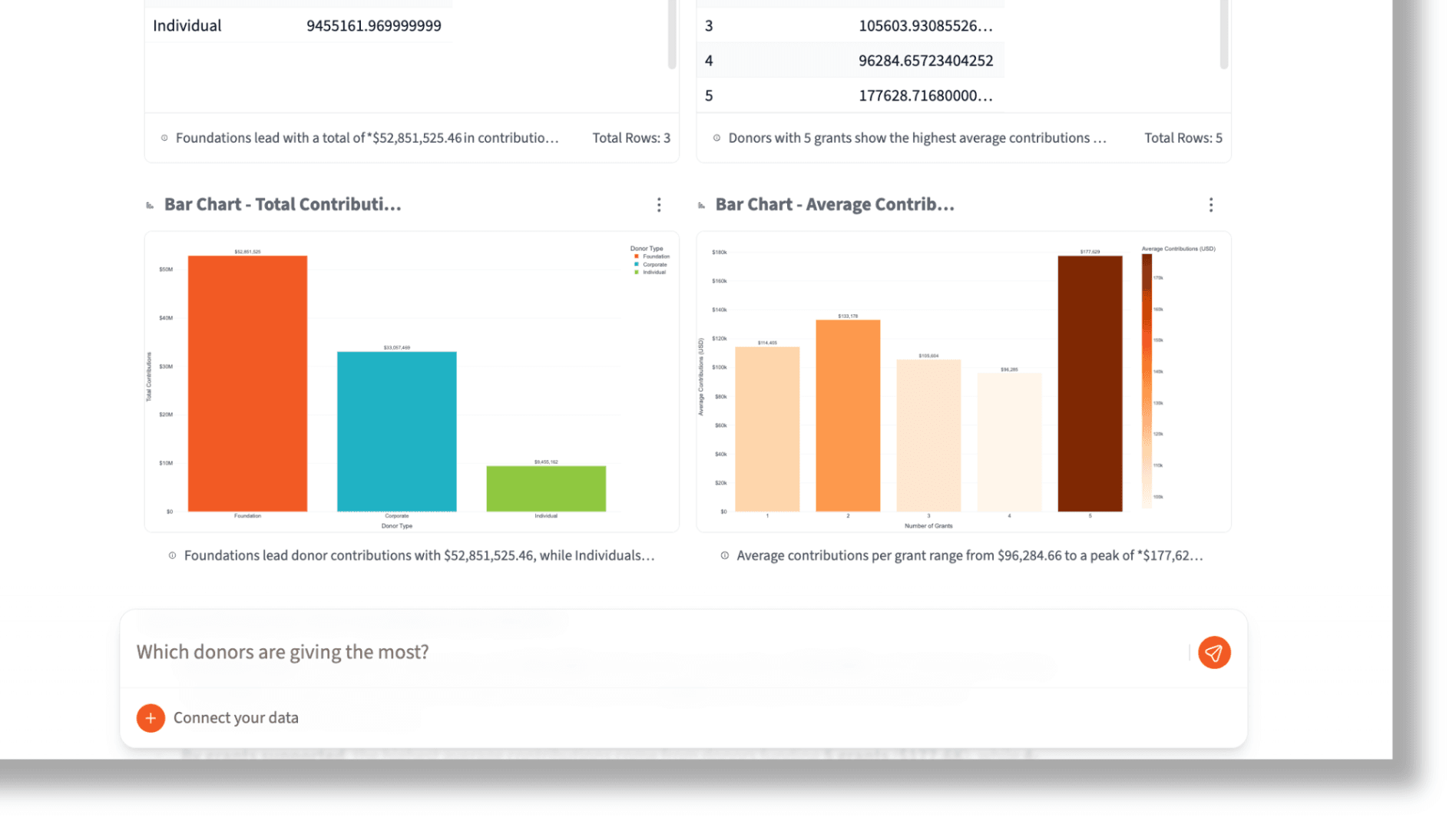
Stop writing SQL by hand. Connect your PostgreSQL database to Querri and ask questions in plain language. Querri translates your questions into optimized SQL and returns charts, tables, and insights instantly.
Ask things like 'What are the top 10 customers by lifetime value?' or 'Show me order trends by region over the last 12 months' and get answers in seconds.
Ask complex analytical questions without writing any SQL
Get instant visualizations from your database tables
Explore schemas and relationships through conversation
Combine Database Data with Any Source
PostgreSQL is powerful on its own, but the real insights come when you blend it with other data. Combine your database tables with spreadsheets, CRM records, advertising data, and more—all inside Querri.
No ETL pipelines or data engineering required. Just connect your sources and start asking questions across all of them.
Blend PostgreSQL tables with spreadsheets and CSV files
Join database records with CRM and marketing data
Build cross-source dashboards without data engineering
How the Integration Works
Authentication
Username/password with SSL encryption. We recommend creating a dedicated read-only user for Querri.
Security
AES-256 encryption at rest and in transit. Whitelist Querri IP 18.189.33.77 in your firewall rules.
Sync Method
Direct query access to live database tables and views. No data replication or batch syncing required.
Read-Only Access
Querri only reads data. Create a SELECT-only user for maximum safety—your data is never modified.
Explore More Integrations
Connect all your data sources to Querri for a complete picture.
Frequently Asked Questions
Common questions about connecting PostgreSQL to Querri.
Querri is an AI-powered PostgreSQL analytics tool that lets you query your database using natural language instead of SQL. It connects directly to your PostgreSQL instance, auto-discovers tables and schemas, and generates optimized queries so anyone on your team can get insights without writing code.
Yes. Querri translates your plain-English questions into optimized PostgreSQL queries automatically. Just type a question like 'What are the top 10 customers by revenue?' and Querri writes and executes the SQL for you, returning charts and tables instantly.
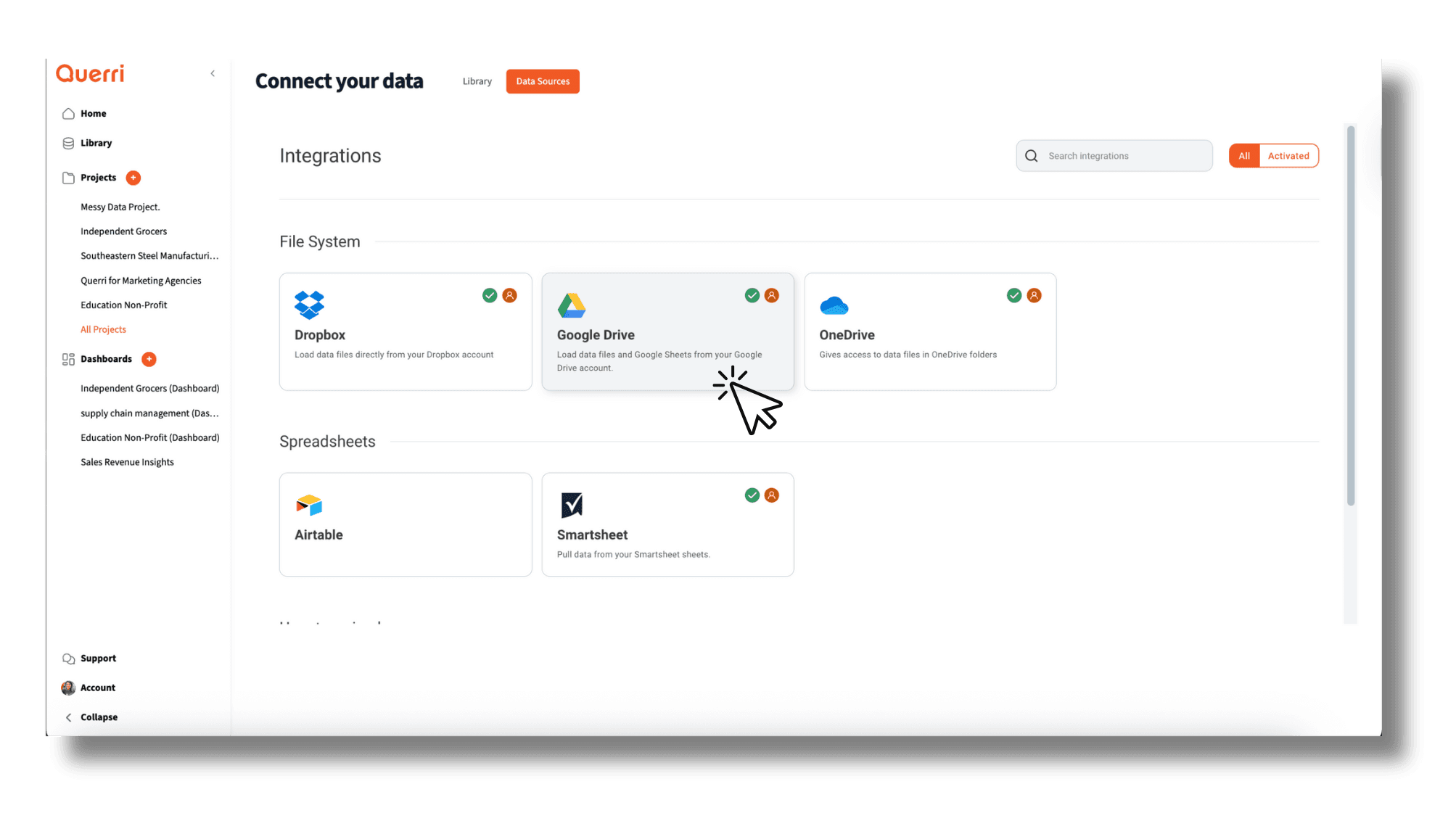
In Querri, go to Settings and click Add Connector. Enter your PostgreSQL host, port (default 5432), database name, and read-only credentials. Whitelist Querri's IP address 18.189.33.77 in your firewall, test the connection, and you're ready to start asking questions.
Yes. Querri supports AWS RDS for PostgreSQL, Azure Database for PostgreSQL, Google Cloud SQL, and Heroku Postgres. The setup is the same as any PostgreSQL connection—just provide your RDS endpoint as the host and whitelist Querri's IP in your security group.
Querri is SOC 2 Type II certified and uses AES-256 encryption for data at rest and in transit. We recommend creating a dedicated read-only database user for Querri so it can never modify your data. You also control access by whitelisting a single IP address (18.189.33.77).
Querri supports PostgreSQL 9.6 and above, including all current major versions. It also works with managed PostgreSQL services like AWS RDS, Azure Database, Google Cloud SQL, and Heroku Postgres regardless of the minor version.
No. Querri uses live, direct query access to your PostgreSQL database. It reads data in real time without replicating, exporting, or batch-syncing your tables. Your data stays in your database at all times.
Yes. Querri offers drag-and-drop dashboards with 8 chart types powered by Plotly. You can pin any query result to a dashboard, schedule automatic refreshes with cron scheduling, and share or embed dashboards using the Embed SDK.
Run CREATE USER querri_reader WITH PASSWORD 'your_password'; then GRANT CONNECT ON DATABASE your_db TO querri_reader; and GRANT SELECT ON ALL TABLES IN SCHEMA public TO querri_reader;. This ensures Querri can only read data and never modify your database.
Yes. Querri supports multi-schema access within a single database connection. It auto-discovers all schemas your connected user has permissions for, so you can query tables across different schemas without creating separate connectors.
Querri is designed for non-technical users who need to analyze PostgreSQL data without learning SQL. Users ask questions in plain English, and Querri handles the query generation, execution, and visualization automatically. It also supports scheduled reports and embeddable dashboards.
Yes. Querri generates interactive visualizations from your PostgreSQL data using Plotly, including bar charts, line charts, scatter plots, pie charts, and more. Every query result can be turned into a chart with a single click and added to a drag-and-drop dashboard.
Yes. You can restrict which columns Querri can access by configuring your PostgreSQL user's permissions at the column level. Querri respects whatever permissions your database user has, so you can limit exposure to sensitive fields like SSNs or salary data.
Yes. Querri lets you blend PostgreSQL tables with data from Google Sheets, Salesforce, HubSpot, CSV files, and other connected databases. You can join and analyze data across sources without building ETL pipelines or writing integration code.
Querri generates optimized SQL queries with appropriate filters, limits, and aggregations to handle large tables efficiently. It queries your database directly, leveraging PostgreSQL's own indexing and query optimizer, so performance scales with your database's capabilities.