Querri vs Snowflake
Snowflake is a great warehouse. Querri is the whole road to the answer.
Same goal: trusted answers. Very different projects.
Snowflake is one of the best data warehouses ever built, and a warehouse is where the work starts: pipelines, models, a BI layer, AI on top and a meter someone has to watch. Querri is the question-first data platform. It starts from the questions your business asks and builds what's needed to answer them, in one product, on one predictable bill.
Time, cost and control
Answers this quarter, a bill you can plan, and no new team to hire
Snowflake is the start of a data platform. Querri is the finished path from your systems to an answer. Here's what that difference means for the business.
-
Answers in days, not quarters
A warehouse project runs weeks to months before anyone asks a question. With Querri, you connect a system or upload a file and ask the same day.
-
A bill you can plan, with no surprises
Snowflake bills by consumption, with separate tools for ingestion and dashboards on top. Querri is one predictable bill: a monthly credit allowance tied to the work your team does, alerts before you reach it, and no automatic overage charges.
-
No data team required
The warehouse path needs engineers to build it and keep it running. In Querri, the people who already know the business decide what the numbers mean, in plain language.
-
Secure, auditable, nothing to rip out
SOC 2 Type II, HIPAA and ISO 27001:2022, and your data never trains a model. Every number shows its query, and if you already run Snowflake, Querri connects to it.
Where each one fits
Pick by the team and the timeline you have
We'd rather you pick the right tool than pick us for the wrong reason. Here's where each one fits.
Choose Snowflake when
- You have a data team that will build pipelines, dbt models and semantic views, and keep them current.
- Your data runs to many terabytes, or you need elastic, high-concurrency SQL for hundreds of analysts.
- Data must stay in your own warehouse, with zero-copy sharing to partners or Iceberg tables in your own cloud.
- You run data engineering and data science workloads, not only business analytics.
- Someone will own the bill: warehouse sizing, auto-suspend, resource monitors and budgets.
Choose Querri when
- You want business answers in days, not after a warehouse project.
- Your data lives in business systems (CRM, accounting, ERP, payments, spreadsheets) and the hard part is joining them.
- The people who know what the numbers mean aren't engineers, and shouldn't have to write YAML to say so.
- You want one predictable bill, not a meter that grows with every question an agent answers.
- You want dashboards, reports, an AI agent, data cleaning and MCP for Claude and ChatGPT built in, not assembled.
Feature by feature
The detailed comparison
Every row says where each one is stronger. Where Snowflake wins, we say so. Facts are current as of October 2026 and linked in the sources.
Snowflake prices are US list from Snowflake's Service Consumption Table and documentation as of October 15, 2026. Prices vary by region, cloud and contract.
Pricing
Consumption pricing rewards a team that watches it
Paying only for what you use is a real advantage when someone manages it. Without that someone, the meter follows every warehouse left running, every oversized query and every question an AI agent answers, and the bill arrives after the fact.
How Snowflake is billed
- Credits cost $2, $3 or $4 (Standard, Enterprise, Business Critical, US). An X-Small warehouse uses 1 credit an hour, and each size up doubles it.
- A warehouse made in the web interface defaults to X-Large: 16 credits an hour, about $48 an hour on Enterprise, or about $1,150 a day if it never stops (our arithmetic).
- The default auto-suspend bills 10 idle minutes, every resume bills at least a minute, and a runaway query is cancelled after 2 days by default.
- CoWork is billed in AI Credits "based on token consumption" at $2 each, and the SQL it runs is billed again as warehouse compute.
- Cortex Analyst on its own is 67 credits per 1,000 messages: about $0.13 to $0.27 a question depending on edition, plus compute.
- Resource monitors can't track AI or serverless spend, and budgets only alert. A hard stop on AI spend takes custom code or per-user quotas.
When consumption pricing is the better deal
If you have a data team that sizes warehouses from evidence, sets 60-second auto-suspend, uses resource monitors and budgets, and reviews spend every week, consumption pricing can be very efficient: you pay for the work and nothing else. ChartMogul cut its weekly Snowflake cost by 70% with that kind of work. If that's your team, the guides below are where to start.
What happens when nobody's watching
Choosing Snowflake? Keep the meter in check.
If Snowflake is the right call for you, these are the controls and habits that keep the bill predictable.
- Set resource monitors Notify and suspend warehouses at a credit quota. They don't cover AI. Snowflake docs
- Create budgets Track spend, including AI, and alert before the month is gone. Snowflake docs
- Tune auto-suspend and sizing Snowflake's own guidance on suspend times and warehouse size. Snowflake docs
- FinOps for data cloud platforms The FinOps Foundation's playbook, with Snowflake as the main example. FinOps Foundation
- 15 proven cost strategies SELECT's practitioner guide, from 60-second auto-suspend up. SELECT
- How ChartMogul cut 70% A real team's optimization, step by step. Proof it works, and that it's work. ChartMogul
How Querri keeps the bill predictable
- One bill, no surprises. One plan for the whole organization, with the AI, storage and unlimited dashboard viewers included. See plans and pricing.
- One simple credit. A credit is a unit of business work, like answering a question or syncing a source, so usage is easy to understand and easy to plan for.
- Unlimited dashboard viewers on every plan. Viewing, uploads, exports and the Library never cost credits.
- Usage alerts at 80% of the plan, when it's over and on a spike, plus a monthly limit for any person.
- No automatic overage charges. We tell you as you approach your limit, and you decide what happens next.
- No warehouse to size, suspend or forget. Storage, the engine and the AI are in the plan.
Total cost
What it takes to get the first answer
A warehouse is where the work starts. Before a business user gets a trusted answer, someone builds what goes in front of it and behind it. Here's the typical Snowflake path, next to Querri.
The Snowflake path is our estimate from Vendr contract data, published list prices and salary ranges in the linked sources, not a quote. A lean setup costs less; if you already have the team, the people line is a cost you've already chosen.
Architecture
An engine built for the biggest data. DuckDB for the data you actually have.
This is the real architectural difference, and it explains much of the cost gap. Snowflake runs its own distributed SQL engine on virtual warehouses: clusters of compute you size and pay for by the second while they run. Querri runs DuckDB, an in-process analytical engine that is extremely fast on a single machine, over open Parquet and Iceberg files.
Snowflake
A distributed warehouse, metered by size and time
- Storage and compute are separate, so each team can run its own warehouse without slowing the others. Elegant, and Snowflake made it famous.
- Warehouses bill per second, with a one-minute minimum each time one resumes. Each size up doubles the credits per hour.
- Gen2 warehouses, now Snowflake's default, cost about 35% more per hour, with query acceleration switched on.
- Genuinely the right tool for many terabytes, heavy concurrency and enterprise data sharing.
Querri
DuckDB on open files, sized to business data
- Each organization's data is stored as Parquet in Apache Iceberg tables, in its own storage.
- DuckDB queries it in process: no warehouse to size, resume, suspend or leave running.
- Python joins in where a dataframe beats SQL.
- Open formats throughout, so nothing about your data is locked into a proprietary engine.
Where each engine is the right tool
Why the architecture shows up on the bill
A warehouse bills for the compute that's running, not the work it does. The default auto-suspend keeps it running for 10 idle minutes, a warehouse made in Snowflake's web interface starts at X-Large (16 credits an hour), and an agent turns one question into several queries. DuckDB does the same work for business-sized data on one machine, only when there's work to do. That's a big part of why Querri can put storage, the engine, AI, dashboards and unlimited viewers into one predictable plan.
Built in, not assembled
Everything between your data and the answer, in one product
On the warehouse path, these are separate products to buy, connect and keep in sync. In Querri they're one chain: new data rebuilds the views on it, KPIs recompute and every dashboard refresh replays its saved query, so any number traces back to its source.
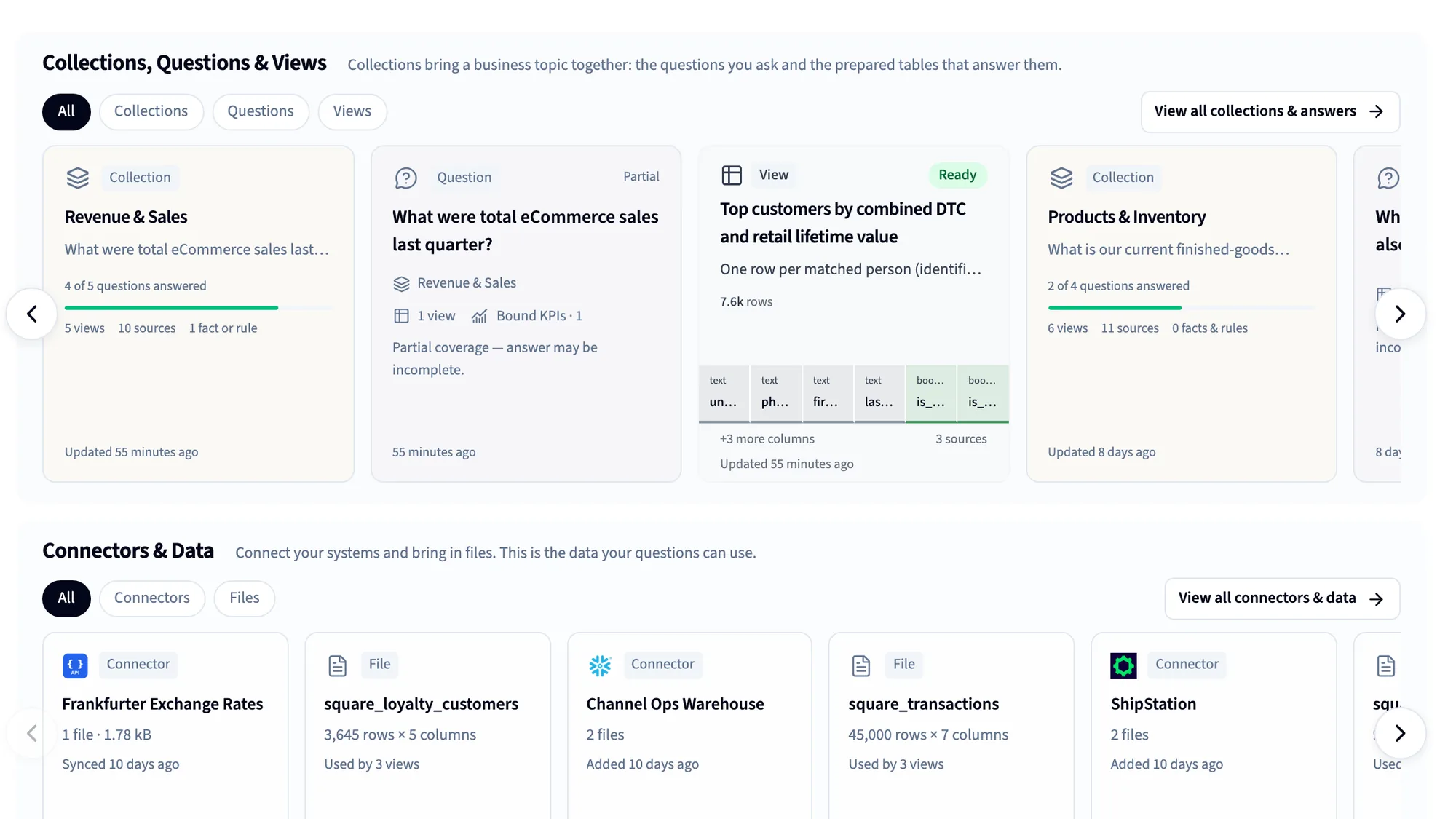
125+ connectors
CRM, accounting, ERP, payments, ads and databases, plus spreadsheets and files.
Automatic data cleaning
More than 180 checks on every table, and the Janitor to fix what they find.
The Library
A business-first semantic layer: definitions, KPIs and rules, taught by saying them.
Dashboards
Built by asking or from a screenshot, shared with unlimited viewers.
Nightly insights and Monitors
Querri works through your data overnight and shows what changed.
MCP for Claude and ChatGPT
Every assistant answers from the same definitions, under each person's access.
Reports and Excel
Scheduled projects, formatted workbooks and decks, delivered for you.
White label and embed
Bring the same understanding inside your own product, under your brand.
Using both
How Snowflake and Querri work together
Plenty of teams will run both, and that's a good setup. Keep Snowflake for what it does best, and let Querri be where the business asks. Your Snowflake tables become one of Querri's sources, next to the systems that never made it into the warehouse.
Keep in Snowflake
- Very large data and heavy transformation
- Pipelines that feed other systems
- Data sharing with partners and the Marketplace
- Data science and engineering workloads
Do in Querri
- Business questions across every system
- Definitions the business owns, in plain language
- Dashboards for everyone, with unlimited viewers
- AI answers in Querri, Claude and ChatGPT
How the connection works
-
Querri reads only the tables you choose, using a Snowflake service user with key-pair or token authentication and a read-only role.
-
It syncs a copy on the schedule you set, from hourly to monthly, rather than querying Snowflake live. Only the sync touches your warehouse, so everyday questions in Querri don't run up credits.
-
For very large tables, sync the modeled or summarized tables your team already built. Snowflake does the heavy lifting; Querri does the asking.
-
Querri never writes back to Snowflake, and your data is never used to train any model.
FAQ
Questions people ask when comparing Querri and Snowflake
Is Querri a replacement for Snowflake?
For a team without data engineers that wants business answers, Querri covers what they'd buy a warehouse stack for: connecting systems, storing and cleaning the data, defining metrics, dashboards and AI. For many terabytes, heavy data engineering, data sharing or machine learning, Snowflake is the stronger platform, and Querri can connect to it as a source.
How much does Snowflake cost per month?
Snowflake bills by consumption. Credits cost $2, $3 or $4 depending on edition (US list), an X-Small warehouse uses 1 credit an hour and each size up doubles that, storage is about $23 a TB a month, and AI features use AI Credits at $2 each. Vendr reports a median contract of about $100,000 a year, before ingestion, BI and people. Querri is one predictable plan with AI and dashboards included; see current plans.
Why is my Snowflake bill so high?
Usually a few settings and habits: warehouses that stay up for the default 10 idle minutes after every query, oversized warehouses (one made in the web interface defaults to X-Large, 16 credits an hour), long-running queries (the default timeout is two days), and AI agents that turn one question into several model calls and queries. Snowflake's resource monitors, budgets and auto-suspend tuning help, and they take someone's ongoing attention.
Can I cap Snowflake AI or CoWork spend?
Not with resource monitors: Snowflake's documentation says they can't track spending on serverless features and AI services. Budgets do cover AI, including CoWork, but they're for alerting and notification only. A hard stop needs custom code or per-user credit quotas. In Querri, admins set a monthly credit limit for any person, and Querri never auto-charges for overages.
What does Snowflake CoWork cost?
CoWork has no seat fee. It's billed in AI Credits at $2 each based on token consumption, the tools it calls (such as Cortex Analyst or Cortex Search) add their own charges, and the SQL it runs is billed as warehouse compute. So the cost grows with questions times agent steps. Querri includes AI in every plan, drawn from a set monthly credit allowance.
What does Cortex Analyst cost per question?
As a standalone API, Cortex Analyst is 67 platform credits per 1,000 messages, about $0.13 a message on Standard, $0.20 on Enterprise and $0.27 on Business Critical (US), plus the warehouse compute to run the SQL it writes. Through CoWork or Cortex Agents it's billed by tokens in AI Credits instead.
Is Querri's DuckDB engine fast enough compared to Snowflake?
For business data, yes, and often faster to the answer, because there's no warehouse to resume. DuckDB runs analytical queries in process on a single machine, so queries over millions of rows return in seconds. Snowflake's distributed warehouses pay off at many terabytes and heavy concurrency, where they're the right tool.
How much data can Querri handle?
Querri is built for the data businesses run on: CRM, accounting, ERP, ads, payments and spreadsheets, typically megabytes to hundreds of gigabytes. Files upload at up to 2 GB each, and storage grows with your plan. If your data is many terabytes, keep it in Snowflake and let Querri answer from the tables you sync.
Can Querri connect to Snowflake?
Yes. Querri's Snowflake connector syncs a copy of the tables you choose on a schedule, using key-pair or token authentication, which Snowflake now requires for service users. You keep your Snowflake investment and give business users answers on top of it, with no semantic-view project first.
Does Querri query Snowflake live?
No. Querri syncs a copy of each source into its own storage, as Parquet in Iceberg tables, on the schedule you set, from hourly to monthly. Every answer reflects the latest sync. If you need data to never leave your Snowflake account, Snowflake's own AI is the better fit.
Do I need a data warehouse to do analytics?
Not to get business answers. A warehouse is one good approach, and it takes engineering to build and run. Querri gives you the storage, the cleaning, the definitions and the answers in one product. Practitioners usually point to a warehouse when data reaches many terabytes, when you need engineering workloads like machine learning or streaming, or when you have a data team with use cases that need it.
Is Snowflake easy for business users?
Business users can ask questions in Snowflake CoWork, and it's a capable product. The answers depend on semantic views and governance that data people build and maintain, and Snowflake's partners say accuracy drops when those are weak. In Querri, the people who know the data set its meaning in plain language, and Querri tells you when a question has more than one reading.
What's the best Snowflake alternative for a team without data engineers?
One that doesn't need pipelines, a modeling layer and a BI tool before the first answer. Querri connects your systems, cleans the data automatically, learns your definitions in plain language and builds dashboards by asking, on one predictable plan. You can start on the free plan.
Can I try Querri on my own data first?
Yes. You can start on the free plan with no credit card, connect a source and ask. See plans for what each includes. Or bring your hardest question to a 20-minute walkthrough.
Sources
Where these facts come from
Checked October 15, 2026. Snowflake updates pricing and products often; if something here is out of date, tell us and we'll fix it.
- Service Consumption Table (credit prices, warehouse rates, Cortex Analyst) Snowflake, effective Oct 15, 2026
- Overview of warehouses (sizes, web interface default) Snowflake docs
- CREATE WAREHOUSE (auto-suspend default) Snowflake docs
- Parameters: STATEMENT_TIMEOUT_IN_SECONDS Snowflake docs
- Gen2 standard warehouses Snowflake docs
- Cortex and CoWork pricing (AI Credits) Snowflake docs
- Working with resource monitors Snowflake docs
- Monitor credit usage with budgets Snowflake docs
- Warehouse considerations Snowflake docs
- Key concepts and architecture Snowflake docs
- About Secure Data Sharing Snowflake docs
- Apache Iceberg tables Snowflake docs
- Snowflake launches CoWork IT Brief, Jun 2026
- Snowflake CoCo and CoWork explained (a Snowflake partner) Keyrus, Jun 2026
- Snowflake Q2 fiscal 2027 results SEC filing, Sep 2026
- Snowflake contract data (median contract) Vendr
- I inherited a $140K Snowflake bill Level Up Coding, May 2026
- "My org's Snowflake bill has 2xed" Hacker News, Jan 2024
- "$2M/yr on contract with Snowflake" Hacker News, Jun 2026
- "The Snowflake police" Hacker News, Apr 2026
- Instacart clarifies its Snowflake payments CNBC, Sep 2023
- Snowflake and Instacart: the facts Snowflake, Aug 2023
- FinOps for data cloud platforms FinOps Foundation
- Snowflake cost optimization: 15 proven strategies SELECT, Feb 2024
- How we reduced Snowflake costs by 70% ChartMogul, May 2025
- Fivetran pricing (contract bands from $12,000) Fivetran
- Fivetran usage-based pricing Fivetran docs
- Fivetran and dbt Labs complete merger Fivetran, Jun 2026
- Data engineering salaries Axial Search, 2026
- Why DuckDB DuckDB
- Big Data is Dead MotherDuck (Jordan Tigani), Feb 2023
- Is Big Data Dead? MotherDuck and the small data manifesto DataCamp podcast (Ryan Boyd), Oct 2024
- Querri pricing Querri
- Predictable credit use Querri docs
See your own data answer before you sign a warehouse contract
Connect a system or drop in a spreadsheet, ask the question that matters most, and see the query behind the answer. If Snowflake is the better fit, we'll tell you.