Querri vs Microsoft Fabric
Fabric is a platform you build on. Querri is the answer you build toward.
Same goal: trusted answers. Very different projects.
Microsoft Fabric is a serious platform for teams with engineers to run it: capacity to size, pipelines, a semantic model, Power BI licenses and Copilot on top. Querri is the question-first data platform. It starts from the questions your business asks and builds what's needed to answer them, in one product, on one predictable bill.
Time, cost and control
Answers this quarter, a bill you can plan, and no new team to hire
Fabric is a platform your engineers build on. Querri is the finished path from your systems to an answer. Here's what that difference means for the business.
-
Answers in days, not quarters
Pipelines, a semantic model and a Power BI rollout come before the first trusted answer. With Querri, you connect a system or upload a file and ask the same day.
-
A bill you can plan, with no surprises
Fabric bills capacity, plus a Power BI license for every viewer below F64, and throttles when it runs hot. Querri is one predictable bill: a monthly credit allowance tied to the work your team does, alerts before you reach it, and no automatic overage charges.
-
No data team required
The Fabric path needs data engineers and a Power BI developer. In Querri, the people who already know the business decide what the numbers mean, in plain language.
-
Secure, auditable, nothing to rip out
SOC 2 Type II, HIPAA and ISO 27001:2022, and your data never trains a model. Every number shows its query, and Excel, Power BI and Microsoft 365 stay where they are.
Where each one fits
Pick by the team and the timeline you have
We'd rather you pick the right tool than pick us for the wrong reason. Here's where each one fits.
Choose Microsoft Fabric when
- You have, or plan to hire, data engineers who will build and run pipelines, a lakehouse and Power BI models.
- Your data runs to many terabytes, or you need Spark for data science, machine learning or real-time streams.
- Everything already lives in Azure and Microsoft 365, and Entra ID and Purview governance must cover the data too.
- Someone will own the capacity: sizing it, watching the Capacity Metrics app and isolating heavy workloads.
- You're standardizing on Power BI across a large organization, where F64 and above makes viewing free.
Choose Querri when
- You want business answers in days, not after a data platform project.
- Your data lives in business systems (CRM, accounting, ERP, payments, spreadsheets), much of it outside Microsoft.
- The people who know what the numbers mean aren't engineers, and shouldn't have to write DAX to say so.
- You want one predictable bill, with unlimited dashboard viewers and no capacity to size or throttle.
- You want dashboards, reports, an AI agent, data cleaning and MCP for Claude and ChatGPT built in, not assembled.
Feature by feature
The detailed comparison
Every row says where each one is stronger. Where Fabric wins, we say so. Facts are current as of October 2026 and linked in the sources.
Fabric prices are US list, pay-as-you-go unless marked, from Microsoft's pricing pages and the Azure Retail Prices API in October 2026. Prices vary by region and agreement.
Pricing
Capacity pricing works when someone is watching it
A reserved Fabric capacity is a fixed monthly price, and that's a real strength. Microsoft's own guidance names the trade-off: "costs are tied to the size of the capacity available, not the actual workload utilization," and "spikes in one workload may slow others." Every pipeline, notebook, report and Copilot question shares that capacity, and when it runs hot, the result is throttling, or overage billed at a premium.
How Fabric is billed
- Capacity in CUs at $0.18 per CU-hour (US East): F2 is $262.80 a month and F64 is $8,409.60, or about 41% less reserved for a year.
- Below F64, every viewer needs a Pro ($14) or PPU ($24) license, on top of capacity.
- Interactive work is smoothed over 5 to 64 minutes, background jobs over 24 hours. Past the limits, Fabric delays, then rejects requests.
- Capacity overage is on by default for new capacities and bills the excess at 3x the pay-as-you-go rate. Microsoft: "Your actual charges can exceed the rolling 24-hour overage threshold."
- Pausing a capacity to stop throttling adds the remaining smoothed usage to your Azure bill.
- Copilot "consumes your available Fabric capacity," so a popular AI rollout competes with your reports.
When capacity pricing is the better deal
If you have a Fabric admin who sizes capacity from real measurements, buys a reservation, isolates critical workloads on their own capacity and watches the Capacity Metrics app, Fabric's cost can be very efficient at scale, especially at F64 and above where viewing is free. Microsoft's own guidance is to measure on pay-as-you-go first. If that's your team, the guides below are where to start.
What it looks like when capacity runs out
Choosing Fabric? Keep the capacity in check.
If Fabric is the right call for you, these are the controls that keep the bill and the throttling predictable. All are Microsoft's own documentation.
- Understand throttling The smoothing windows and the stages from delay to rejection. Microsoft Learn
- Install the Capacity Metrics app See which items use your CUs, with 14 days of history. Microsoft Learn
- Set surge protection Reject background jobs early so interactive reports keep working. Microsoft Learn
- Decide on capacity overage It's on by default at 3x the rate. Set the threshold, or turn it off. Microsoft Learn
- Optimize and size capacity Measure on pay-as-you-go first, then reserve. Microsoft Learn
- Pause and resume safely What pausing does to smoothed usage and your bill. Microsoft Learn
How Querri keeps the bill predictable
- One bill, no surprises. One plan for the whole organization, with the AI, storage and unlimited dashboard viewers included. See plans and pricing.
- One simple credit. A credit is a unit of business work, like answering a question or syncing a source, so usage is easy to understand and easy to plan for.
- Unlimited dashboard viewers on every plan. Viewing, uploads, exports and the Library never cost credits.
- Usage alerts at 80% of the plan, when it's over and on a spike, plus a monthly limit for any person.
- No automatic overage charges. We tell you as you approach your limit, and you decide what happens next.
- No capacity to size, pause or throttle. Storage, the engine and the AI are in the plan.
Total cost
What it takes to get the first answer
Fabric puts many tools under one roof, which genuinely helps. You still assemble and staff each layer. Here's the Fabric path for a team of about 100, next to Querri.
Fabric figures are our arithmetic from Microsoft's US list prices and the salary and implementation ranges in the linked sources, not a quote. Your mix will differ: if you already have the team, the people line is a cost you've already chosen.
Architecture
Spark and Polaris for the biggest data. DuckDB for the data you actually have.
This is the real architectural difference, and it explains most of the cost gap. Fabric runs distributed engines built to split huge jobs across many machines. Querri runs DuckDB, an in-process analytical engine that is extremely fast on a single machine, over open Parquet and Iceberg files.
Microsoft Fabric
Distributed engines on one shared capacity
- Spark for lakehouses and notebooks; each CU gives two Spark cores, with burst up to 3x.
- Polaris, a distributed SQL engine, behind the Fabric Warehouse; VertiPaq behind Power BI and Direct Lake.
- OneLake stores tables as Delta Parquet or Iceberg in your tenant.
- Genuinely the right tool for many terabytes, streaming, and data science at scale.
Querri
DuckDB on open files, sized to business data
- Each organization's data is stored as Parquet in Apache Iceberg tables, in its own storage.
- DuckDB queries it in process: no cluster to start, size, keep warm or pay for while idle.
- Python joins in where a dataframe beats SQL.
- Open formats throughout, so nothing about your data is locked into a proprietary engine.
Where each engine is the right tool
Why the architecture shows up on the bill
A distributed engine has to be provisioned for the peak: capacity sits reserved whether or not anyone asks a question, and Spark sessions draw on it while they're open. On Fabric itself, one public benchmark found single-node DuckDB finished the same 5 GB job on about a fifth of the CUs Spark used, and started in seconds instead of minutes. Querri is built on that architecture, which is a big part of why it can put storage, the engine, AI, dashboards and unlimited viewers into one predictable plan.
Built in, not assembled
Everything between your data and the answer, in one product
In Fabric, these are separate workloads to build and connect. In Querri they're one chain: new data rebuilds the views on it, KPIs recompute and every dashboard refresh replays its saved query, so any number traces back to its source.
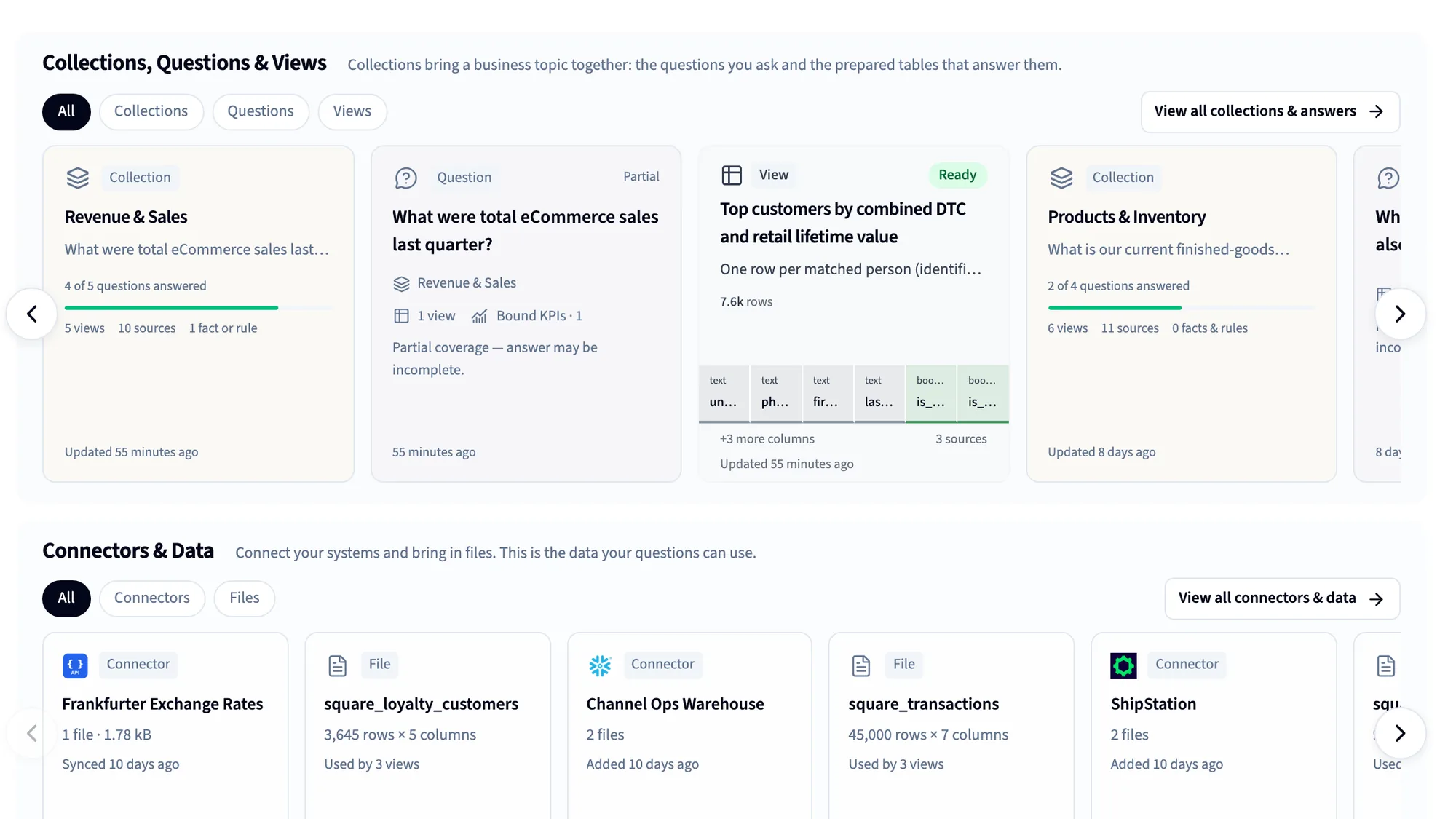
125+ connectors
CRM, accounting, ERP, payments, ads and databases, plus spreadsheets and files.
Automatic data cleaning
More than 180 checks on every table, and the Janitor to fix what they find.
The Library
A business-first semantic layer: definitions, KPIs and rules, taught by saying them.
Dashboards
Built by asking or from a screenshot, shared with unlimited viewers.
Nightly insights and Monitors
Querri works through your data overnight and shows what changed.
MCP for Claude and ChatGPT
Every assistant answers from the same definitions, under each person's access.
Reports and Excel
Scheduled projects, formatted workbooks and decks, delivered for you.
White label and embed
Bring the same understanding inside your own product, under your brand.
Using both
How Microsoft Fabric and Querri work together
Plenty of teams will run both, and that's a good setup. Keep Fabric, Power BI and Excel for what they do well, and let Querri be where the business asks the questions nobody built a report for. Your Fabric data becomes one of Querri's sources, next to the systems that live outside Microsoft.
Keep in Microsoft
- The Power BI reports your board relies on
- Excel, where finance runs
- Large data engineering and Spark workloads
- Entra ID and Purview governance
Do in Querri
- Questions nobody built a report for
- Definitions the business owns, in plain language
- Dashboards for everyone, with no viewer licenses
- AI answers in Querri, Claude and ChatGPT
How the connection works
-
Fabric warehouses and lakehouse SQL endpoints speak the same protocol as SQL Server. Querri connects to them through its SQL Server connector, signing in as a Microsoft Entra service principal with read access. We'll help you set it up.
-
It syncs a copy of the tables you choose on the schedule you set, from hourly to monthly. Only the sync touches Fabric, so everyday questions in Querri don't draw on your capacity.
-
For very large tables, sync the curated or summarized tables your team already built. Fabric does the heavy lifting; Querri does the asking.
-
Querri never writes back to Fabric, and your data is never used to train any model.
FAQ
Questions people ask when comparing Querri and Fabric
Is Querri a replacement for Microsoft Fabric?
For a team without data engineers that wants business answers, Querri covers what they'd use Fabric for: connecting systems, storing and cleaning the data, defining metrics, dashboards and AI. For heavy data engineering, many terabytes, streaming or machine learning, Fabric is the stronger platform, and Querri can sit alongside it.
How much does Microsoft Fabric cost per month?
Fabric is billed by capacity at $0.18 per CU-hour in US East. F2 is $262.80 a month pay-as-you-go and F64 is $8,409.60, about 41% less with a one-year reservation. Below F64, every person who views Power BI content also needs a Pro ($14) or Premium Per User ($24) license. Querri is one predictable plan with AI, dashboards and unlimited viewers included; see current plans.
What is Fabric throttling, and why do reports fail?
Fabric smooths usage over time, then throttles when a capacity has used more than it has. Past 10 minutes of future capacity, new interactive requests are delayed by 20 seconds; past 60 minutes they're rejected; past 24 hours all requests are rejected. People see "Your organization's Fabric compute capacity has exceeded its limits." Querri has no capacity to throttle: questions run within your plan's credit allowance.
What is Fabric capacity overage, and is it on by default?
Capacity overage lets a capacity keep running past its limits and bills the excess at 3x the pay-as-you-go rate. Microsoft's documentation says it's enabled by default for new capacities, with a default threshold of 25%, and that actual charges can exceed the threshold. You can change or turn it off. Querri never auto-charges for overages.
Does Copilot in Fabric cost extra?
Copilot in Fabric and Power BI needs a paid capacity of F2 or above and isn't available on trial capacity. It doesn't have a separate fee, but it consumes the same capacity as your reports and pipelines, so heavy use can lead to throttling. Microsoft 365 Copilot, at $30 a user a month, can also answer from Power BI models. In Querri, AI is included on every plan.
Do I need F64 for Power BI?
Not for Copilot: F2 is enough. F64 matters for viewing: below F64, every viewer of Power BI content needs a Pro or PPU license, and free viewing starts at F64, about $8,400 a month at list. Querri includes unlimited dashboard viewers on every plan, including Free.
Is Querri's DuckDB engine fast enough compared to Spark?
For business data, usually faster. DuckDB runs analytical queries in process on a single machine, with no cluster to start, so queries over millions of rows return in seconds. Spark pays a coordination cost to split work across machines, which only pays off when the data is far too large for one. For many terabytes or petabytes, Fabric's distributed engines are the right tool.
How much data can Querri handle?
Querri is built for the data businesses run on: CRM, accounting, ERP, ads, payments and spreadsheets, typically megabytes to hundreds of gigabytes. Files upload at up to 2 GB each, and storage grows with your plan. If your data is many terabytes, a warehouse or lakehouse is the right home for it, and Querri can answer from the summarized tables you sync.
Does Querri connect to Microsoft Fabric or OneLake?
Yes, through its SQL Server connector. Fabric warehouses and lakehouse SQL endpoints speak the same protocol as SQL Server, so Querri can sync the tables you choose, signing in as a Microsoft Entra service principal with read access. It also connects to SQL Server and Azure SQL databases, Excel and CSV files and 125+ business systems, including the ones that live outside Microsoft.
Does Querri query my data live?
No. Querri syncs a copy of each source into its own storage, as Parquet in Iceberg tables, on the schedule you set, from hourly to monthly. Every answer reflects the latest sync, and your source systems see a scheduled read rather than a query storm.
Is Querri secure enough to sit next to Microsoft 365?
Querri is SOC 2 Type II, HIPAA and ISO 27001:2022 certified. Each organization has its own database and storage, row-level access policies apply in chat, dashboards and MCP alike, and your data is never used to train any model. Microsoft's identity and compliance breadth is wider, and if Entra and Purview must govern every byte, that's a reason to stay in Fabric.
What's the best Microsoft Fabric alternative for a team without data engineers?
One that doesn't need a pipeline, a semantic model and a capacity before the first answer. Querri connects your systems, cleans the data automatically, learns your definitions in plain language and builds dashboards by asking, on one predictable plan. You can start on the free plan.
Will Power BI Q&A still work?
Microsoft is retiring Power BI Q&A by the end of December 2026 and pointing users to Copilot, which needs paid Fabric capacity or a Microsoft 365 Copilot license. Querri includes plain-language questions on every plan.
Can I try Querri on my own data first?
Yes. You can start on the free plan with no credit card, connect a source and ask. See plans for what each includes. Or bring your hardest question to a 20-minute walkthrough.
Sources
Where these facts come from
Checked October 15, 2026. Microsoft changes Fabric often; if something here is out of date, tell us and we'll fix it.
- Microsoft Fabric pricing Microsoft Azure
- Azure Retail Prices API (Fabric CU-hour rates) Microsoft Azure, Oct 2026
- Power BI pricing Microsoft
- Microsoft Fabric licenses (viewers below F64) Microsoft Learn
- Copilot in Fabric overview Microsoft Learn
- The Fabric throttling policy Microsoft Learn
- Enable capacity overage Microsoft Learn
- Pause and resume your capacity Microsoft Learn
- Surge protection Microsoft Learn
- Evaluate and optimize your capacity Microsoft Learn
- Fabric Capacity Metrics app Microsoft Learn
- Spark job concurrency and queueing Microsoft Learn
- OneLake overview Microsoft Learn
- Direct Lake overview Microsoft Learn
- Extending Polaris to support transactions (the Fabric Warehouse engine) Microsoft, arXiv, Jan 2024
- FabCon and SQLCon 2026 in Barcelona Microsoft Azure blog, Sep 2026
- Power BI Q&A retirement (MC1218421) Microsoft 365 Message Center, Jan 2026
- Fabric IQ roadmap Directions on Microsoft, Aug 2026
- "All of my Power BI reports are failing" Microsoft Q&A, Jan 2026
- Fabric capacity stuck in Pausing Microsoft Q&A, Apr 2026
- Unusual Fabric cost increase on an F8 reservation Microsoft Q&A, Nov 2025
- Well-Architected: cost optimization for Microsoft Fabric Microsoft Learn
- Why you should enable capacity overage Actionable Reporting, Mar 2026
- Microsoft Fabric, two years later Hylaine (Microsoft partner), Dec 2025
- 10 things I hate about Fabric deployment pipelines Data Savvy (Meagan Longoria), Aug 2026
- Fabric benchmark: Spark versus Python notebooks endjin, Apr 2026
- Microsoft Fabric pricing and licensing AlphaBOLD, Aug 2026
- What does a Microsoft Fabric implementation really cost? Towards AI, Sep 2026
- Why DuckDB DuckDB
- Big Data is Dead MotherDuck (Jordan Tigani), Feb 2023
- Is Big Data Dead? MotherDuck and the small data manifesto DataCamp podcast (Ryan Boyd), Oct 2024
- Querri pricing Querri
- Predictable credit use Querri docs
See your own data answer before you size a capacity
Connect a system or drop in a spreadsheet, ask the question that matters most, and see the query behind the answer. If Fabric is the better fit, we'll tell you.