If AI has handed you a number that fell apart in the meeting, you're not alone.
Every answer rests on choices. Querri tells you when it made one. It checks your data before it queries, works the answer out two independent ways, and keeps the query behind every number open for anyone to read.
In the app
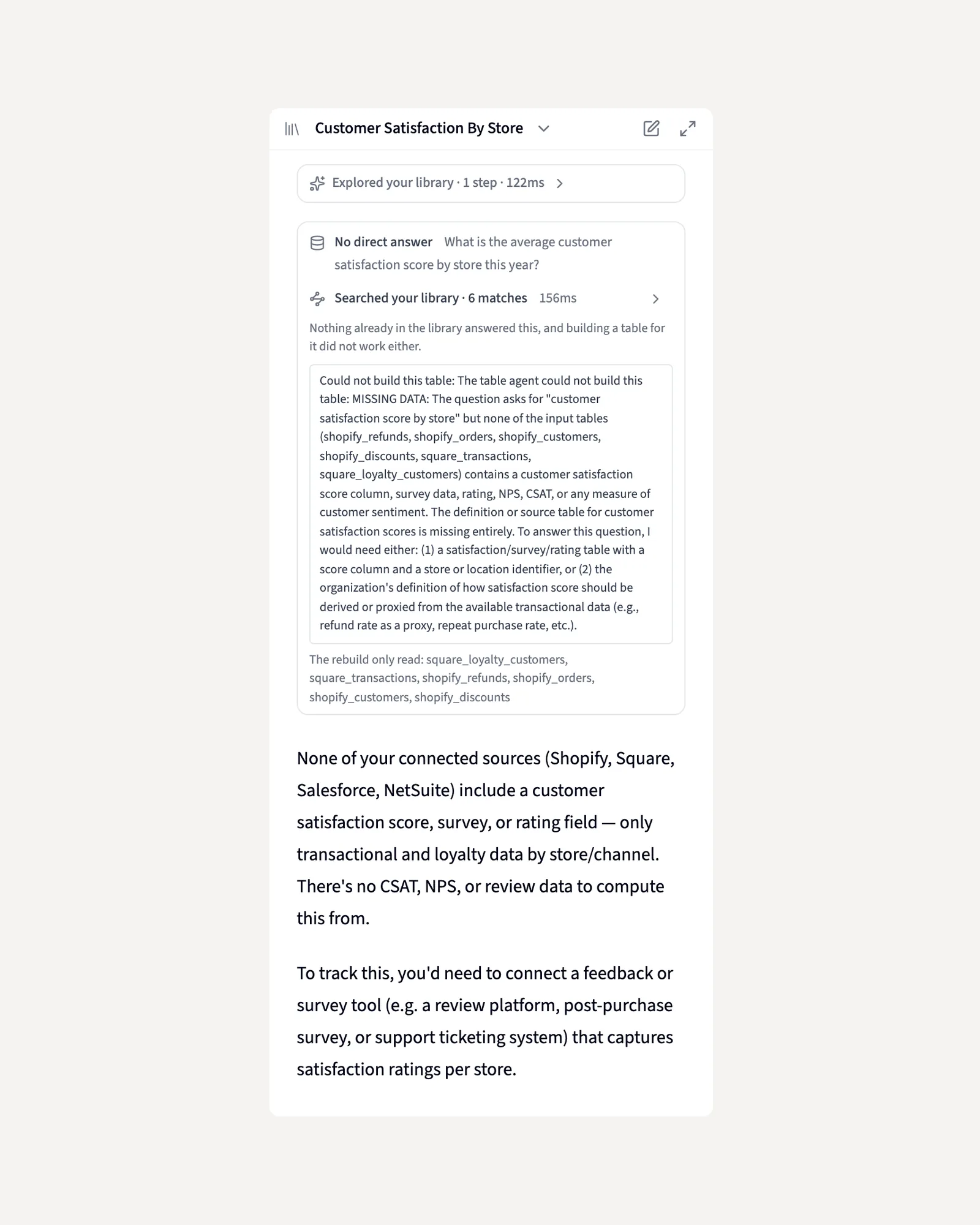
The checks, as they look in Querri.
These are screenshots of Querri with a demo company's data. The caveats, the route and the query sit right beside each number.
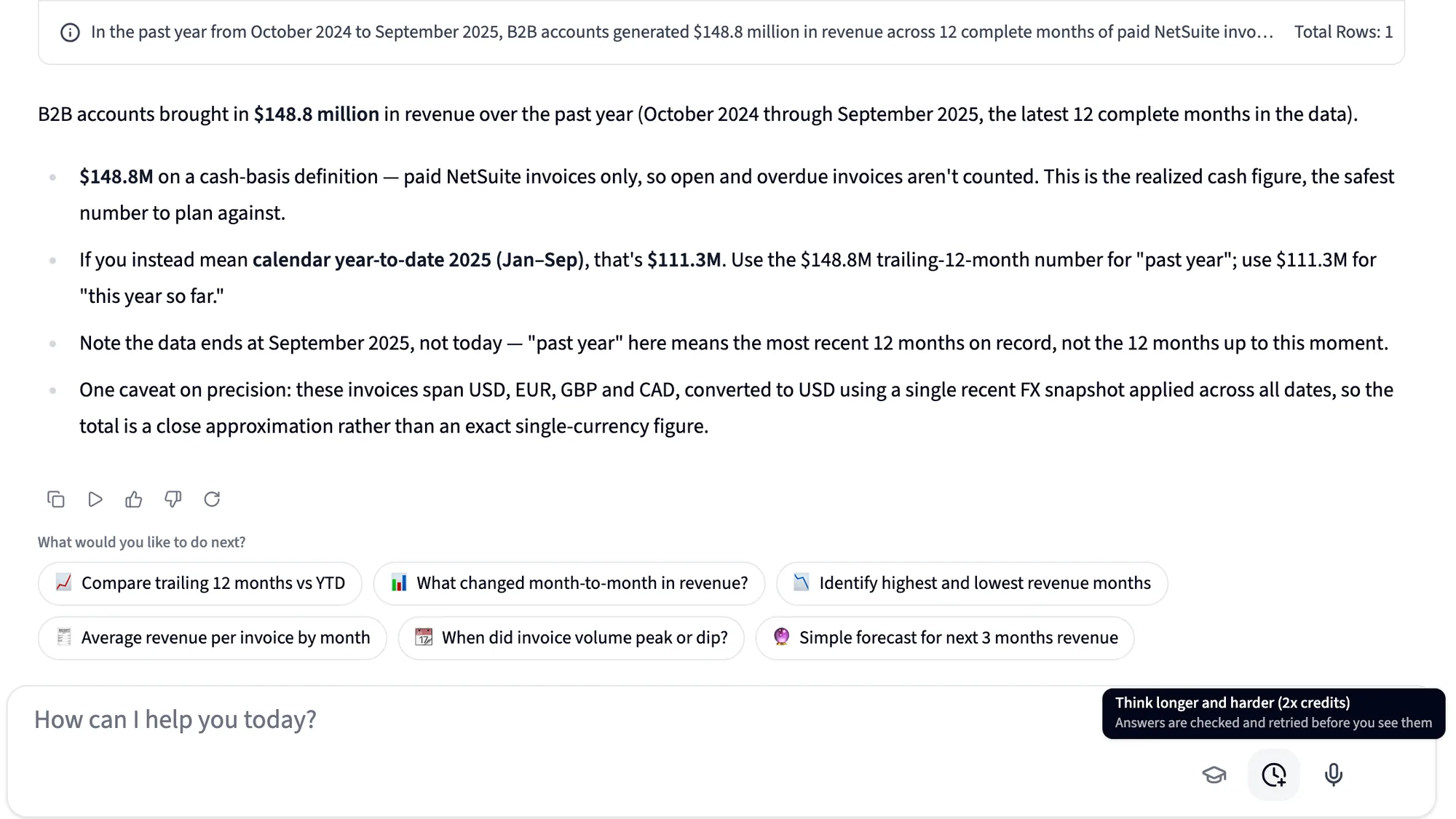
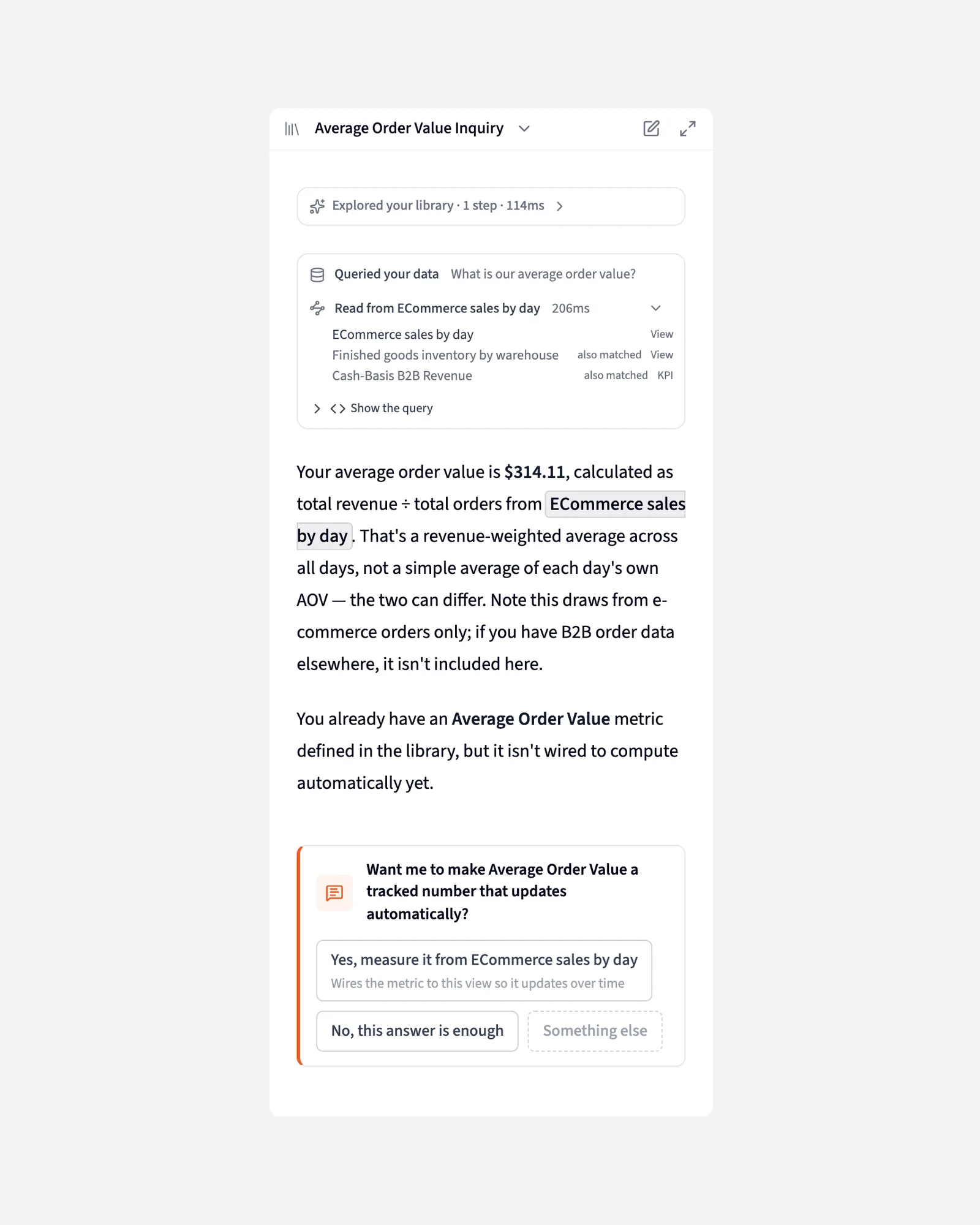
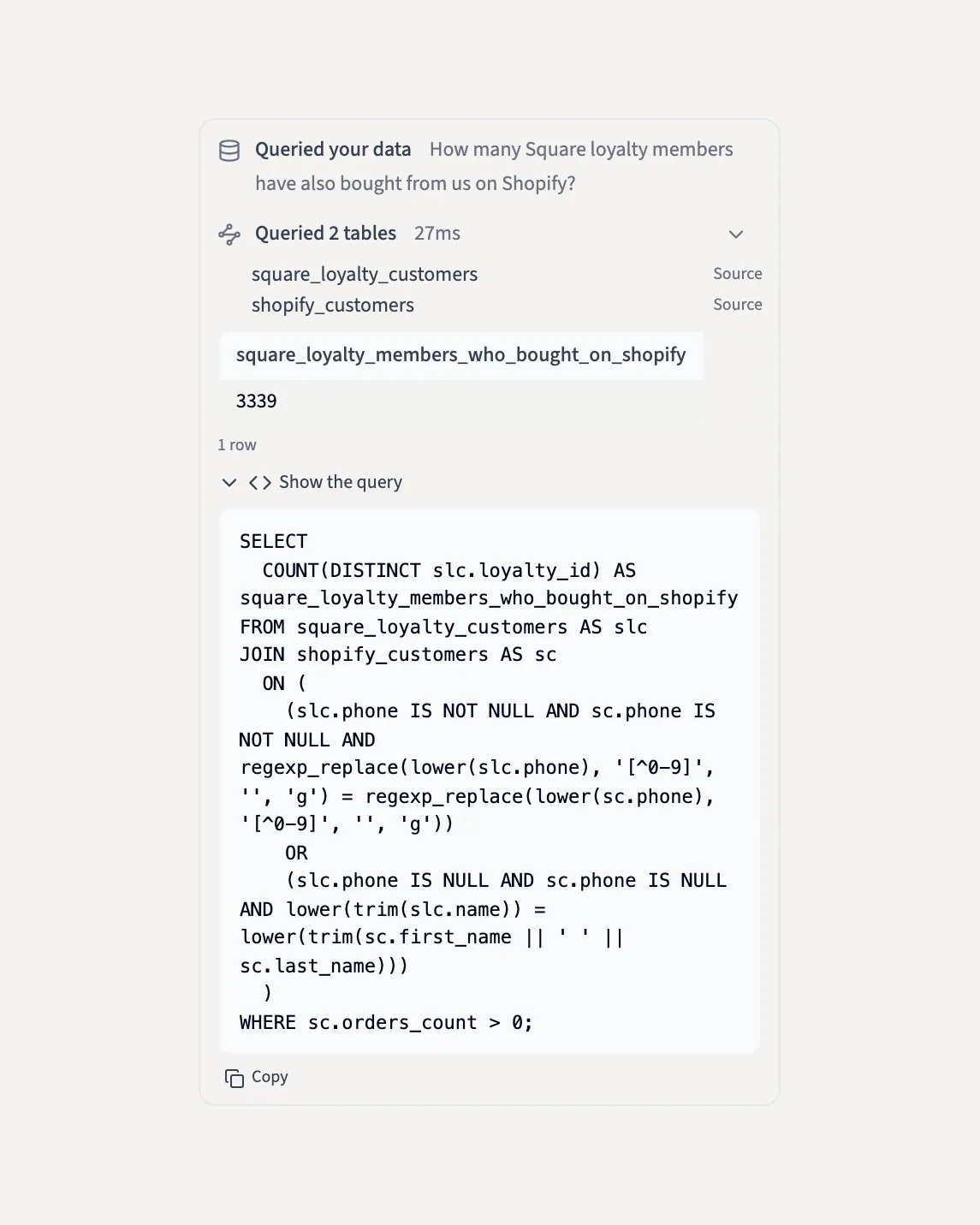
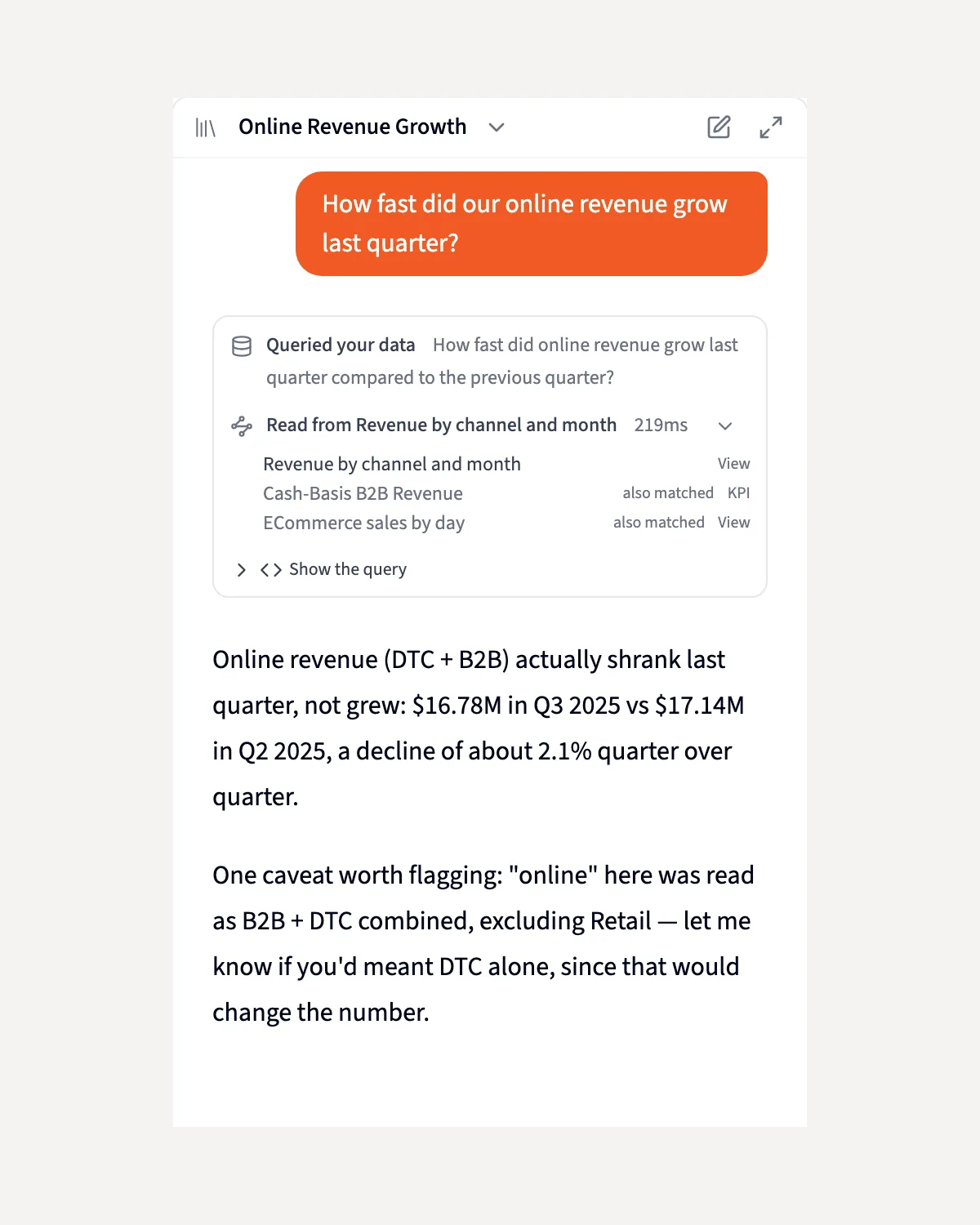
Querri checks its work, so you don't have to.
It checks your data before the analysis and the result after, tells you what it couldn't settle, and traces every number to its source.
It checks the data before it writes the query
One pass over the columns it's about to touch counts duplicate IDs and whether they disagree, the same value spelled many ways, text that only looks blank (“N/A”, “-”) and values that won't convert to a number or a date.
It works the answer out a second way
A separate route works the answer out from the same data and your same definitions without seeing the first query. The two results are compared row by row, and you hear when they disagree.
It tells you how much a cleanup moved the number
Drop the cancelled orders and the total moves. Querri tells you by how much, so a cleanup nobody asked for shows up as a caveat instead of quietly changing the answer.
It says so when it couldn't check
If a check didn't run, the answer says so plainly. Silence never passes for clean.
When a question has two fair answers, you get both numbers.
“Average daily deliveries” can mean per day worked or per calendar day. Querri names the reading it used, works out the other one, and tells you what each is good for.
On benchmark questions with more than one defensible answer, Querri flagged the other reasonable reading 73% of the time, versus 12% for a leading general-purpose AI agent.
Ask your question. The Librarian knows where the answer lives.
The Librarian reads first from a saved view or KPI that clearly owns the question, and only then writes SQL against your source tables. Code, not the prompt, decides whether a view qualifies, so it declines rather than guesses.
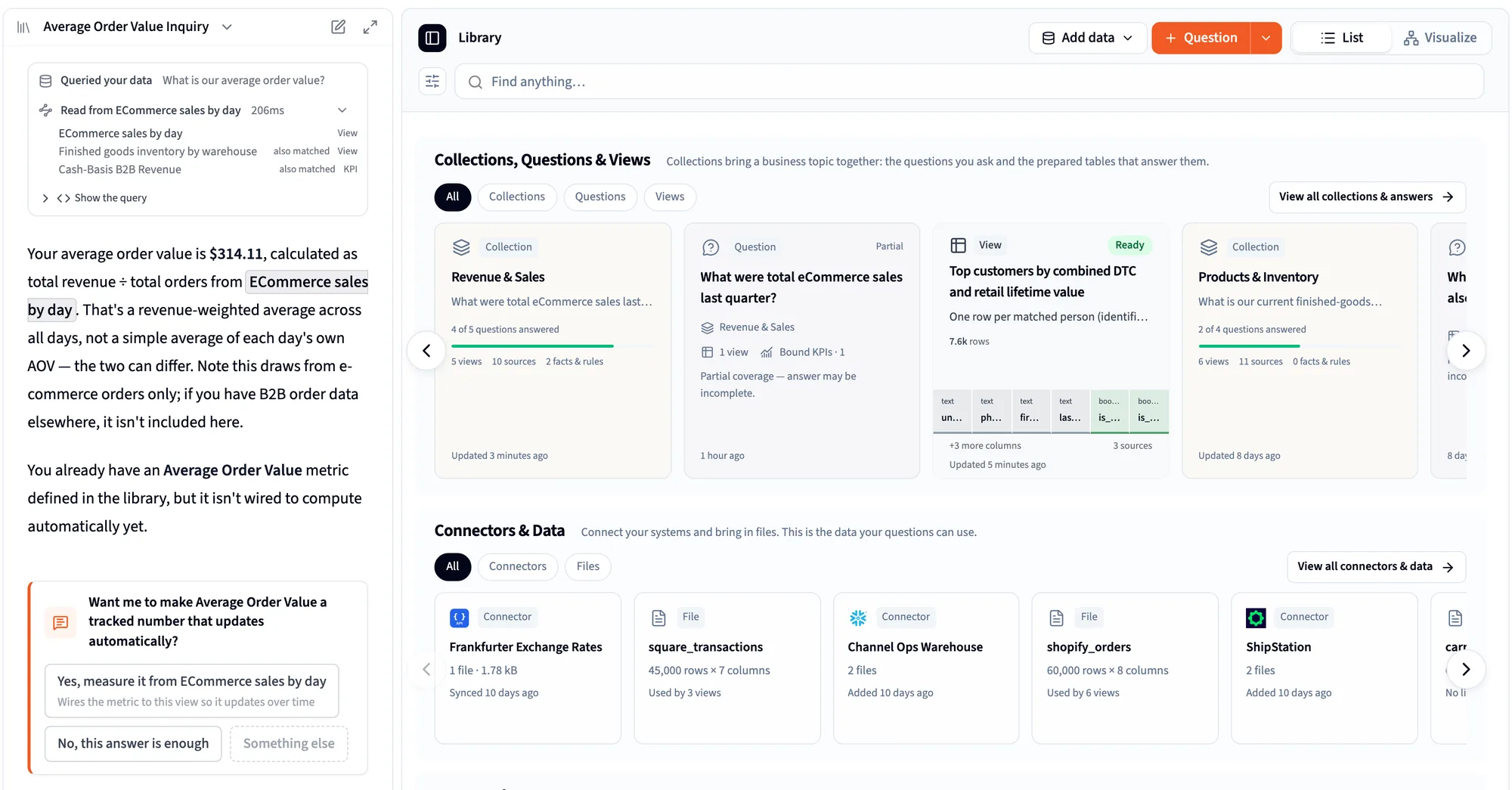
- Every answer shows its route: Read from, Queried or Searched your library.
- Show the query opens the SQL, with a Copy button for the one technical person on the team.
- When nothing fits, the answer reads No direct answer, with no made-up number.
- Answers only include data the person asking is allowed to see.
The agreed number, with the query behind it
When the whole team waits on the one person who knows where the data lives, the Librarian takes the questions and answers from the number your company already agreed on.
Your company shouldn't have to solve the same data problem twice.
When someone asks a question the team already answered, the Librarian reads it from the saved view that owns it, so it comes back in seconds, from the same place every time. And a scheduled report can't quietly give you a different number next month: re-running it replays the code that ran the first time, and no model is asked again.
On a question the company had already answered, reusing the saved answer was 4.6× faster than a leading general-purpose AI agent, with 2.8× fewer tokens, at 6.1× lower cost.
A new question is worked out fresh, from the same definitions. Steps that use a model on purpose (Researcher, Categorize and Wrapped decks) call it again on each run.
Didn't we answer this already?
Yes, and now it comes back in seconds. The route row says where the number came from, and the query is one click away.
You decide when an answer gets the full check.
Thorough, the default, reviews every table it builds with a second pass, cross-checks it against an independent derivation and retries a table that fails. Fast is one pass with the same context and none of that checking, and its label says so. Choose it per message.
It checks its work the way a careful analyst would.
Look at the data first
Before it queries, Querri measures the columns the question touches, under the same row filter the query will run with.
Work it out two ways
Two routes, both starting from your own definitions and rules, work the answer out separately and are compared row by row.
Check the summary, keep the query
Every number in the written summary is checked against the result, and the query behind it stays open for anyone to read.
IT sets the guardrails. The people who know the data set the meaning. Everyone else just asks.
Data consumer
Walk into the meeting knowing your number will hold up. If a question has two fair readings, Querri tells you before someone else does, and if the data can't answer, it says so instead of guessing.
Data owner
Stop being the human fact-checker for every AI answer. Querri checks the data for gaps and duplicates, works the answer out two ways and shows the query, so verifying a number takes a minute, not an afternoon.
Data team and IT
AI you can audit. The model writes code, the code runs inside Querri with access rules applied first, and every number traces to its query and its source. A saved report replays exactly.
Questions people ask
Does every answer get the full check?
Every table Querri builds does in Thorough mode, which is the default. Forecasts and other Python steps get the number check on their summary and show their code. If you choose Fast for a quick read, the label tells you the review was skipped.
What happens when my data can't answer the question?
Querri says so instead of estimating. In the Library, the Librarian's answer reads No direct answer, with no made-up number. In a project, Querri tries the other sources that matched the question before it says the data is missing, and names the ones it tried.
Will a saved report give me a different number next month?
Not on its own. Re-running a saved view, project, dashboard refresh or scheduled report replays the code that ran the first time. A new question is worked out fresh, from the same definitions. Steps that use a model on purpose, such as Researcher, Categorize and Wrapped decks, call it again on each run.
Does the AI do the math?
No. The AI writes SQL and Python that run against your data, and charts are drawn from those results. That's why every number can show the query behind it.
Won't all those caveats make people trust the answer less?
The answer comes first and the caveats sit below it. A clean table that passed review shows no warning at all. A caveat appears only when there is something true to say, and that's the thing you'd want to know before the meeting.
How accurate is it?
Measured against the source data, Querri got 97% of the ambiguous benchmark questions right, versus 80% for a leading general-purpose AI agent.
Who can see an answer, and is my data used to train a model?
Answers only include data the person asking is allowed to see, because access rules are applied before any query runs. Your data never trains a model. Querri is SOC 2 Type II, HIPAA and ISO 27001:2022 certified.
Ask it the question that tripped it up.
Bring your hardest question to a walkthrough and watch how Querri gets to an answer, step by step.