KPIs and the Five Dimensions
You watch a few numbers closely. What isn't anyone measuring? Know what you measure. And what you don't.
Most companies don't lack numbers. They lack someone stepping back to ask whether they're the right ones. Describe a KPI in a sentence and Querri measures it from your data, ties it to Revenue, Cost, Efficiency, Quality or Risk, and finds the parts of the business nobody is watching yet.
How it's done today
Scorecards watch what you chose. Nothing tells you what you didn't.
Mid-sized companies rarely have a head of data to step back and ask whether they track the right numbers.
A metrics layer or a scorecard
It holds the numbers the company already decided to track, accurately. Nothing in it says Risk has no metric at all.
A spreadsheet of KPI definitions
The definitions drift from the queries that produce the numbers, and nobody checks one against the other.
A consultant, once a year
Someone reviews what to measure and which questions matter. It works, at a price most mid-sized companies don't pay.
An AI chat on the data
It answers what you ask, when you think to ask it, and has no view of what you're not asking.
In the app
A KPI in the Library, and one measured from a sentence.
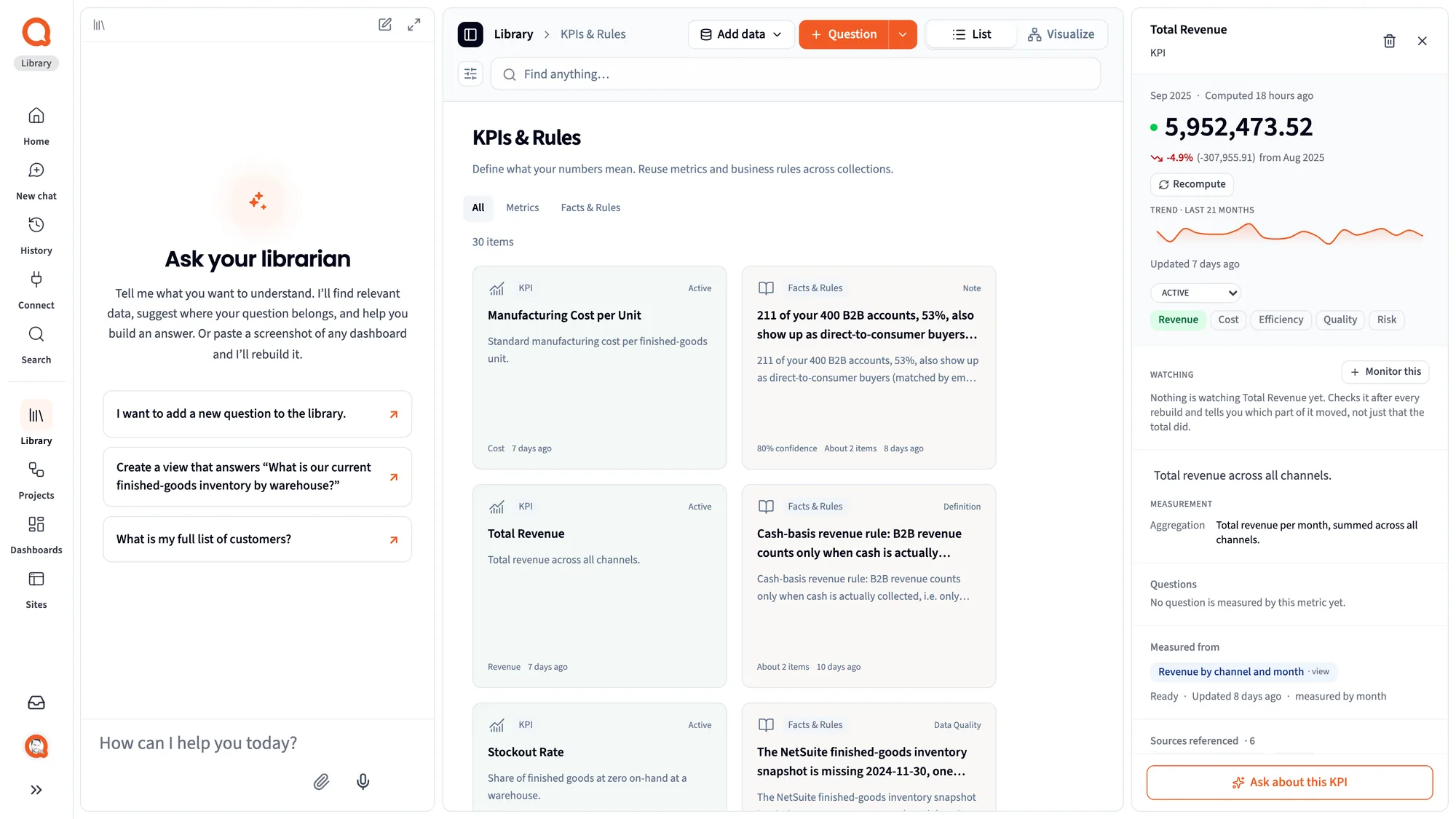
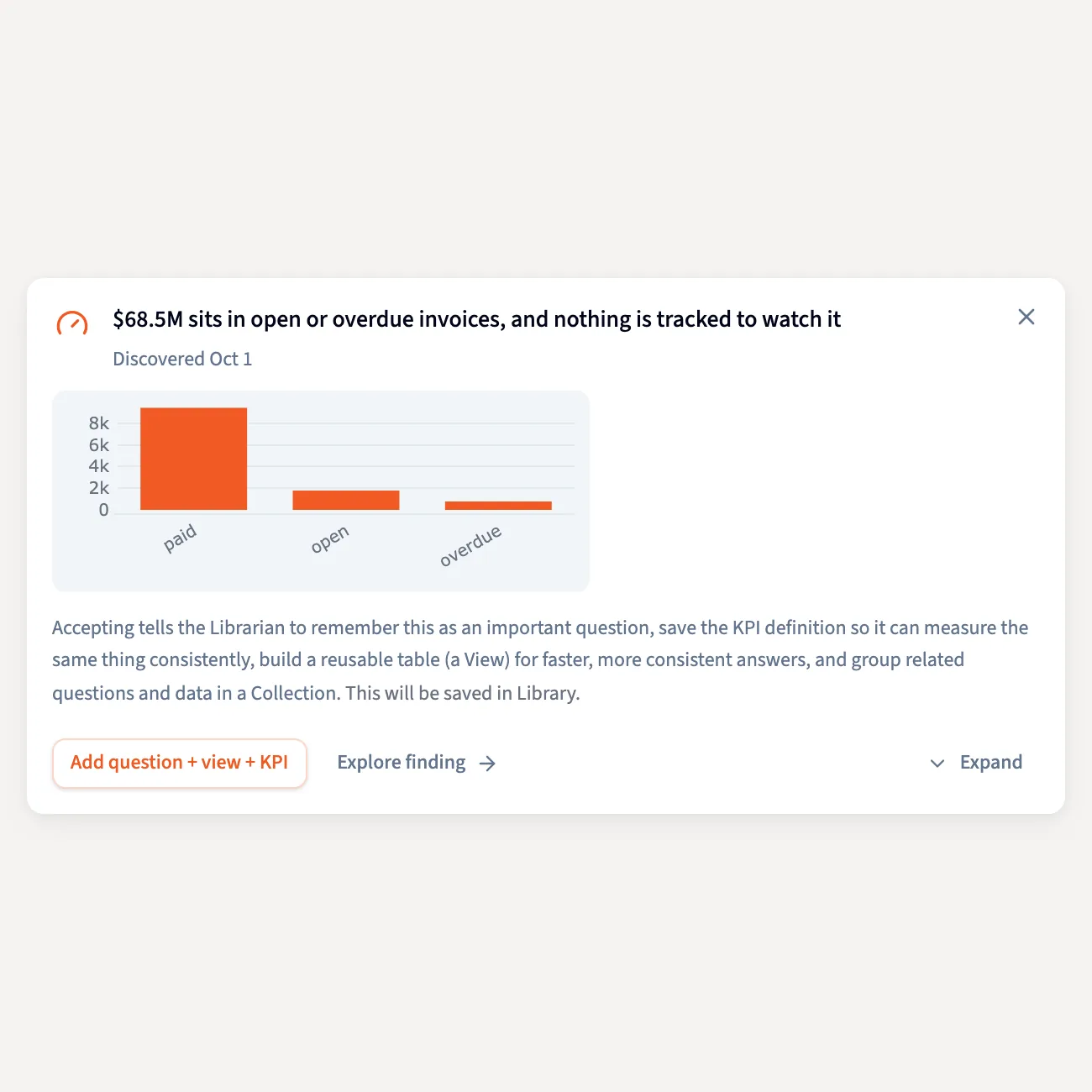
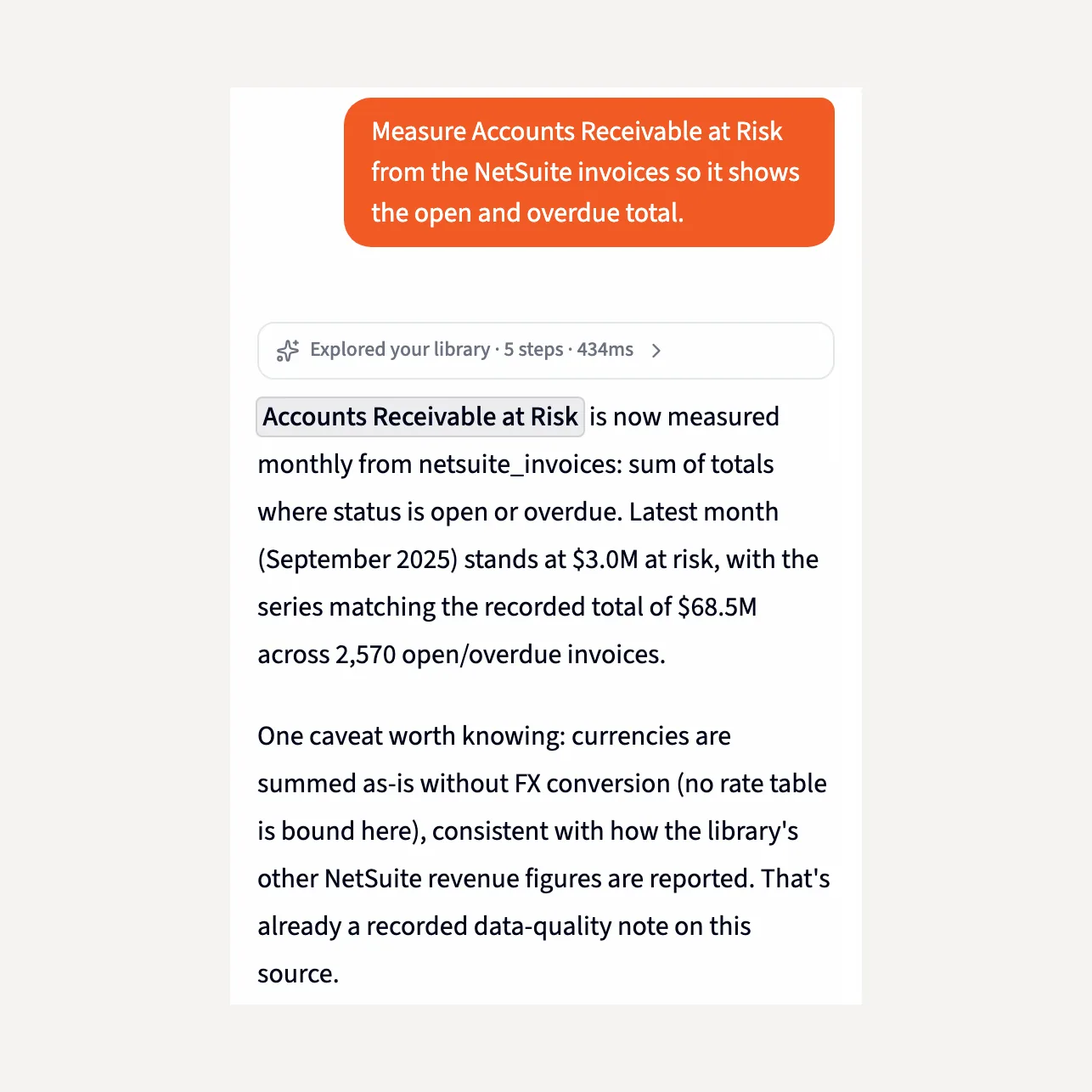
These are screenshots of Querri with a demo company's data: a KPI with its dimension and source view, a number nothing was tracking, and the KPI measured from a one-line request.
Coverage gaps
Every business runs on revenue, cost, efficiency, quality and risk. Querri checks you're watching all five.
Each night Querri checks every dimension for a KPI that a business question actually uses. A dimension with none is a gap, ranked ahead of everything else, and so is a KPI that no question uses. For each gap it proposes up to three questions, checked against your data, and leaves them in the Inbox for a person to accept.
A KPI from a sentence
Describe the metric in words. Querri writes the query, runs it and tells you where your data forced a different definition.
Querri writes one query against the table's real columns. It's checked for one table and one row per period, and it runs against your data before anything is saved. Then the plain-English definition is rewritten to say what the query actually did, and the Librarian tells you the difference.
- Every KPI is one readable query over one named view, with a history of every change to how it's calculated.
- A KPI is saved only when you confirm it.
- Name the number before the data exists. It waits until a table can measure it.
Question-first setup
Start from the question. Querri builds the data around it.
Setup opens with "What keeps you up at night?" Querri turns your words into business questions and writes them into the Library with up to three KPIs, held as targets before any data is connected. When the data arrives, it works through up to six of the questions you chose and checks each answer with a real query.
- It judges each proposed question on four tests: broad enough to organize follow-ups, an ongoing concern, pulls related questions together, and tied to your business rather than a textbook company.
- Each question links to the KPI that measures it, so a question with no number behind it shows.
- Whenever someone adds data, Querri checks which open questions it can now answer.
Numbers you can quote
The numbers stay current, and never mislead.
When the view under a KPI rebuilds, the KPI recomputes. A missing period stays blank instead of reading as zero. Someone who can see only some rows gets the definition and no number, never a partial total labelled as the company's.
- Ask for a number the company tracks and you get the agreed figure, quoted from the KPI, in chat, on a dashboard or in Claude.
How it works
From a sentence to a number the whole company trusts.
- 1
Say what you want to track
"Track net retention as a KPI." Or start from what keeps you up at night and let Querri suggest the questions and KPIs.
- 2
Querri measures it
It writes and checks one query, runs it on your data, ties the KPI to its dimensions and tells you if the data forced a different definition. You confirm it.
- 3
It checks coverage every night
Querri looks for the dimension nobody is watching and the KPI no question uses, and proposes questions in the Inbox for you to accept.
Who it's for
One definition, three people who rely on it.
Data consumer
Ask for a number the company tracks and get the agreed figure, quoted from the KPI, in chat, on a dashboard or in Claude.
Data owner
Name the metric in a sentence, even before the data exists. Querri measures it when it can, tells you where the data changed the definition, and points at the dimension you've left empty.
Data team / IT
Every KPI is one readable query over one named view, with a history of every change to how it's calculated, so no transformation hides inside a metric.
FAQ
Questions about KPIs
What are the Five Dimensions of Business Value?
Revenue, Cost, Efficiency, Quality and Risk. Every KPI counts toward at least one of them, so it's obvious when a team tracks revenue and nothing else.
Isn't five categories too simple for our business?
It's the top of the map, not the whole map. A KPI can count toward up to three dimensions, and you track as many KPIs as the business needs. The point is seeing at a glance that Risk is empty.
How do I add a KPI?
Say it in a sentence, like "Track net retention as a KPI." Querri writes the query against your data, runs it, and tells you if the data forced a different definition. The KPI is saved only when you confirm it.
Can I add a KPI before the data exists?
Yes. Name the number and it's held as a target until a table can measure it. Setup can write up to three KPIs into the Library before anything is connected.
Will Querri change our KPIs on its own?
No. It proposes; you decide. A KPI is saved only when you confirm it, and nightly findings wait in the Inbox until a person accepts them.
We already have scorecards. Why add this?
Keep them for the numbers you've chosen. Querri adds what a scorecard can't: which parts of the business have no number at all, and the questions to start measuring them. Its KPIs also reach chat, projects and Claude.
Who sees which numbers?
With row-level access, someone who can see only some rows gets the KPI's definition and no number, never a partial total labelled as the company's. Querri is SOC 2 Type II, HIPAA and ISO 27001:2022 certified, and it never trains a model on your data.
Not a virtual employee you ask when something occurs to you.
A strategic partner that knows what makes your business tick, and shows you which of the five dimensions nobody is watching.
SOC 2 Type II, HIPAA and ISO 27001:2022 certified, and your data never trains a model.