Skip to content

Shopify + Querri

Shopify reporting,with every other channel in the room.

Ask what each product made after fees, shipping, discounts and ad spend, and the answer accounts for Amazon, your ad accounts and your books as well. Querri copies your Shopify store into one Library on a schedule, so Shopify is one channel in the answer instead of the whole picture.

Querri only reads your Shopify data and never changes an order, a product or a customer. You approve access on Shopify's own screen, so Querri never sees a password. SOC 2 Type II, HIPAA and ISO 27001:2022 certified.

Why Shopify reporting gets hard

Shopify runs the store. Knowing what the business made takes more than the store.

Founders, finance leads and ecommerce managers hit the same walls once Shopify is one channel of several. None of them is a Shopify flaw; they appear when the question reaches past what one storefront can see.

01

Net sales is Shopify's definition, not yours

Shopify counts net sales as gross sales minus discounts and returns, and a return lands on the day it's processed, not the day of the order. Finance may want returns set against the original sale instead.

02

Profit stops at cost per item

Shopify's gross profit is net sales minus cost per item, and only for products and variants that had a cost recorded when they sold. Payment fees and ad spend sit outside it, so contribution margin still lives in a spreadsheet.

03

Sales don't match the bank

Sales reports don't track payment movement. Shopify Payments pays out net of fees, refunds and adjustments, grouped by payout date, and pending payout dates are estimates until the money moves.

04

The weekly numbers start in your inbox

Past 50 orders, or for any export by date, Shopify emails the CSV instead of downloading it. Payout transaction exports arrive by email too, so the Monday report starts with waiting.

05

Every other channel lives somewhere else

Amazon, wholesale, ad spend and the ERP each keep their own numbers. Even reporting across your own stores in Shopify analytics needs the Shopify Plus plan.

What you can finally answer

Eight Shopify questions that used to end in a spreadsheet

Each one is something founders, finance and ecommerce teams ask every month, why it's hard with the store alone, and what Querri does with it.

What's our contribution margin by SKU after fees, shipping, discounts and ads?

Why it's hard

Unit cost sits on the inventory item, fees in Shopify Payments, discounts on the order, and ad spend in Meta and Google. No single report holds all four.

With Querri

Querri joins order lines, unit costs and payout fees with spend from Meta Ads and Google Ads, and stores contribution margin as a KPI so chat, dashboards and Claude quote the same number.

Why doesn't Shopify revenue match what Shopify Payments paid out?

Why it's hard

A payout nets charges against fees, refunds, adjustments and reserves across many days of orders. Matching it back by hand means a CSV that arrives by email.

With Querri

Querri syncs payouts and the balance transactions behind them, each tied to its order and its payout, so the gap between sales and cash comes back itemized. Add QuickBooks to follow it into the bank with Shopify + QuickBooks.

How many weeks of cover do we have per SKU, by location, and what runs out first?

Why it's hard

Shopify shows on-hand stock per location, but cover means dividing by recent sales, and units sitting at Amazon aren't in Shopify at all.

With Querri

Querri reads available, committed and incoming units for every location and puts Amazon inventory beside them. Monitors check cover every night and flag the SKU and location heading for a stockout.

Which first purchases bring customers back?

Why it's hard

Repeat rate by first product means grouping every customer by their first order and following them for months. That's a cohort table someone rebuilds every quarter.

With Querri

Ask for it and Querri groups customers by first order month and first product, then follows their later orders. Keep it as a project so next month's run uses fresh orders; ask for a chart with Visualize.

Which discount codes paid for themselves?

Why it's hard

Shopify can tell you how often a code was used. Whether those orders made money after the discount, cost and fees is a different question.

With Querri

Querri reads the codes on each order and the discounts table, then works out margin per code. Teach it once in Facts & rules which codes are influencer codes and which are retention offers, and every answer groups them that way.

How do our retail stores, online store and Amazon compare?

Why it's hard

Point-of-sale and online orders share one Shopify admin, but Amazon is a separate account with separate fees, and nobody lines up the three on the same margin.

With Querri

Every Shopify order carries its sales channel, so POS and online split cleanly. Add Amazon orders and fees for one channel P&L. The ecommerce solution shows the whole setup.

What's MER and blended CAC this month, and how does it compare to last?

Why it's hard

Revenue and first-time customers are in Shopify; spend is in each ad account. Every platform reports its own return on ad spend, and none of them adds up the total.

With Querri

Querri puts ad spend, as Meta and Google report it, beside Shopify revenue and first-time customers, then measures MER and blended CAC as KPIs. A weekly email keeps it in front of the team; the weekly marketing reporting playbook walks through it.

Can Claude or ChatGPT answer Shopify questions with numbers I can trust?

Why it's hard

Paste an export into a chat and each prompt picks its own idea of net sales. Two people ask the same question and bring two numbers to the meeting.

With Querri

Link Querri to Claude or ChatGPT one time. The assistant reads from your Library, uses your definitions and respects each person's access, so the margin it quotes is the dashboard's margin.

Shopify plus the rest

Shopify is one channel. The answer needs all of them.

Your store knows its orders. Amazon knows its fees and settlements, the ad accounts know the spend, and the ERP or the books know cost and cash. With all of them in one Library, a question about the business doesn't stop at the edge of the storefront.

Shopify pairs well with

Answers you can stand behind

September's net sales depend on when a return counts. Querri tells you which way it counted.

Shopify books a return as a negative on the day it's processed, so an August order returned in September lowers September. Finance often wants returns set against the month of the original sale. Both are fair readings. Querri picks one, says which, and puts the other figure next to it, so nobody spends the month-end review arguing over a $14K gap. See how answers work.

Wake up to what changed

Querri watches stock, margin and channels overnight

Each night Querri compares your KPIs with their own history, by SKU, channel and location, and does the math rather than guessing. Anything worth a look is in your Inbox by morning, and nothing changes until you say so.

Custom Shopify dashboards

A Shopify dashboard with Amazon, ads and the books on the same page

Describe the dashboard you want, or hand Querri a screenshot of the one you open every morning as a starting point. Edits are a sentence each, the charts draw on the same Library the chat uses, and each channel manager can see only the rows that belong to them.

  • Built by asking, changed by asking
  • Shopify beside Amazon, ad spend and finance
  • Each person sees only their rows
Ask for a dark theme and the whole dashboard changes; one click puts it back.

Reports you can stop rebuilding

Six Shopify reports, built once

What comes over

Orders, catalog, inventory, customers and payouts, for the full life of the store

Querri reads every table below from your store and keeps it current on the schedule you set. Point-of-sale orders are ordinary orders, so they come over too, marked by sales channel. Money comes over in your store's currency, with the shopper's currency code on each order for multi-currency markets.

Tables Querri syncs

  • Orders
  • Order line items
  • Shipping lines
  • Refunds
  • Transactions
  • Fulfillments
  • Returns
  • Fulfillment orders
  • Draft orders
  • Abandoned checkouts
  • Products
  • Product variants
  • Collections
  • Customers
  • Locations
  • Inventory items
  • Inventory levels
  • Discounts
  • Gift cards
  • Marketing events
  • Payouts
  • Balance transactions
  • Shop
  • Each store you connect gets its own set

Kept in sync

Incremental syncs pick up changed records by their last-updated time, as often as hourly, and an edited order brings its line items with it. A full refresh daily, weekly or monthly also clears records deleted in Shopify.

Every order, not the last 60 days

Querri reads through Shopify's GraphQL Admin API with bulk operations, so the full order history of a large store loads without running into rate limits.

Read only

Every permission Querri requests from Shopify is a read permission. Orders, products, customers and inventory levels stay exactly as your team left them.

Approved on Shopify's screen

The store owner approves Querri on Shopify's own page. No password or secret ever passes through the Connector Agent.

How to connect Shopify

Store connected in minutes; the Connector Agent handles setup

  1. 1

    Ask the Connector Agent

    Tell the Connector Agent "connect our Shopify store," or choose Shopify in the catalog. Installing Querri from the Shopify App Store works too.

  2. 2

    Enter your store

    Type the store name, such as acme or acme.myshopify.com, or paste its admin link.

  3. 3

    Approve on Shopify

    Shopify shows the read-only access Querri is asking for. Approve it there; Querri never sees your password.

  4. 4

    Approve the load and a schedule

    Nothing loads until you say yes. Querri loads every table that has data and syncs on the schedule you pick.

  5. 5

    Ask your first question

    Orders, products and payouts are in the Library, so you can ask about them, chart them or schedule a report.

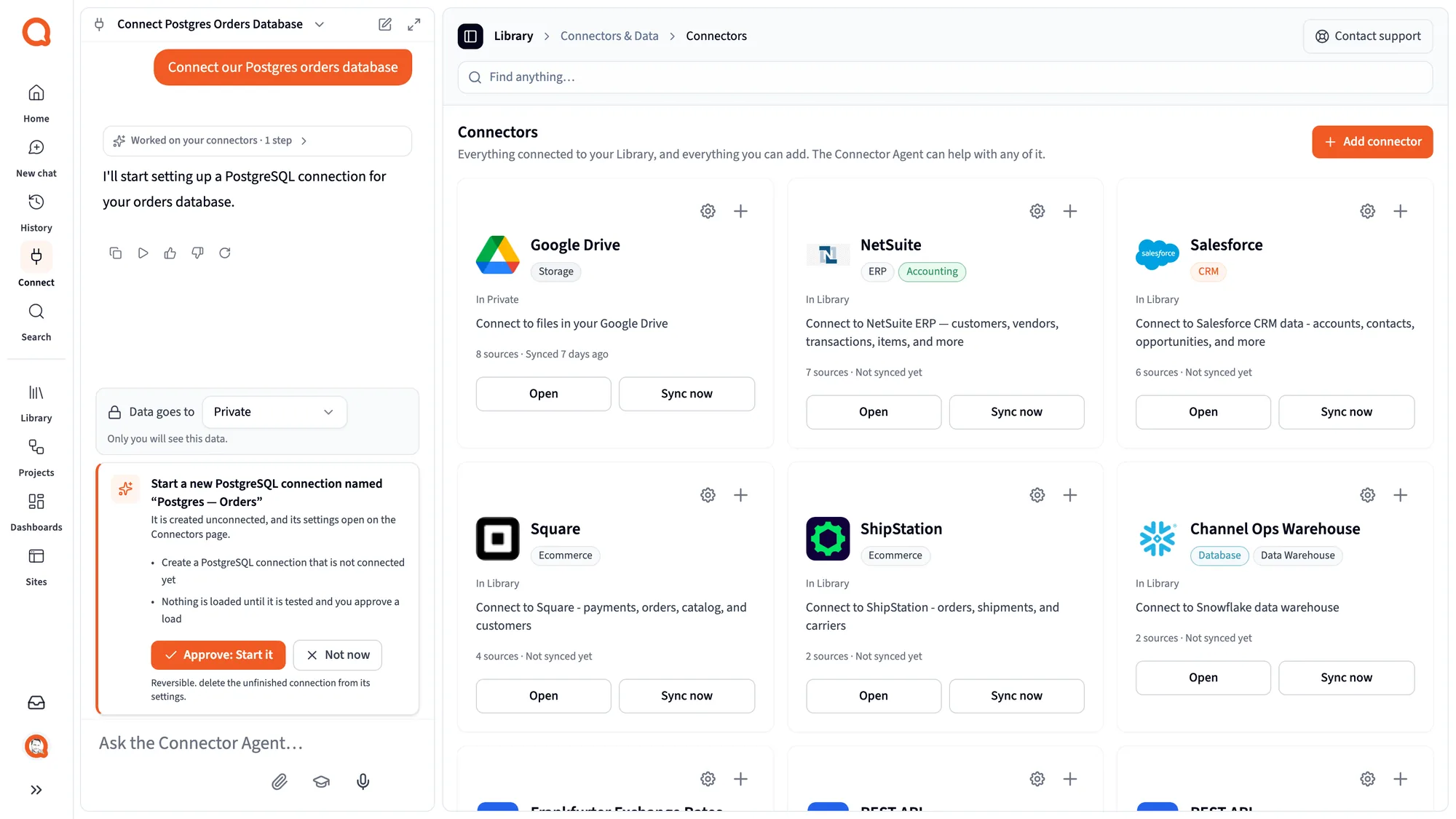
The Connect page in Querri, where the Connector Agent asks for approval before it starts a connection, next to a row of connector cards
The agent waits for your yes before it connects or loads anything.

Shopify FAQ

Questions about Shopify and Querri

How do I connect Shopify to Querri?

Ask the Connector Agent in Querri to connect your Shopify store, or choose Shopify in the catalog. Type the store name, approve Querri's read-only access on Shopify's own screen, then say yes to the first load and pick a schedule. Your Shopify password never reaches Querri.

What Shopify data does Querri sync?

Orders with their line items, shipping lines, refunds, transactions, fulfillments and returns; draft orders and abandoned checkouts; products, variants and collections; customers; locations, inventory items with unit cost and inventory levels; discounts, gift cards and marketing events; and Shopify Payments payouts and balance transactions. Point-of-sale orders are included.

How often does Shopify data sync to Querri?

Changed records come over as often as hourly, based on each record's last-updated time. A full refresh, which also clears records deleted in Shopify, runs daily, weekly or monthly, and a manual sync can run whenever you like. Questions run on Querri's copy, not live against your store.

Does Querri change anything in my Shopify store?

No. Querri only reads from Shopify. Every permission it requests is a read permission, so it can't create, edit or delete an order, product, customer, discount or inventory level, and it doesn't reprice, reorder or change listings.

How far back do Shopify orders go in Querri?

All the way back. Querri has Shopify's permission to read your full order history rather than the most recent 60 days, and it loads large stores through Shopify's bulk operations, so years of orders come over without hitting rate limits.

Can I connect more than one Shopify store?

Yes. Each store is its own connection with its own set of tables, named after the store. All of them land in the same Library, so you can total every store or compare one with another. Each order keeps its currency code, so stores in different currencies stay distinguishable.

How do I reconcile Shopify payouts with orders?

Querri syncs Shopify Payments payouts and the balance transactions behind each one, and every transaction carries its order and its payout. Ask why a payout differs from the week's sales, and the answer lists the charges, refunds, fees and adjustments that make up the gap.

How do I see profit by product from my Shopify data?

Querri reads unit cost from Shopify's inventory items and joins it to order lines and payout fees, plus label costs from a shipping tool and spend from your ad accounts. Tell it once what contribution margin means for your brand, and it reports margin by product, SKU or channel, and can list products with no cost recorded.

How do I combine Shopify and Amazon data?

Connect both, and Querri puts Shopify orders beside Amazon orders, fees, settlements, refunds and inventory. Upload a SKU-to-ASIN sheet once and state the match as a rule, and every answer lines up products across both channels, with a note when a SKU has no match.

How do I combine Shopify and NetSuite or QuickBooks data?

Connect Shopify and your ERP or accounting system, and Querri joins them in one Library: Shopify orders and payouts beside NetSuite sales orders and item costs, or beside QuickBooks deposits and the general ledger. The Shopify + NetSuite and Shopify + QuickBooks pages walk through both.

How do I combine Shopify and Meta Ads data?

Connect both, and Querri puts daily spend for each campaign, ad set and ad, as Meta reports it, beside Shopify revenue and first-time customers. From there you can measure MER, blended CAC and spend against contribution margin, and add Google Ads for the full total.

How do I get an inventory cover report by location?

Ask for weeks of cover by SKU and location. Querri divides available units at each location by recent sales from the same store, and can add Amazon inventory beside it. Save it as a monitor and Querri checks it every night, flagging the SKUs heading for a stockout.

Can I build a custom Shopify dashboard?

Yes. Describe it, or give Querri a screenshot of a dashboard you like as a starting point. Every edit is a request in plain words, one dashboard can hold Shopify beside Amazon, ad spend and your books, and row-level access limits each person to their own rows.

Can I export Shopify reports to Excel automatically?

Yes. Build the report once as a project and put it on a schedule. Each run uses fresh Shopify data and emails a formatted Excel workbook with live formulas. With Loop, each channel manager or store gets a workbook holding only their own numbers.

Can I ask ChatGPT or Claude about my Shopify data?

Yes. Link Querri to Claude or ChatGPT one time. The assistant then reads from your Querri Library, follows your definitions and rules, and sees only what that person can see in Querri, so its margin agrees with your dashboard.

Does Querri do ad attribution for Shopify?

No. Querri doesn't track pixels or run multi-touch attribution or media-mix models. It puts ad spend, as Meta and Google report it, beside Shopify revenue and margin, so you can see MER, blended CAC and spend against contribution for the whole business.

What doesn't the Shopify sync include?

Querri doesn't sync disputes and chargebacks, staff accounts, metafields, product images, Shopify's own reports or B2B company records, though B2B orders still come over as orders. Refunds and discount codes come over at the order level, not line by line. A deleted record stays until the next full refresh.

Is my Shopify data secure in Querri?

Querri is SOC 2 Type II, HIPAA and ISO 27001:2022 certified. The store owner approves access on Shopify's own screen, so no password passes through Querri, and your data never trains a model. Within Querri, sharing and row-level access set which rows each person sees.

Ask Shopify the question your other channels have been waiting on.

It takes a few minutes to connect, and Querri only reads from your store.