How do operations and finance get Databricks answers without a notebook?
Why it's hard
The tables are clean and documented, but the only ways to read them are a notebook, the SQL editor or a dashboard someone else wrote.
 Databricks + Querri
The lakehouse holds what operations, finance and sales want to know. Querri copies the tables you pick into one Library with the rest of your business, so anyone can ask about them in plain language and get your team's definitions back.
Querri only reads from Databricks, with a token kept encrypted and out of the agent's sight. SOC 2 Type II, HIPAA and ISO 27001:2022 certified.
Why Databricks reporting gets stuck
Data engineers move into Databricks because it handles the hard pipeline work. The friction shows up later, when someone outside the data team has a question about what's in it.
A regional manager won't open a notebook or the SQL editor. Each question becomes a request to the data team, and the queue grows faster than the team does.
Net revenue is a CASE statement in one notebook, a dbt model in another and a slightly different filter in a dashboard query. Nobody outside engineering can see which is right.
Classic and pro SQL warehouses wait 45 minutes of idle time before stopping by default, serverless ones 10. A trickle of ad-hoc questions through the day keeps a warehouse billing.
A notebook table shows at most 10,000 rows or 2 MB, whichever is lower. Anything larger gets downloaded, pasted into Excel and emailed, and the copies drift.
Unity Catalog decides who reads which table inside Databricks. Once a CSV leaves the workspace, those grants don't travel with it, and every recipient sees every row.
What you can finally answer
Each one is a request that lands on a lakehouse team every month, why it takes so long today, and how Querri handles it.
Why it's hard
The tables are clean and documented, but the only ways to read them are a notebook, the SQL editor or a dashboard someone else wrote.
Why it's hard
Metered usage lands in the lakehouse while invoices are raised in the ERP. Comparing the two means a pipeline nobody has built yet, or a month-end spreadsheet.
With Querri
Connect NetSuite beside Databricks and Querri lines up each customer's metered usage with its usage invoices. State once in Facts & rules which events are billable, and the list of unbilled customers follows it.
Why it's hard
The agreed definition sits in transformation code. A sales lead rebuilding the number in a spreadsheet gets close, and close is how two numbers end up in one meeting.
Why it's hard
The model writes its forecast to a Delta table and moves on. Checking it against real orders, week by week and region by region, is nobody's job.
With Querri
Sync the forecast table and the orders table, and track forecast error as a KPI. Nightly insights compares each region to its own history every night and puts a drifting one in your Inbox.
Why it's hard
Someone runs the query, downloads the result, formats the sheet and splits it by region by hand. On their week off, nobody gets it.
With Querri
Save the regional breakdown as a project with a Monday 7 a.m. run. Reports & automation reruns it on the latest sync and emails each manager a formatted workbook of their own region, built with Excel tools.
Why it's hard
Orders are in the lakehouse and conversations are in the support tool. Nobody joins the two, so the cost of a bad support month never shows up in revenue.
With Querri
Connect Intercom next to Databricks and ask. Querri matches customers across both and says how it matched them. The ticket volume playbook shows how to find the contacts that keep coming back.
Why it's hard
Workspace access for outsiders is a security review, and a separate BI tool for client reporting is another contract and another copy of the data model.
With Querri
Build the dashboard by asking, then embed it in your own portal with a row filter per client. With white label, it carries your brand rather than ours.
Why it's hard
An assistant given raw table names guesses which column means revenue and which date to filter on. The answer reads well whether it's right or not.
With Querri
Connect Querri to Claude or ChatGPT, and questions about lakehouse data are answered from your Library under each person's access in Querri. When a question can be read two ways, it names the reading it used.
Databricks plus the rest
Engineering pipes the high-volume data into Databricks first. The ERP, the CRM, the support desk and the budget sheet often wait their turn. Querri puts them in one Library next to your lakehouse tables, so a cross-system question doesn't need a new ingestion job.
Databricks pairs well with
Answers you can stand behind
"How many orders were late in September?" can count orders that left the warehouse after the promised date or orders that reached the customer after it. Both are fair, and operations and customer service each favor one. Querri answers with one reading, names it and shows the other count, so the argument is about fixing delays rather than about the query. See how an answer gets checked before you see it.
Wake up to what changed
Every night, Querri checks your KPIs against their own past with plain arithmetic and goes looking for the shift nobody asked about. What it turns up waits in your Inbox in the morning, and nothing changes until you approve it.
Custom Databricks dashboards
Ask for the layout in a sentence, or hand over a screenshot of the report finance pulls up every Monday. Edits work the same way: a request in plain words. The charts read from the same Library as chat, and each viewer can be held to their own rows.
Requests you can stop running by hand
Each region's numbers from the gold tables, as a formatted Excel file in each manager's inbox.
See Excel toolsCustomers with metered usage in the lakehouse and no matching usage invoice in the ERP, rerun on your schedule.
See reportsModel forecasts from a Delta table next to real orders, with the error tracked by region.
See KPIsProduct usage from the lakehouse with support and billing signals, one score per account.
Read the playbookWhich issues bring customers back to support, set against what they order.
Read the playbookThe time from account creation to the first event that predicts a customer stays.
Read the playbookWhat comes over
The tables and views you select are copied into Querri's storage, and every answer comes from that copy rather than a live query against Databricks. It can only read what the token's user or service principal is allowed to read.
What you can sync
Full refresh by default. Pick a cursor column (Querri suggests updated_at) and incremental runs pull only rows past the last value seen, as often as hourly. Tables with a primary key are upserted, so overlap doesn't double-count.
Rows arrive 50,000 at a time as typed Parquet files and become a Querri dataset in Iceberg-backed storage. A per-table row cap is there if you want one.
Querri runs schema lookups and SELECT queries, nothing else. It never writes to a table or changes a record. Syncs run on your warehouse or cluster, so they use its compute.
A personal access token or a service principal's token, encrypted at rest and removed from error messages. The Connector Agent sees that a token exists, never the token itself.
How to connect Databricks
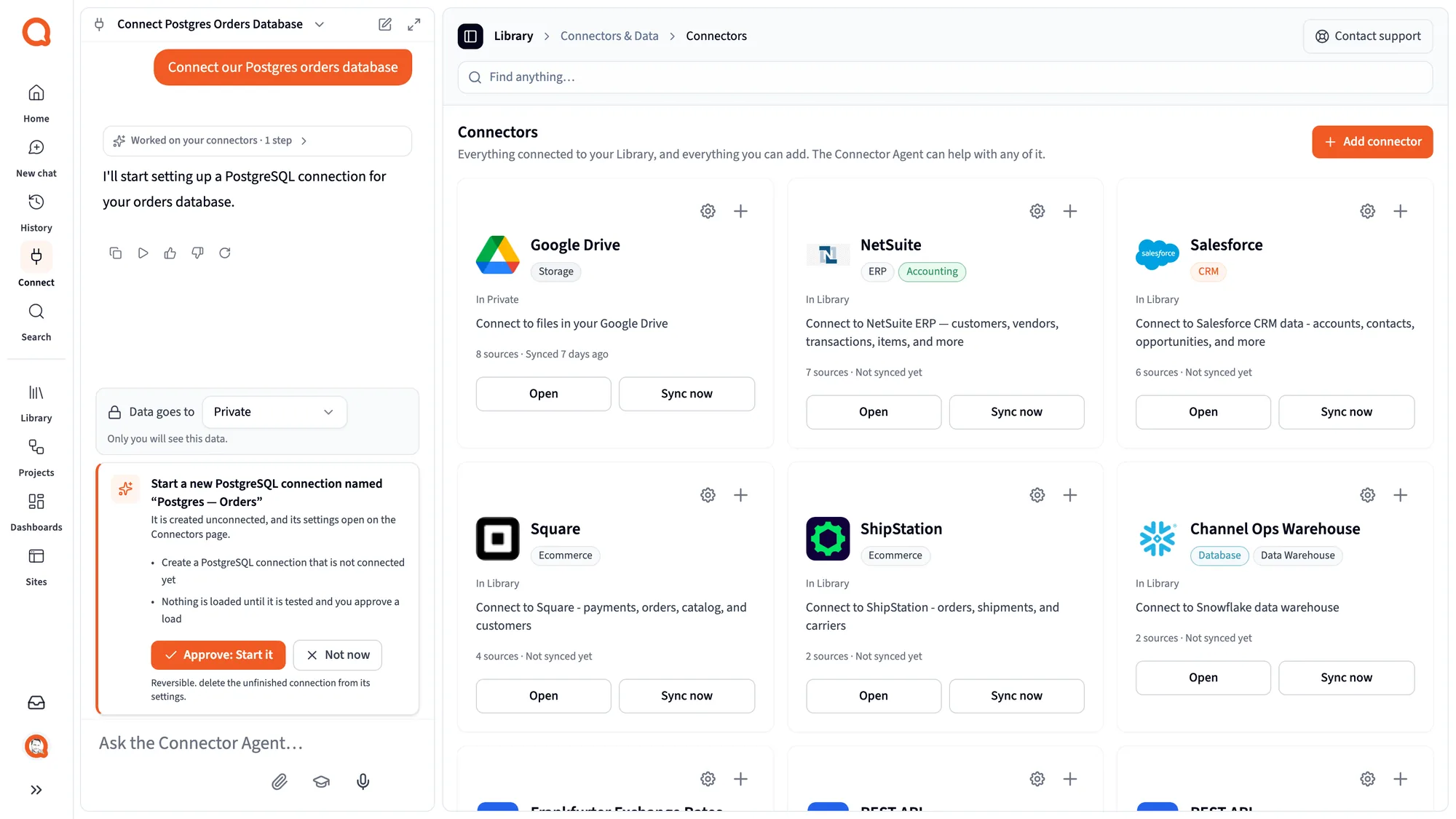
In Connect, type "add our Databricks workspace," or click the Databricks card in the catalog.
From your SQL warehouse's Connection details, copy the server hostname and the HTTP path. An all-purpose cluster works too.
Paste a personal access token or a service principal's token, and name a catalog and schema if you want one other than the default.
Keep every table or pick a few, set a cursor column for incremental syncs, and choose a schedule. Nothing loads until you approve.
Once the first load lands, ask about the lakehouse tables in chat, or build dashboards and scheduled reports from them.
Databricks FAQ
Tell the Connector Agent you want Databricks, or choose its card in the catalog. Enter the server hostname and HTTP path from your SQL warehouse's Connection details, then paste an access token into the secure form. Optionally name a catalog and schema. Then pick the tables, set how often they refresh and approve the first load.
The tables and views in the schema you choose, either all of them or a list you pick, with their columns and types. It works with Unity Catalog or the Hive metastore, through a SQL warehouse or an all-purpose cluster. Querri can only read what the token's user or service principal can read.
A full re-read of the schema can be set to daily, weekly or monthly. Incremental syncs, keyed on a cursor column like updated_at, run hourly, daily or weekly and bring only rows past the last value. Before a big meeting, start one by hand. Rows deleted in Databricks stay in Querri until the next full refresh.
No. Querri only reads your Databricks tables and never changes a record in them. It runs schema lookups and SELECT queries and never creates, updates or deletes a table or row. Those queries do run on your warehouse or cluster, so a sync uses its compute.
Querri can only sync what the token's user or service principal is granted, so a service principal with read access to just the schema you want is the cleanest setup. After the sync, Unity Catalog grants no longer apply person by person: Querri's sharing settings and a row filter for each person decide what they see.
No. Questions are answered from a copy Querri keeps of the tables you picked, refreshed on your schedule, so asking one never wakes a SQL warehouse or keeps it from stopping. Only syncs query Databricks. An answer reflects the data as of the latest sync.
Connect NetSuite as well, and both land in the same Library. Querri can match lakehouse usage, orders or shipments to NetSuite invoices, sales orders and payments on a shared order number or customer, and it tells you how it matched. Define once which usage is billable or when an order counts as shipped, and every answer follows it.
Connect Salesforce next to Databricks. Querri matches accounts across the two, best on an ID stored in both, so you can put product or order activity beside pipeline, renewals and open cases. If a match rests on a name rather than an ID, the answer flags it.
Turn the analysis into a project and attach a weekly schedule. On Monday morning it reruns on the newest copy of your lakehouse tables and sends each manager a formatted workbook holding only their region, or one per client. The download-and-paste step goes away.
Sync the Delta table your model writes its forecast to, plus the orders or sales table. Define forecast error once as a KPI, broken out by region or product. Querri keeps its history from the day you start, and Nightly insights flags a region whose error drifts.
Yes. Ask for the dashboard in plain words, or start from a screenshot of one your team already uses, and change it by asking. A single dashboard can mix lakehouse tables with ERP, CRM or spreadsheet data, hold each viewer to their own rows, and be embedded in your own app.
Yes. After a one-time setup in Claude or ChatGPT, questions about lakehouse tables draw on your Querri Library, follow your definitions and rules, and stay inside what that person may see in Querri, so the assistant and your dashboards agree.
No. The connector needs an access token, either a personal access token or one belonging to a service principal. OAuth would fall back to a browser sign-in that can't complete on a server during scheduled syncs. A service principal's token keeps the connection independent of any one employee.
A connection covers a single catalog and schema. Custom SQL queries aren't supported, so select tables or views instead. There's no OAuth and no writing back, and incremental syncs miss deletions until the next full refresh. Several catalogs or schemas simply mean several connections.
Yes, through the optional VPN tunnel in the connection's advanced settings. Without it, Querri refuses private addresses and connects over HTTPS on port 443 only. If a warehouse is stopped or the host is wrong, the connection gives up within a couple of minutes rather than hanging.
Yes. Rows stream in chunks of 50,000 into typed Parquet files, rather than one giant pull, and progress shows as rows arrive. On tables that grow every day, a cursor column lets each run read only rows past the last one. You can also cap rows per table.
No. Once the tables are synced, anyone with access asks in plain language. Querri shows the steps behind each answer, so someone on the data team can check the logic, and a good answer can be saved as a project that reruns on fresh data.
Querri is SOC 2 Type II, HIPAA and ISO 27001:2022 certified, and your data is never used to train a model. Your access token is encrypted at rest, scrubbed from error messages and never shown to the Connector Agent, and the connection uses HTTPS only.
Keep exploring
Connect with a hostname, an HTTP path and a token. Querri only reads the lakehouse and never writes to it.