Skip to content

Airtable + Querri

Airtable reportingacross every base you run.

Your teams run their work in Airtable, one base at a time. Querri reads all of them, keeps one definition of what your statuses and fields mean, and answers the questions that cross bases, teams and systems in plain language.

Querri only ever reads from Airtable and never changes a record. Your token goes into a secure form the agent never sees. SOC 2 Type II, HIPAA and ISO 27001:2022 certified.

Why Airtable reporting gets hard

Airtable is where the work happens. Seeing all of it is harder.

People love Airtable because every team can shape a base to fit how it works. The same freedom is what makes a company-wide report hard to build.

01

An interface sees one base

Interface Designer builds on the tables of the base it lives in. When delivery, creative and finance each keep their own base, an all-teams view means synced tables or another tool.

02

Record limits push history out

A base holds 50,000 records on the Team plan and 125,000 on Business. Busy teams archive last year into a separate base, and the year-over-year comparison leaves with it.

03

Linked records don't count cleanly

Linked records, lookups and multiple selects are great for running work and awkward for counting it. Export a view and they arrive as comma-separated text in one cell.

04

No trend line for "what changed"

A base shows each record as it is now. How long tasks sat in Review, or how the backlog grew this quarter, is buried in record-by-record revision history, not in a chart.

05

Reporting runs on CSVs and scripts

The weekly report is a CSV downloaded per view and pasted into Excel, or a script someone wrote against an API capped at 5 requests per second per base. Both break when the person who built them is out.

What you can finally answer

Eight Airtable questions that used to mean a spreadsheet

Each one is a request operations, project and marketing leads actually make, why Airtable alone struggles with it, and what Querri does instead.

Which projects are late across every team's base?

Why it's hard

Each team built its own base with its own status names and due-date fields. Rolling them up means synced tables, matching field names by hand and hoping nobody renames a column.

With Querri

Querri reads every base the token can read into one Library. Say once in Facts & rules what "late" means, and every base is judged the same way. Visualize shows which bases feed which answers.

Which delivered projects haven't been invoiced yet?

Why it's hard

Delivery marks a project Done in Airtable; finance invoices in QuickBooks. Nobody owns the gap between them, so finished work sits unbilled until month-end.

With Querri

Connect QuickBooks next to Airtable and Querri matches delivered projects to invoices by client and amount. The unbilled ones come back as a list, and it tells you how it matched and which pairs it couldn't settle.

Which pieces on our content calendar actually brought in leads?

Why it's hard

The content calendar is an Airtable base; leads and campaigns live in HubSpot. Connecting a published post to the deals it started means a spreadsheet join by URL or campaign name.

With Querri

Querri brings HubSpot into the same Library and joins content to campaigns and contacts, saying how it matched them. The channel-to-revenue playbook carries it through to closed revenue.

Is our request backlog growing, and since when?

Why it's hard

Airtable shows how many requests are open today. Last month's count lives only in revision history or in a screenshot someone saved.

With Querri

Track open requests as a KPI and Querri keeps its history from the day you start, so "compared with last month" is one question. Nightly insights flags the week it starts to climb.

How many requests did each team close, when Status has twelve spellings?

Why it's hard

Single-select options get added on the fly: "Done", "Complete", "Shipped ✅". One request tagged with three teams gets counted three times, or once, depending on who built the formula.

With Querri

Querri checks the columns before it answers: values spelled many ways, multi-select fields that would double-count, blanks that aren't blank. It tells you what it cleaned and how much that moved the count. See data cleansing.

Can every client get their own status report each Friday, in Excel?

Why it's hard

One filtered view per client, one CSV download per view, then formatting in Excel by hand. With twenty clients, Friday afternoon is gone.

With Querri

Make the Friday report one project with a step per client. Put it on a schedule, and after the latest Airtable sync every client gets a formatted workbook with only their work in it. See reports and automation.

Which vendors keep missing their delivery dates?

Why it's hard

Vendors are linked records on hundreds of tasks across bases. A vendor scorecard means a rollup per base and a judgment call about what counts as late.

With Querri

Save how you score a vendor once as a Skill, and anyone can run it the same way. Monitors check each vendor against its own track record every night and put the slips in your Inbox.

Can I ask Claude or ChatGPT about our Airtable bases and get the same answer as the dashboard?

Why it's hard

An assistant pointed at raw Airtable data guesses what your fields and statuses mean, and two people asking the same thing get two counts.

With Querri

Connect Querri to Claude or ChatGPT once. The assistant answers from your Library with your definitions, and each person only sees the rows their access allows.

Airtable plus the rest

Your bases know the work. Other systems know what it earned.

Airtable tracks projects, content and requests. The invoice is in QuickBooks, the lead is in HubSpot, the budget is in a spreadsheet. Querri joins them in one Library, so a question about the work can reach the money.

Airtable pairs well with

Answers you can stand behind

Two fair readings of one Airtable question, and Querri names the one it used

"Projects finished in September" can mean projects marked Done in September or projects due in September that are now Done. Both are fair, and the counts differ. Querri answers with one, names it and shows you the other, so the team talks about the work instead of the filter. See how answers work.

Wake up to what changed

Querri keeps an eye on every base overnight

Each night Querri checks your KPIs against their own history with plain arithmetic and works through questions about your bases that nobody has asked yet. What it finds waits in your Inbox in the morning, and nothing changes without your OK.

Custom Airtable dashboards

One dashboard for every base, built by asking

Describe the dashboard you need, or start from a screenshot of the one your team keeps in another tool. It can pull from every base at once and from systems outside Airtable, and each team or client can be limited to its own rows.

  • Built by asking, changed by asking
  • Every base in one view, plus finance and marketing data
  • Each client or team limited to its own rows
Every change is a sentence. One request turns the dashboard dark, and the undo is a click away.

Reports you can stop rebuilding

Six Airtable reports, built once

What comes over

Every base your token can read, found for you

Querri discovers the bases and tables your personal access token can read and brings them over with their fields. It can only sync what that token is allowed to see.

Discovered automatically

  • Every base the token can read
  • Every table in those bases
  • Text and long text fields
  • Numbers and currency
  • Dates
  • Single and multiple selects
  • Checkboxes
  • Linked records
  • Each field arrives as a column, linked records included

Fresh copy on a schedule

Each sync reloads your tables in full, daily, weekly or monthly, and you can run one by hand anytime. Records deleted in Airtable drop out on the next sync.

All your bases in one place

Tables from every base the token can read land side by side in the Library, so a question can span bases without synced tables.

Read only

Querri reads your bases and nothing else. Records, fields, views and bases in Airtable stay exactly as your team left them.

A token the agent never sees

You paste a personal access token into a secure form. The Connector Agent only knows whether it's set or missing.

How to connect Airtable

An agent sets up Airtable while you watch

  1. 1

    Ask the Connector Agent

    Open Connect in Querri and tell the Connector Agent "connect our Airtable," or click the Airtable card in the catalog.

  2. 2

    Create a personal access token

    In Airtable, create a personal access token with read access to the bases you want Querri to see.

  3. 3

    Paste it into the secure form

    The token goes straight into a secure form. The agent never sees it, and Querri finds the bases and tables it can read.

  4. 4

    Approve the load and a schedule

    Nothing loads until you approve it. Choose a daily, weekly or monthly refresh.

  5. 5

    Ask your first question

    Each base shows up in the Library as its own set of tables. Start with a question that crosses two of them.

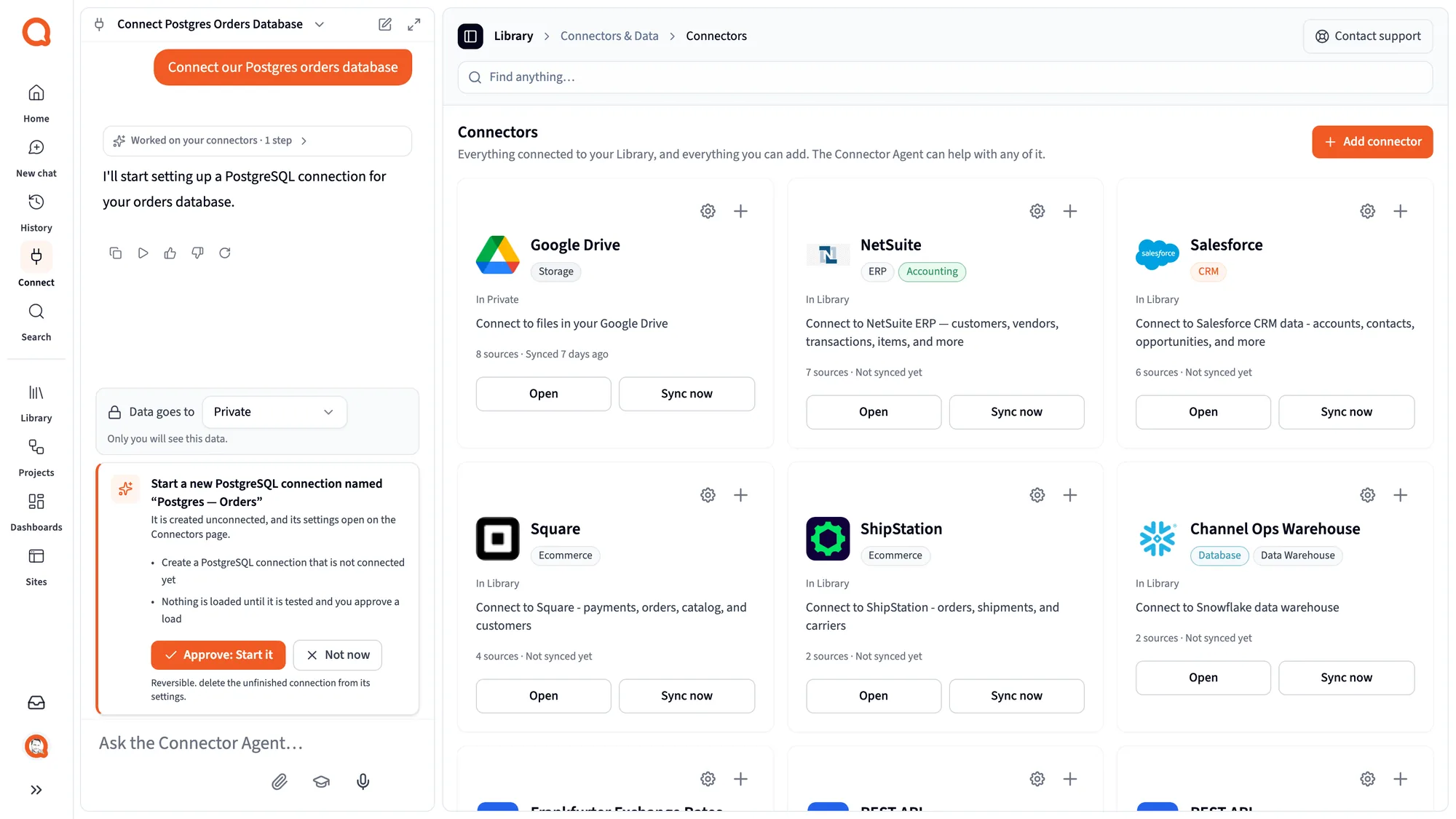
The Connect page with the Connector Agent asking for approval before it starts a connection, beside connector cards for Google Drive, NetSuite, Salesforce, Square, ShipStation and Snowflake
Before any connection is made or any row is loaded, the Connector Agent stops and asks.

Airtable FAQ

Questions about Airtable and Querri

How do I connect Airtable to Querri?

Ask the Connector Agent in Querri to connect Airtable, or pick it from the catalog. Create a personal access token in Airtable with read access to the bases you want, paste it into the secure form, then approve the load and a schedule. The agent never sees the token itself.

What Airtable data does Querri sync?

Every base and table your personal access token can read, discovered automatically. Each field comes over as a column, including linked records, selects, dates and numbers. Querri can only sync what the token is allowed to see, so give it access to exactly the bases you want to report on.

How often does Airtable data sync?

As often as daily. Airtable syncs run as a full refresh on a daily, weekly or monthly schedule, and you can start a sync by hand whenever you need fresher data. Questions run on the synced copy in Querri, not live against your bases.

Does Querri write to or change my Airtable data?

No. Querri reads from Airtable and nothing more. Your records, fields, views and bases stay exactly as they were. Dashboards, reports and anything else you build in Querri work on Querri's own synced copy of the data.

How do Airtable permissions carry over to Querri?

Querri sees only the bases your personal access token can read, so scope the token to what belongs in Querri. Inside Querri, who sees which rows is set by Querri's own sharing and row-level access, not by each person's Airtable permissions, and a row filter follows each person everywhere.

How do I report across multiple Airtable bases?

Connect Airtable once with a token that can read every base you need. Querri brings their tables into one Library, where you define shared terms like "late" or "done" once. Questions, dashboards and reports can then span all of those bases without synced tables or manual exports.

How do I combine Airtable and QuickBooks data?

Connect both, and Querri joins them in the Library: projects or orders in Airtable matched to invoices and payments in QuickBooks by client and amount. You can then ask which delivered work hasn't been billed, and Querri flags any match it isn't confident about.

How do I combine Airtable and HubSpot data?

Connect both, and Querri lines up your Airtable content calendar or campaign tracker with HubSpot campaigns, contacts and deals. It tells you how it matched records across the two systems, so you can follow a piece of content through to the leads and revenue it produced.

How do I get a weekly project status report from Airtable?

Ask for the report once in Querri and save it as a project. Put it on a schedule and Querri reruns it on the latest sync every week, then sends it by email or as a formatted Excel workbook, with one version per team or client if you want.

How do I see how my Airtable data changed over time?

Track the number you care about, such as open requests or late tasks, as a KPI in Querri. Querri keeps the KPI's history from the day you start measuring, so you can compare this week with last month without digging through record revision history.

Can I build custom Airtable dashboards outside Interface Designer?

Yes. Describe the dashboard you want, or start from a screenshot of one you already use. A Querri dashboard can draw on every connected base plus systems outside Airtable, you change it by asking, and each person or client can be limited to their own rows.

How do I export Airtable to Excel automatically?

Build the view you need once in Querri as a project, then schedule it. Querri reruns it after each sync and sends a formatted Excel workbook, so nobody downloads a CSV from each view and reformats it by hand. Each recipient can get their own version.

Can I ask ChatGPT or Claude about my Airtable data?

Yes. Once Querri is connected to Claude or ChatGPT, the assistant answers from your Querri Library instead of raw Airtable tables, so it uses your definition of late or done and each person's own access. Both the assistant and your dashboards read the same Library, so their counts agree.

How does Querri handle linked records and multiple-select fields?

They come over as columns like any other field. Before answering, Querri checks how those columns are used, such as a record tagged with several teams, so a count doesn't quietly double up. When it has to choose how to count, it tells you which way it chose.

Does Querri support incremental syncs for Airtable?

Not today. The Airtable connector runs a full refresh: each sync reloads your tables, daily, weekly or monthly. A side benefit is that records deleted in Airtable disappear from Querri on the next sync, so the copy never keeps rows your team removed.

Can I connect Airtable with OAuth instead of a token?

Not today. Querri connects to Airtable with a personal access token that you create in Airtable and paste into a secure form. The Connector Agent never sees the token; it only knows whether one is set, and you can revoke the token in Airtable whenever you like.

What if our base is close to Airtable's record limit?

Archive older records into another base the token can read. Querri reads every base the token can read, so a report can still span this year's base and last year's archive, and a question about year-over-year change still has both years to work from.

Can each client or team see only their own Airtable rows?

Yes. In Querri you set a row filter for each person once, for example by client or team. It follows them into chat, dashboards, scheduled reports, Claude and ChatGPT, and the API, so nobody sees another client's work by accident.

Is my Airtable data secure in Querri?

Querri is SOC 2 Type II, HIPAA and ISO 27001:2022 certified, and your data is never used to train a model. Your Airtable token goes into a secure form the Connector Agent never sees, and Querri only ever reads from your bases.

Ask the question that spans all your bases.

Paste in an Airtable token and approve the load. Querri reads your bases and never edits them.