Skip to content

NetSuite + Querri

NetSuite reporting,without another saved search.

Ask about receivables, margin or spend in plain language and get an answer that already knows your subsidiaries, your currencies and how your team defines each number. Querri copies NetSuite into one place with the rest of the business and keeps that copy current.

Querri only ever reads from NetSuite. Your access token goes into a secure form the agent never sees. SOC 2 Type II, HIPAA and ISO 27001:2022 certified.

Why NetSuite reporting gets hard

NetSuite keeps the books. Getting answers out is a second job.

Controllers and FP&A teams hit the same walls in every NetSuite account. They come from how an ERP stores data, not from anyone setting it up wrong.

01

Every search starts from one record type

A saved search or workbook dataset begins at one root record and reaches others through joins. Margin by item and customer, or AR next to support cases, means knowing exactly which join path holds the field you need.

02

Getting data out has ceilings

Saved search emails stop at 10,000 rows, and search results cap at 10 MB, roughly 20,000 rows and 50 columns as a CSV. Direct database access through SuiteAnalytics Connect is a separate add-on module.

03

Dashboards are built from portlets

The home dashboard is a grid of portlets with their own limits: up to ten custom KPIs per Key Performance Indicators portlet, and up to three KPI Meters per dashboard. Anything richer goes to a spreadsheet.

04

Subsidiaries and currencies multiply every number

In a OneWorld account the same report gives different totals depending on the subsidiary it runs under and the exchange rate it applies. A consolidated view that everyone agrees on takes care, every month.

05

Half the business lives outside the ERP

Pipeline sits in the CRM, budgets in a spreadsheet, product usage in the warehouse. NetSuite can't see them, so the questions that cross the edge become a weekly export and a VLOOKUP.

What you can finally answer

Eight NetSuite questions finance stopped asking

Each comes from controllers, FP&A and operations leaders on NetSuite: the question, what makes it slow today, and what Querri does instead.

What's our DSO and overdue AR by subsidiary, in one currency?

Why it's hard

Aging reports run per subsidiary context, each in its own currency, and DSO isn't a field anyone can add to a search. Someone rebuilds it in Excel at every close.

With Querri

Say once how you convert and what counts as open AR in Facts & rules. Querri measures DSO as a KPI per subsidiary and keeps its history from the day you start, so the trend is there next quarter.

What's our gross margin by item and customer, month by month?

Why it's hard

Revenue sits on transaction lines, cost of goods on the accounting lines behind them, and the two only line up if you join them the right way. Get it wrong and margin double-counts.

With Querri

Querri reads transactions, lines and accounting lines together, checks for duplicates and gaps before it writes the query, and shows the query behind every number. See how answers are checked, then save it as a project that reruns the same way next month.

Are we on budget by department this quarter?

Why it's hard

The budget often lives in a planning spreadsheet that changes after every reforecast, while actuals live in NetSuite by department and class. Budget vs. actual becomes a monthly paste job.

With Querri

Connect NetSuite and the budget sheet. Querri matches departments and periods in the Library, so the variance updates on every sync, including after the next reforecast.

Which department's vendor spend just jumped, and with whom?

Why it's hard

A spike only shows up if someone compares this month's vendor bills to each department's normal, and the same vendor entered twice splits the total in two.

With Querri

Monitors compare each department to its own history every night, with arithmetic. Querri also catches vendors entered under two spellings and says how merging them moved the number. See data cleansing.

Do the deals sales closed match what we invoiced and collected?

Why it's hard

The CRM says booked, NetSuite says billed and paid, and the customer name rarely matches across the two. Finance and sales each defend their own number at the board meeting.

With Querri

Connect Salesforce and NetSuite together. Querri matches closed deals to sales orders, invoices and payments, says how it matched them, and lists what was booked but never billed.

Which items will run out next month, and at which location?

Why it's hard

Inventory balances show what's on hand today by location and bin. Comparing that to how fast each item has been selling means a second search and a spreadsheet to line them up.

With Querri

Ask once, and Querri sets on-hand balance against trailing sales by item and location. Save your reorder method as a skill and put the result on a dashboard that refreshes on every sync.

Can every subsidiary controller get their own close pack each month?

Why it's hard

One pack per entity means one set of filters per entity, rebuilt at every close, and the formatting falls apart once it's pasted into Excel.

With Querri

Build the pack once. A schedule reruns it after close and sends each controller a formatted workbook with only their subsidiary's rows. See reports and automation and Excel tools.

Can I ask Claude or ChatGPT about NetSuite numbers and get the books' answer?

Why it's hard

A general assistant doesn't know which accounts make up revenue or which periods are closed, so each prompt invents its own version of the P&L.

With Querri

Link Querri to Claude or ChatGPT one time. The assistant answers from your Library with your account mappings and rules, under each person's access, so it gives the same number as the close pack.

NetSuite plus the rest

The finance questions that matter reach past the ledger

NetSuite knows what was billed, paid and shipped. The CRM knows what was promised, the warehouse knows who uses the product, and the budget lives in a spreadsheet. Querri puts them in one Library, so a question about revenue or cost gets one answer.

NetSuite pairs well with

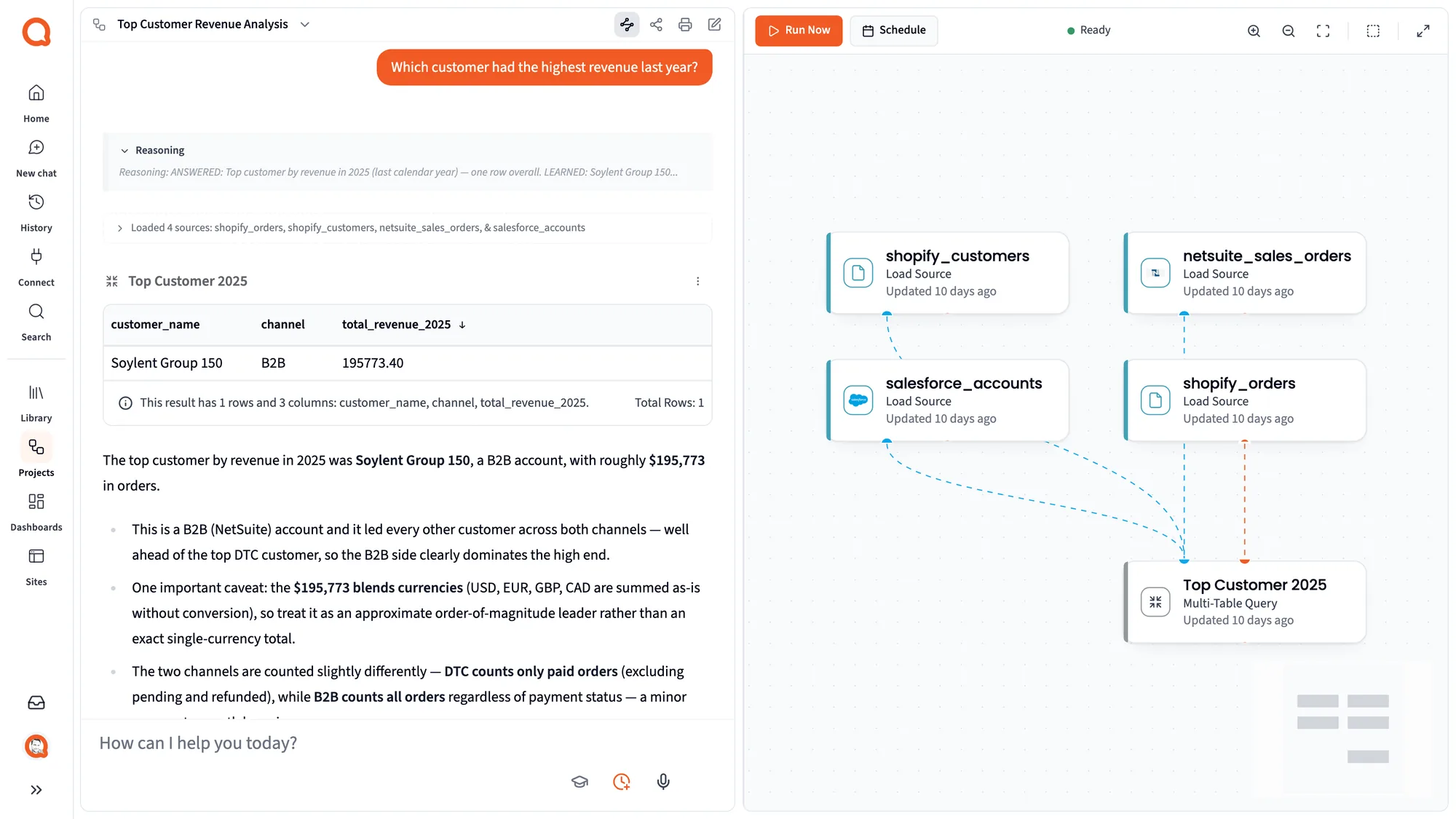
A Querri project that joins four sources, among them Salesforce accounts and NetSuite sales orders, to answer which customer brought in the most revenue last year, with a caveat that the total mixes currencies
NetSuite, Salesforce and two more sources joined in one answer, and Querri points out that the total mixes currencies.

Answers you can stand behind

Some finance questions have two right answers. Querri tells you which one you got

"Revenue in Europe" can mean revenue booked by your European subsidiaries or revenue from customers shipped to in Europe. Both are reasonable, and in a multi-entity account they rarely match. Querri answers with one, says which, and shows the other, so the review is about the business rather than the filter. See how Querri reaches an answer.

Wake up to what changed

Querri reads the ledger overnight

Every night Querri compares your KPIs to their own history and looks for the corner of the books nobody has a report on. By the time you open the Inbox, the findings are there for you to accept or dismiss. Nothing in Querri changes until you say so.

Custom NetSuite dashboards

Finance dashboards that aren't limited to a grid of portlets

Start from a description, or from a screenshot of the flash report the CFO opens every Monday. Change it by asking, mix NetSuite with your budget and CRM data, and limit each controller or department head to their own rows.

  • Asked for in plain language, changed the same way
  • NetSuite beside budgets, pipeline and usage
  • One row filter per person, set once
Every change is a sentence. One request turns the dashboard dark, and the undo is one click away.

Reports you can stop rebuilding

Six NetSuite reports, set up once

What comes over

Your CRM, ledger, inventory and projects, in 27 tables

Querri reads NetSuite tables through SuiteQL and keeps a copy current on the schedule you pick. It can only read what the role behind your access token can see, and some tables need the matching NetSuite feature turned on.

Tables available

  • Customer
  • Contact
  • Vendor
  • Employee
  • Partner
  • Opportunity
  • Support Case
  • Campaign
  • Account
  • Subsidiary
  • Department
  • Class
  • Location
  • Currency
  • Accounting Period
  • Term
  • Price Level
  • Payment Method
  • Transaction
  • Transaction Line
  • Transaction Accounting Line
  • Item
  • Inventory Balance
  • Bin
  • Project
  • Project Task
  • Job Requisition
  • Sandbox accounts connect the same way as production

Kept in sync

On tables with a last-modified date, incremental syncs fetch only what changed, as often as hourly. Schedule a full refresh daily, weekly or monthly to cover the rest and to drop anything deleted in NetSuite.

Tables, not exports

Querri reads tables through NetSuite's REST query API with SuiteQL. Nothing depends on someone exporting a saved search or emailing a CSV.

Read only

Querri only ever reads from NetSuite, with SELECT queries. It never posts a journal, edits a customer or deletes anything.

Tokens stay secret

You connect with token-based authentication. The token and consumer secrets go into a secure form; the Connector Agent only knows whether each one is set.

How to connect NetSuite

Connect NetSuite with an agent doing the setup

  1. 1

    Ask the Connector Agent

    Type "connect our NetSuite" on the Connect page, or click NetSuite in the catalog.

  2. 2

    Create an access token in NetSuite

    Your NetSuite admin sets up token-based authentication for a role that can see the data you want in Querri.

  3. 3

    Enter the credentials in the secure form

    Account ID, consumer key and secret, token ID and secret. The agent never sees them, and it tests the connection.

  4. 4

    Pick the tables

    Choose from 27 tables across CRM, finance, transactions, inventory and projects.

  5. 5

    Approve the first load

    The agent waits for your approval before any data moves. Pick a sync schedule, and the tables land in your Library, ready for questions.

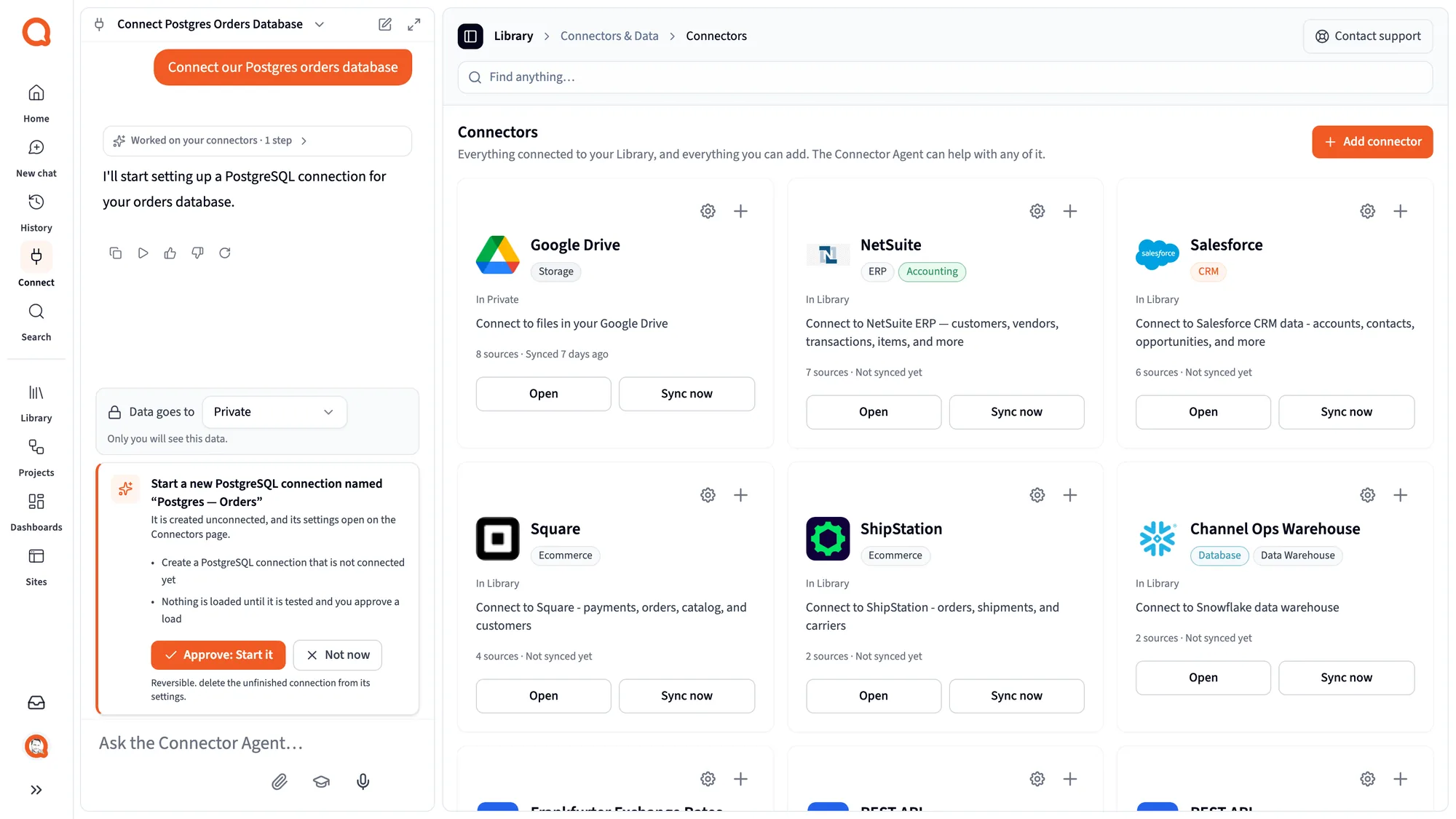
Querri's Connect page: the Connector Agent asks for approval before starting a connection, next to connector cards for Google Drive, NetSuite, Salesforce, Square, ShipStation and Snowflake
Nothing connects and no rows load until you click Approve.

NetSuite FAQ

Questions about NetSuite and Querri

How do I connect NetSuite to Querri?

Tell the Connector Agent "connect our NetSuite" or click it in the catalog. Then enter your account ID, consumer key and secret, and token ID and secret from NetSuite's token-based authentication into the secure form, choose your tables, and approve the load and a schedule.

What NetSuite data does Querri sync?

Up to 27 tables: customers, contacts, vendors, employees, partners, opportunities, support cases and campaigns; accounts, subsidiaries, departments, classes, locations, currencies, periods, terms, price levels and payment methods; transactions and their lines; items, inventory balances and bins; and projects, project tasks and job requisitions.

How often does NetSuite data sync?

You choose. Incremental syncs run hourly, daily or weekly and fetch records by last-modified date. A few tables have no such date, so give those a full refresh, which runs daily, weekly or monthly and also clears out records deleted in NetSuite. You can also sync by hand anytime.

Does Querri write to or change my NetSuite data?

No. Querri only reads from NetSuite, using SELECT queries through the REST query API. It can't post a transaction, edit a customer, delete a record or change a setting. Questions run on Querri's synced copy, so they add no load to your NetSuite account while people ask.

How do NetSuite role permissions carry over to Querri?

Querri can only read what the role behind your access token can see, so pick a role whose access matches what belongs in Querri. Once the data is in Querri, each person's NetSuite role no longer applies: Querri's own sharing and row-level access decide who sees which rows.

Does Querri support NetSuite custom records?

Not today. Querri syncs 27 standard NetSuite tables, covering CRM, finance, transactions, inventory and projects, but it doesn't read custom record types. If a question depends on a custom record, you can add that data to Querri another way, such as a spreadsheet export, and Querri joins it with the rest.

Can I connect a NetSuite sandbox account?

Yes. Sandbox accounts connect the same way as production, with their own account ID and access token. That makes it easy to try questions, dashboards and reports on test data before you point Querri at your production account.

Do I need SuiteAnalytics Connect to use Querri with NetSuite?

No. Querri reads NetSuite through the REST query API with SuiteQL, using token-based authentication, rather than through the SuiteAnalytics Connect ODBC or JDBC drivers. You don't need the Connect add-on module for Querri to sync your data.

How do I combine NetSuite and Salesforce data?

Connect both, and Querri matches Salesforce opportunities to NetSuite sales orders, invoices and payments in the Library, then tells you how it matched them. Write down once whether a booking means a closed-won deal or a signed sales order, and that rule holds in every answer, dashboard and report.

How do I combine NetSuite with budget data in a spreadsheet?

Connect NetSuite and the Google Sheet or Excel file that holds the budget. Querri lines up departments, classes and periods across the two, so budget vs. actual updates on every sync and keeps working after the next reforecast changes the sheet.

How do I combine NetSuite and Snowflake data?

Connect both, and Querri joins NetSuite customers and invoices to the usage or event tables in your Snowflake warehouse. Then you can ask which customers you're billing that stopped using the product, or how revenue per customer tracks with adoption.

How do I get an AR aging and DSO report by subsidiary from NetSuite?

Connect NetSuite, then ask for open AR by age bucket and DSO by subsidiary. Tell Querri once how to convert currencies and what counts as open, and it tracks DSO as a KPI with its history kept, so you can see the trend at every close.

How do I get gross margin by item and customer from NetSuite?

Ask for it in plain language. Querri reads transaction lines and accounting lines together so cost of goods lines up with revenue, checks for duplicates before it answers, and shows the query behind the number. Save it as a project to rerun every month.

Can I build custom NetSuite dashboards outside of NetSuite?

Yes. Ask for the dashboard in plain words, or hand Querri a screenshot of a saved-search portlet or a spreadsheet chart to start from. Edits are requests too, it can mix NetSuite with budgets and CRM data, and each person can be limited to their own subsidiary or department.

How do I export NetSuite data to Excel automatically?

Build the report once in Querri, then put it on a schedule. Querri reruns it on freshly synced NetSuite data and emails a formatted Excel workbook, and it can send each controller or client a version with only their own rows.

Can I ask ChatGPT or Claude about my NetSuite data?

Yes. After a one-time link to Querri, Claude or ChatGPT answers from your Library, using your account mappings and close rules and only the rows each person may see. Ask Claude for Q3 operating expense and you get the figure on your Querri dashboard, not a guess.

Can each subsidiary or department see only its own numbers?

Yes. Give each person a row filter in Querri, such as the UK subsidiary or the Marketing department. It applies everywhere they go: chat, dashboards, scheduled reports, Claude, ChatGPT and the API. People never see rows outside their filter.

Do questions run live against NetSuite?

No. Querri copies NetSuite data into your Library on the schedule you choose, and questions run on that copy. That keeps answers fast and adds no load to NetSuite, and you can run a manual sync whenever you need the latest records.

Is my NetSuite data secure in Querri?

Querri is SOC 2 Type II, HIPAA and ISO 27001:2022 certified, and your data is never used to train a model. NetSuite tokens go into a secure form the Connector Agent never sees, and Querri only ever reads from your account.

Ask NetSuite the question that waits until after close.

Connect it with a token in a few minutes. Querri reads your data and never changes a record.