Which SKUs lost margin last month, and in which channel?
Join Shopify, Amazon and NetSuite in one project. Find the SKUs whose margin after channel fees fell against their own six months, and see whether price, cost, fees or returns moved.
Open QuerriWhat you'll need
Querri (Free trial) to join the three systems and rank every SKU
Shopify, Amazon Seller Central and NetSuite: Step 1 says what each adds
Your margin rules: so every channel is measured the same way
Free resources
Start your free trial here →Sample data sets
Synthetic data for Curio Supply, a made-up home goods brand. Not real customer, retailer or marketplace data.
Need help?
If you have any questions, you can request a demo or email our team.
Before we begin
The monthly package shows gross margin by channel, and most months it barely moves. A SKU can lose six points on Amazon while the channel line holds, because the fee that changed sits below gross margin. Sales, fees and cost live in three systems, so following one SKU across them is a spreadsheet job the close rarely has time for.
This playbook compares every SKU's margin in every channel with its own prior six months, and takes apart the ones that fell.
How it works:
- • Connect Shopify, Amazon Seller Central and NetSuite
- • Build net revenue and gross margin by channel
- • Rank SKUs by margin change in each channel
- • See what moved: price, cost, fees or returns
- • Build the monthly margin view for leadership
Follow the steps
Connect Shopify, Amazon Seller Central and NetSuite
Three sources, one project:
- •
Shopify: store order lines, discounts and refunds.
- •
Amazon Seller Central: sales, referral and FBA fees, and refunds.
- •
NetSuite: wholesale invoices, trade credit memos and landed cost by month.
All three connect directly and sync on a schedule. Querri matches Amazon seller SKUs to NetSuite items through the SKU map in the item cost table.
Tip: Pull six months before the month you're closing, so every SKU is compared with its own history.
-
 Shopify sales
-
 Amazon transactions
-
 NetSuite sales and item cost
 One project
Build net revenue and gross margin by channel
Start with the channel lines leadership already sees:
"Build net revenue and gross margin by channel for October 2026, against each channel's own April to September."
Gross margin across all channels was 59.8%, against 60.5% for April to September. Amazon's held at 67.6%, yet after channel fees Amazon fell to 43.3% from 45.0%.
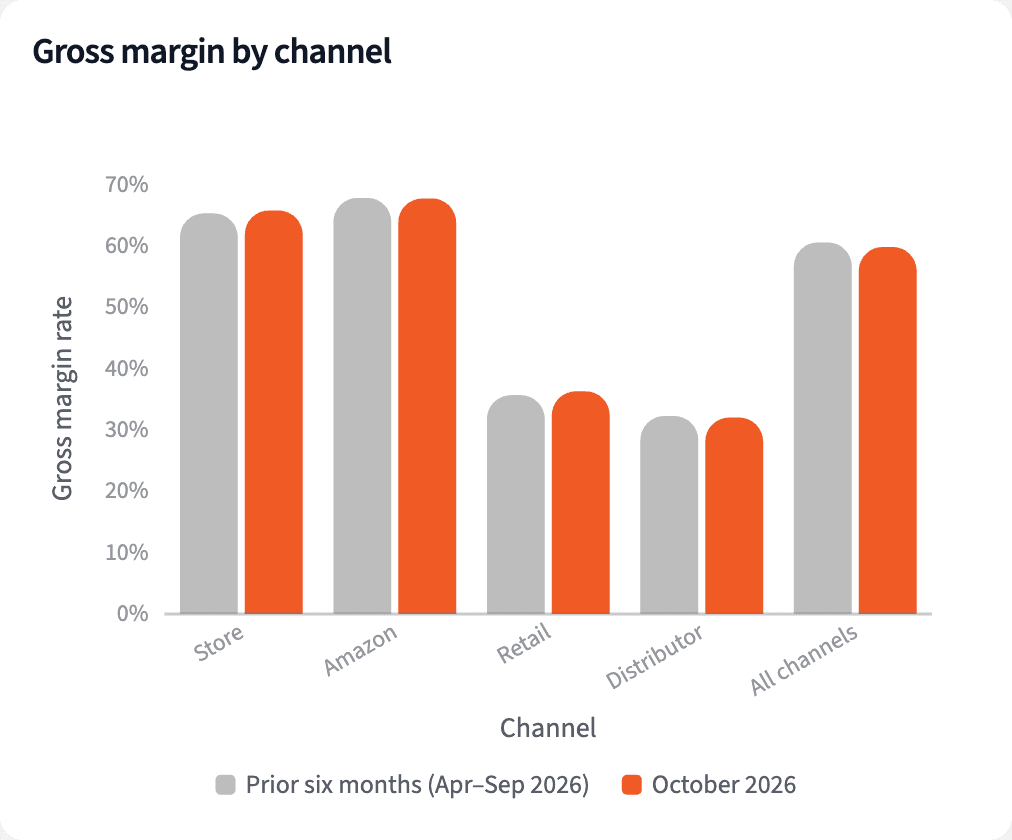
| Channel | October | April to September |
|---|---|---|
| Store | 65.7% | 65.2% |
| Amazon | 67.6% | 67.7% |
| Retail | 36.2% | 35.6% |
| Distributor | 32.0% | 32.2% |
| All channels | 59.8% | 60.5% |
Gross margin rate by channel, October 2026 against April to September 2026.
Rank SKUs by margin change in each channel
Now compare every SKU with its own history, channel by channel:
"For every SKU and channel with $10,000 or more of October net revenue, compare margin after channel fees with its own prior six months. Flag drops of 4 points or more."
4 of 89 SKU and channel pairs fell 4 points or more after channel fees. Three are on Amazon.
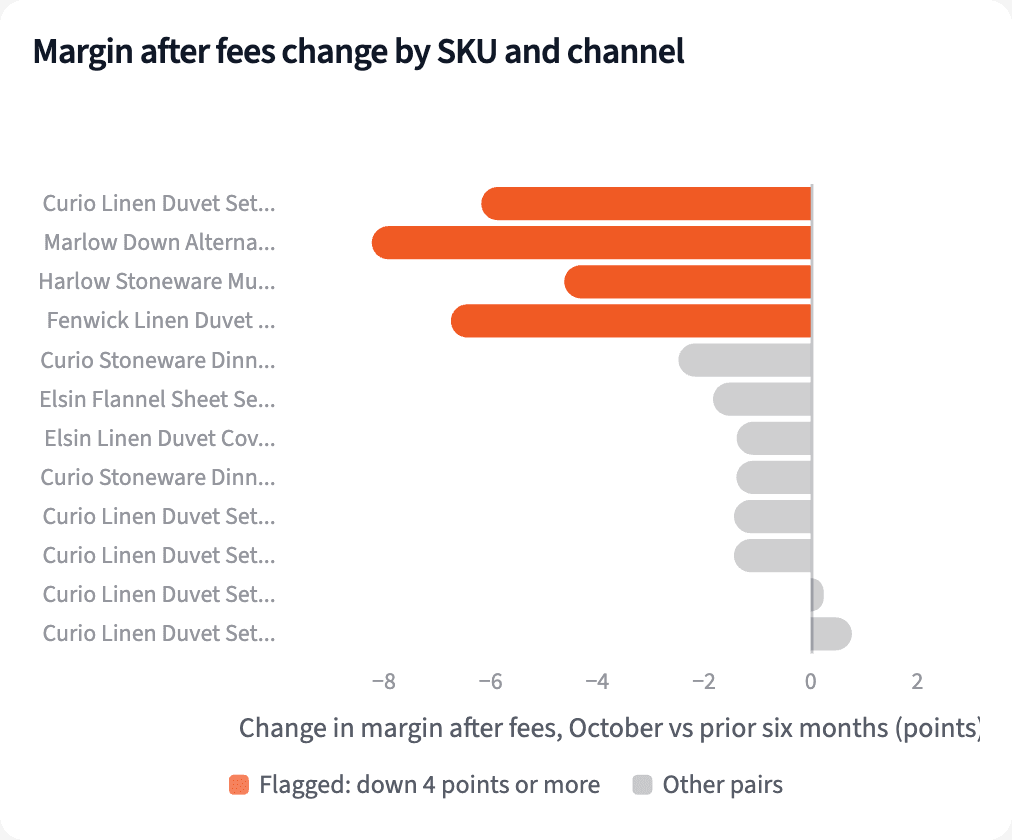
| SKU and channel | October (prior) | Change |
|---|---|---|
| Curio Linen Duvet Set, Queen (Amazon) | 41.0% (47.1%) | -6.2 points |
| Marlow Comforter, Queen (Amazon) | 37.1% (45.3%) | -8.2 points |
| Harlow Stoneware Mug Set (Amazon) | 34.2% (38.9%) | -4.6 points |
| Fenwick Linen Duvet Cover, Queen (Retail) | 30.3% (37.1%) | -6.8 points |
Flagged pairs: margin after channel fees, October 2026 (April to September 2026).
See what moved: price, cost, fees or returns
For each flagged SKU, take the margin apart per unit:
"For each flagged SKU, show price, product cost, referral fee, FBA fee and refunds per unit, October against the prior six months. When did anything change?"
Price and landed cost held. The FBA fee per unit stepped up on 2026-09-15, and at October's volume the change cost $17,955.
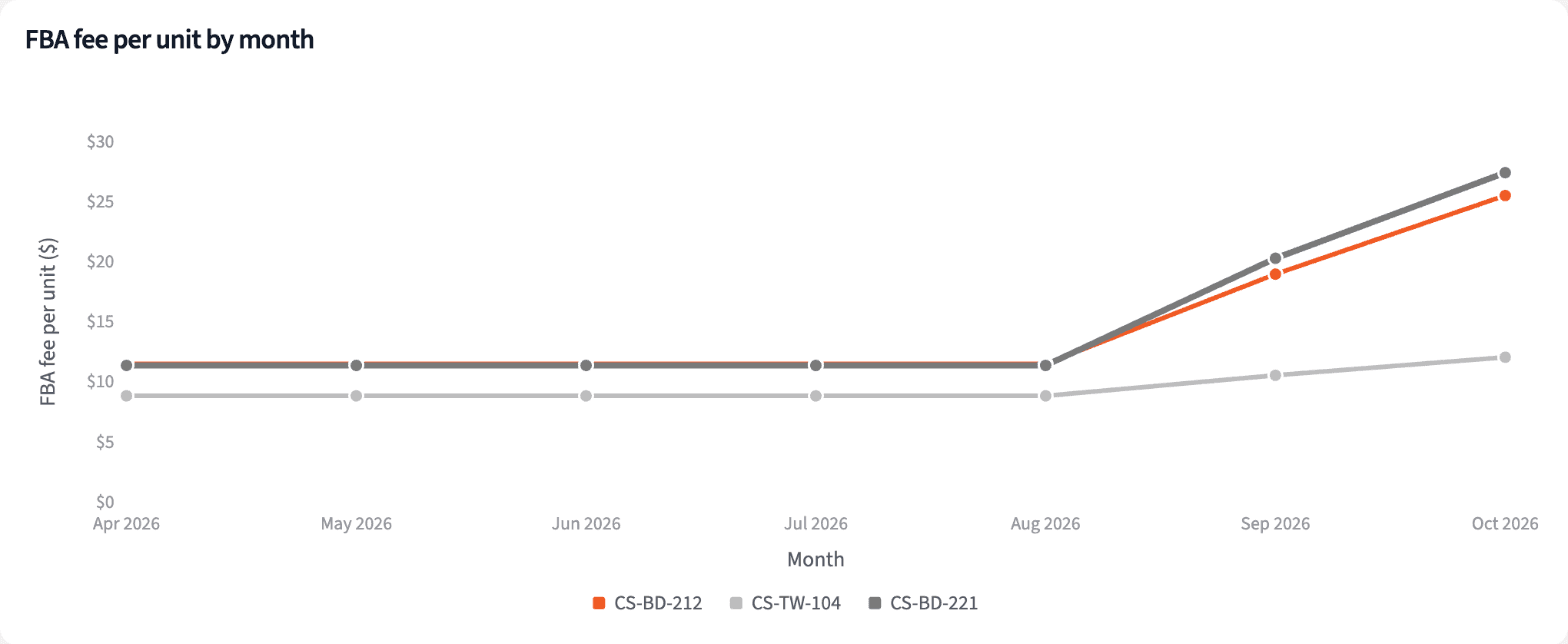
| SKU | FBA fee per unit | October cost |
|---|---|---|
| Curio Linen Duvet Set, Queen | $11.50 to $25.50 | $10,794 |
| Marlow Comforter, Queen | $11.37 to $27.40 | $5,386 |
| Harlow Stoneware Mug Set | $8.84 to $12.05 | $1,775 |
| Total | $17,955 |
FBA fee per Amazon-fulfilled unit, August against October 2026, and the October cost of the change.
Build the monthly margin view for leadership
Four numbers for the package, and what moved.
The narrative Querri writes:
Gross margin by channel barely moved in October, but three Amazon SKUs lost margin to a higher FBA fee and one retail SKU to a lower invoice price.
What you can create or export:
- The table, to Excel, CSV or Google Sheets
- A live dashboard that refreshes with each sync
- A presentation for the meeting, to PDF or PowerPoint
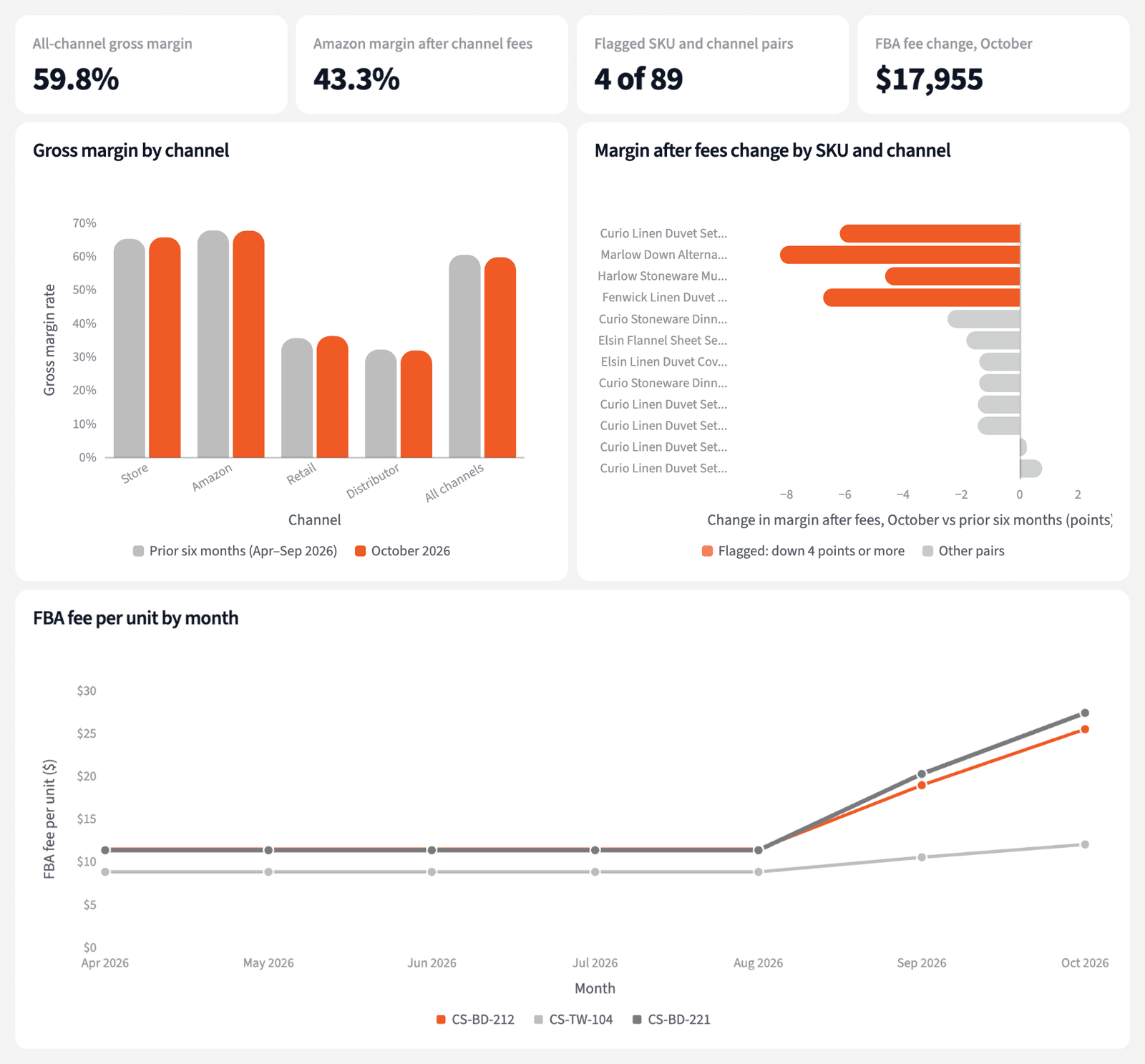
| SKU and channel | What moved | Next step |
|---|---|---|
| Curio Linen Duvet Set, Queen (Amazon) | FBA fee | Review the fee |
| Marlow Comforter, Queen (Amazon) | FBA fee | Review the fee |
| Harlow Stoneware Mug Set (Amazon) | FBA fee | Review the fee |
| Fenwick Linen Duvet Cover, Queen (Retail) | Invoice price | Check the promo terms |
Flagged SKU and channel pairs, October 2026.
Bring three SKUs and what moved them to the meeting.
Try it on your own dataTips for a margin package people trust
Compare each SKU with itself
A SKU's own six months is a fairer test than the channel average. A big seller can't hide a small one's drop, and seasonal items stay comparable.
Read margin after fees, not only gross margin
Marketplace fees sit below gross margin. A fee change can take points off a SKU while gross margin and the channel line stay flat.
Teach Querri your rules once. Every answer after that follows them.
What counts as a channel fee, how trade credit memos are spread, which SKUs are big enough to flag: say each rule once and Querri applies it to every question on that data.
Show me how
Say it in chat
Settle a rule in conversation and the Librarian records it as a fact under Facts & Rules, attached to the table it governs. Every later question on that data applies it, whoever asks, and every view built afterwards carries it.
"Margin after channel fees for Amazon is net revenue less landed cost, referral fees and FBA fees. Save that as a rule for the Amazon transactions table."
Or bring the document that already says it
Upload your margin reporting policy or close checklist like any other file. Querri files a From a document card in the Inbox with the statements it found, each with its page and exact words; tick the ones to keep and they become facts. The rules this playbook depends on:
- Channels: Store, Amazon, Retail and Distributor, split by NetSuite class
- Amazon net revenue: product sales plus promotional rebates
- Channel fees: referral and FBA fees, less any refunded
- Trade: credit memos with no quantity, spread by net revenue
- Checked: $10,000 or more of the month's net revenue in a channel
- Flagged: 4 points or more below its own prior six months
"Read our margin reporting policy and propose the rules it states about channel fees and trade spend. I'll review them in the Inbox."
Where the rules reach
A rule is attached to the data, not to one person's chat, so it follows the data everywhere:
- • Every question asked in chat, by anyone on the finance team
- • Every view the Librarian builds on that data
- • Every step of a project, including the code it writes
- • Dashboards and scheduled runs, each time they refresh
- • Claude and ChatGPT, when they ask Querri
You stay in control
Every rule is listed under Facts & Rules next to the data it governs, where you can edit or remove it. Rules from a document wait for your tick in the Inbox, and a Worth remembering card is how Querri offers one it noticed itself. Workspaces and roles decide who can change what. Company-wide rules go in Settings → Customize; the Library is where the rest lives.
The payoff at month end
The package shows the channel lines and the few SKUs that moved under them, with what changed. Moving the flag threshold is a sentence.
Frequently asked questions
What is margin after channel fees?
Why compare with the prior six months?
Which SKUs are checked?
What happened to the retail SKU?
How are Amazon SKUs matched to NetSuite items?
How is trade spend handled?
Does Querri change anything in NetSuite?
How often should this run?
Other popular resources
Playbook
Payouts against the books
Do Shopify payouts and Amazon settlements match the books?
Playbook
Deductions against promos
Which retailer deductions match a promo we agreed to?
Demo
Request a walkthrough
See Querri in action with your own data.
Pricing
Compare plans
Find the right plan for individuals, teams, or enterprise.