Which shippers are paying slower than they used to?
Join QuickBooks Online receivables to your Tai load export. See each shipper's days to pay against its own pattern, and what its short pays were billed for.
Open QuerriWhat you'll need
Querri (Free trial) to join the exports and run the checks
QuickBooks Online and a Tai load export: Step 1 says what each adds
Your collections rules: so every shipper is measured the same way
Free resources
Start your free trial here →Sample data sets
Synthetic data for a made-up freight brokerage. Not real shipper data.
Need help?
If you have any questions, you can request a demo or email our team.
Before we begin
The aging report tells you how old the money is. It takes more work to see who has changed. A large shipper can slow down by two weeks while nearly all of its balance still sits in Current. The payments are in QuickBooks and the loads behind them are in the TMS, so connecting a slower shipper to the charges it is holding back has meant exports, lookups and a lot of patience.
This playbook ages the receivables, compares every shipper's days to pay with its own history, and matches each short pay to the load it was billed for.
How it works:
- • Upload the Tai export and connect QuickBooks
- • Age receivables and list short pays
- • Compare each shipper with its own pattern
- • See what the short pays were billed for
- • Build the weekly receivables view
Follow the steps
Upload the Tai export and connect QuickBooks
Two systems, one project:
- •
QuickBooks Online: invoices, payments, credit memos, the A/R Aging Detail and each customer's terms.
- •
Tai load export (or your TMS load report): the load behind each invoice: lane, line haul, fuel and every accessorial charge.
QuickBooks Online connects directly and syncs on a schedule. The Tai export comes in as a file; upload next week's over the old one and every view rebuilds.
Tip: Pull at least 15 months of invoices and payments, so every shipper has a full year of history to compare against.
-
 QuickBooks receivables
-
 Tai load export
 One project
Age open receivables and list short-paid invoices
Start where the collections meeting starts, then find the invoices paid but not in full:
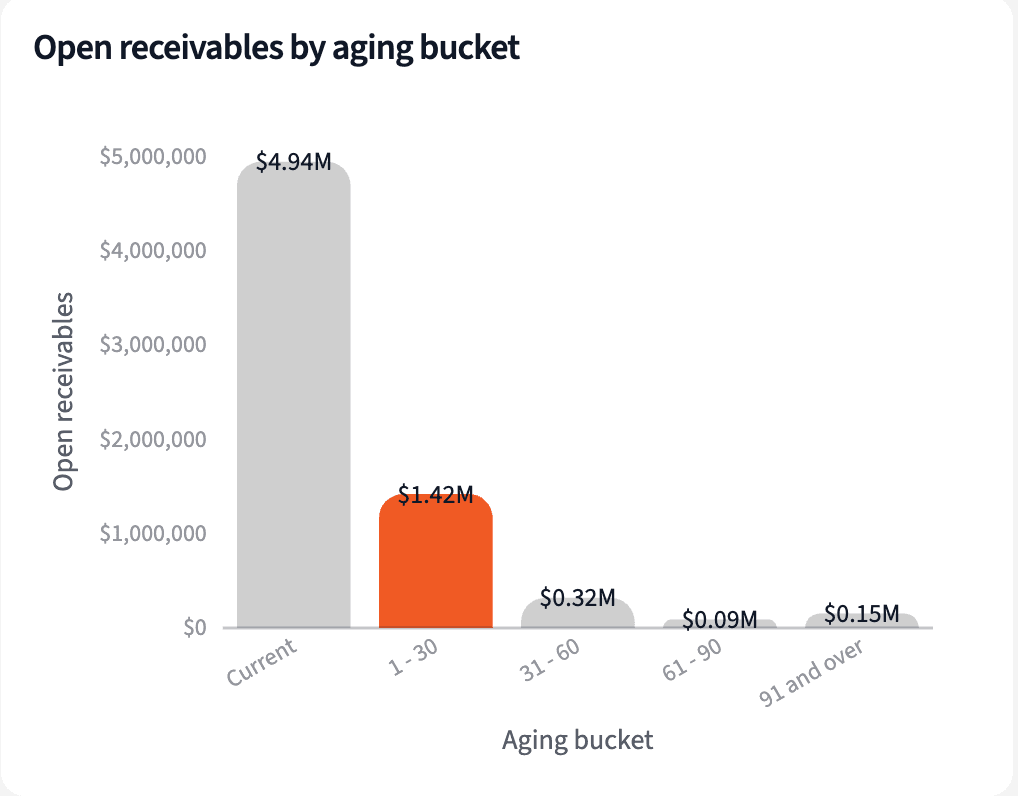
"Age our open receivables as of November 1 and work out DSO. Then list the invoices shippers paid in October but not in full, once counting every cent and once ignoring differences of $50 or less."
DSO is 42 days and 92% of the money is current or under 30 days late. The aging looks calm. The $50 rule cuts October's short pays from 35 to 22.
| Aging bucket | Invoices | Open |
|---|---|---|
| Current | 2,938 | $4,940,130 |
| 1 to 30 days | 842 | $1,418,322 |
| 31 to 90 days | 251 | $407,792 |
| Over 90 days | 136 | $151,539 |
| Total | 4,167 | $6,917,783 |
Open receivables on November 1, 2026, by aging bucket.
Compare each shipper's days to pay with its own pattern
Hold every shipper against its own last 12 months, not against the company average:
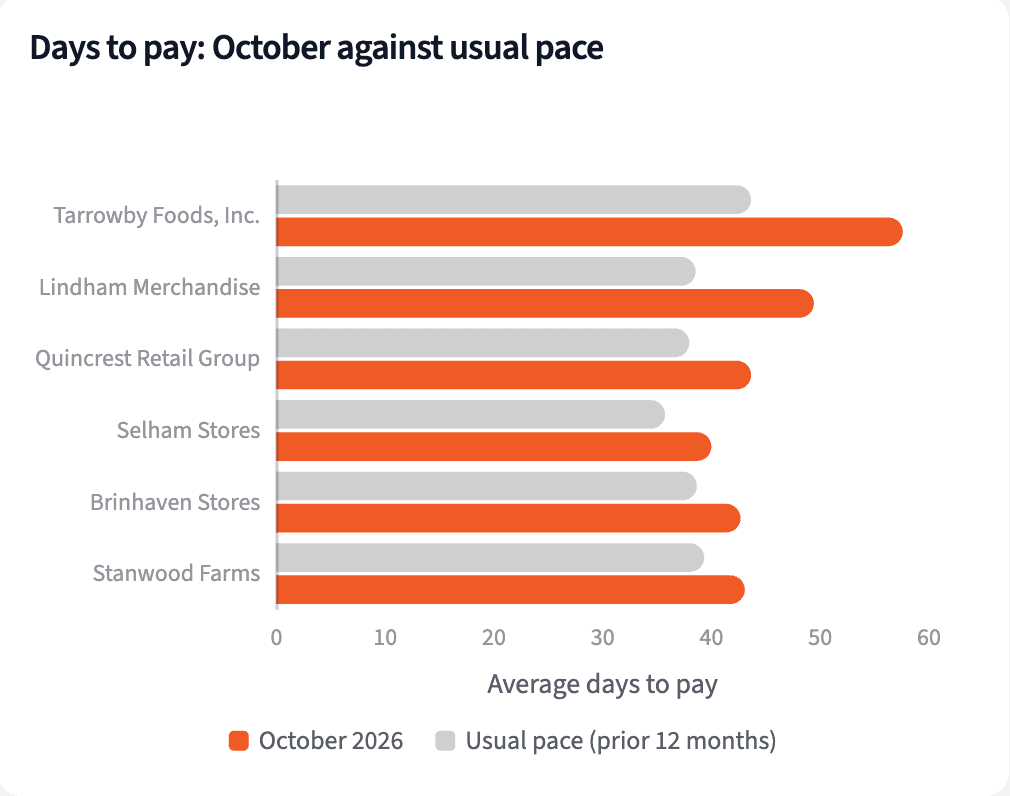
"For every shipper with at least 20 invoices paid in October, compare October's average days to pay with its own average over the 12 months before. Flag anyone 5 or more days slower."
The company barely moved, 41.2 days to 41.7. Three shippers are 5 or more days slower. Tarrowby Foods is 14 days slower and owes the most, almost all of it still current.
| Shipper | Usual | October | Change |
|---|---|---|---|
| Tarrowby Foods | 43.6 | 57.6 | +14.0 |
| Lindham Merchandise | 38.5 | 49.4 | +10.9 |
| Quincrest Retail Group | 38.0 | 43.7 | +5.7 |
| Company | 41.2 | 41.7 | +0.5 |
Average days to pay, invoices closed in October 2026 against the 12 months before.
See what the short-paid dollars were billed for
Follow each short pay to its load through the load number on the invoice:
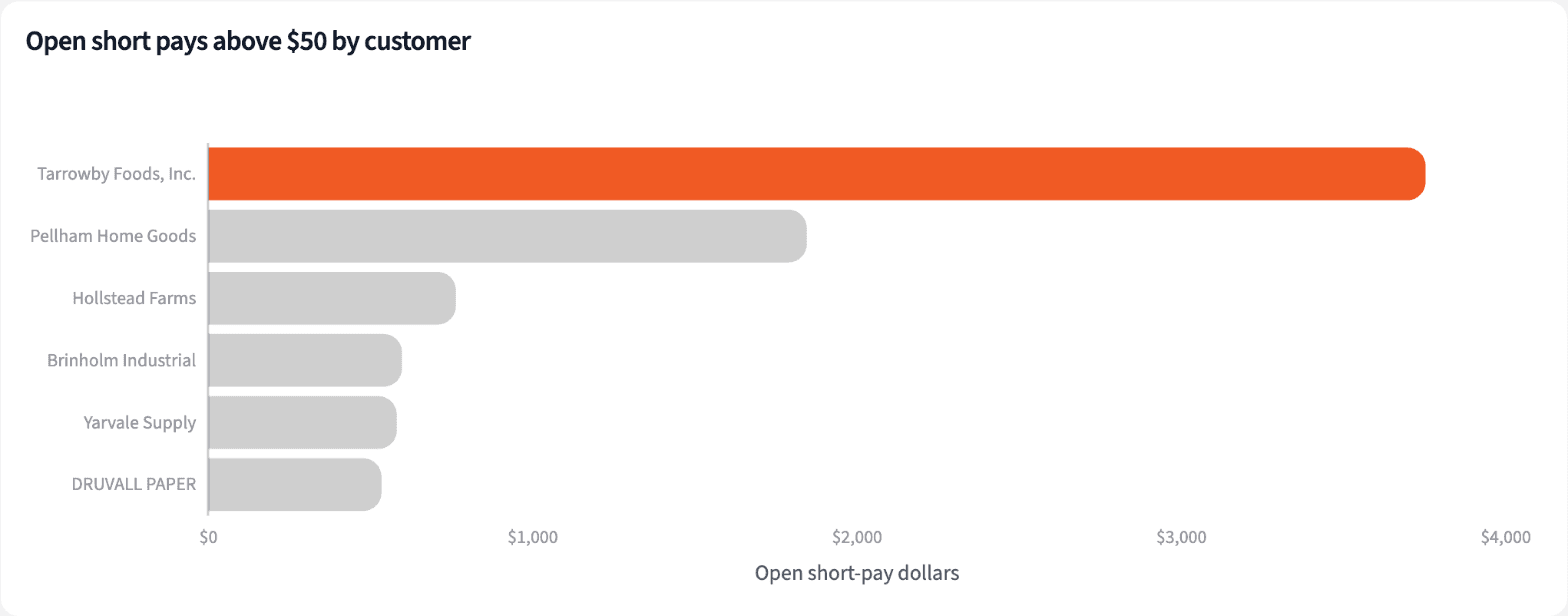
"Match every open short pay over $50 to its Tai load through the load number on the invoice. Which charge does the missing amount equal: line haul, fuel, detention or lumper?"
13 of Tarrowby's 14 short pays equal the detention charge on the load, to the cent, all on Fresno to Denver. No other shipper's short pays match detention.
| Shipper | Short pays | Open | Equal to detention |
|---|---|---|---|
| Tarrowby Foods | 14 | $3,753 | 13 |
| Pellham Home Goods | 5 | $1,845 | 0 |
| Hollstead Farms | 3 | $763 | 0 |
| All shippers | 38 | $11,509 | 13 |
Open short pays over $50 on November 1, 2026, from every payment month.
Build the weekly receivables view for the controller
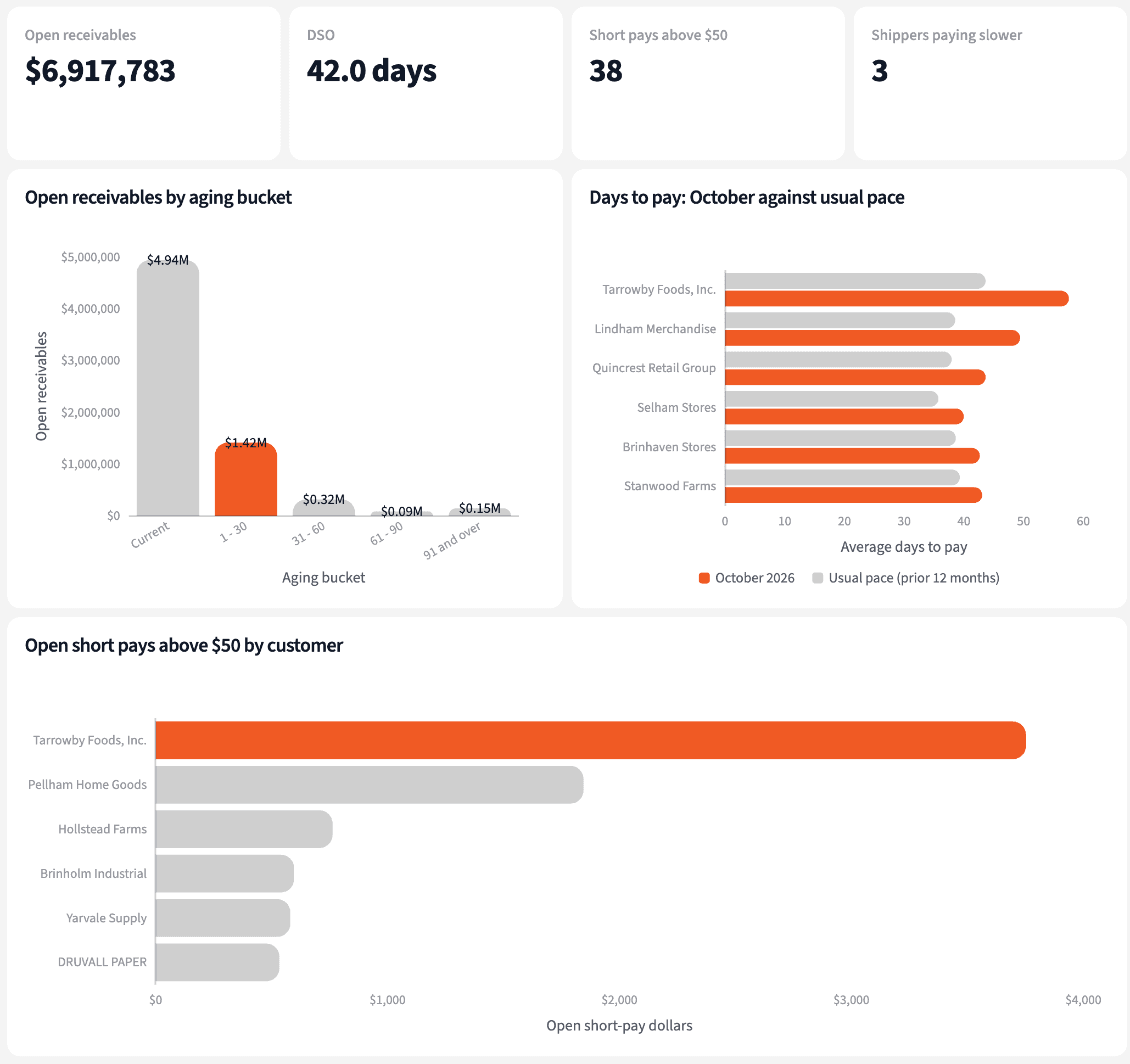
Four numbers for Monday, and the calls to make first.
The narrative Querri writes:
Receivables look steady in total, but the largest balance belongs to a shipper that has slowed by two weeks and is short paying the detention billed on one lane.
What you can create or export:
- The call list, to Excel, CSV or Google Sheets
- A live dashboard that refreshes with each QuickBooks sync
- A presentation for the weekly finance meeting, to PDF or PowerPoint
| Shipper | Days to pay | Open |
|---|---|---|
| Tarrowby Foods | 57.6 (usual 43.6) | $498,670 |
| Lindham Merchandise | 49.4 (usual 38.5) | $25,531 |
| Quincrest Retail Group | 43.7 (usual 38.0) | $22,647 |
The call list, week of November 2, 2026.
See which shippers have changed before their invoices reach 60 days.
Try it on your own dataTips for a collections call that starts with the facts
Measure each shipper against itself
The company's average days to pay moved half a day. One shipper moved 14. Compare every account with its own history and the change stands out weeks before the aging does.
Match short pays by load, not by name
The load number on the invoice ties QuickBooks to the TMS even when the customer names differ. Then the short pay tells you which charge is in dispute.
Teach Querri your rules once. Every answer after that follows them.
What counts as a short pay, how days to pay is measured, what slower means: say each rule once and Querri applies it to every question on that data.
Show me how
Say it in chat
Settle a rule in conversation and the Librarian records it as a fact under Facts & Rules, attached to the table it governs. Every later question on that data applies it, whoever asks, and every view built afterwards carries it.
"A short pay is an invoice with a payment applied and more than $50 still open. Save that as a rule for the QuickBooks invoices table."
Or bring the document that already says it
Upload your credit and collections policy like any other file. Querri files a From a document card in the Inbox with the statements it found, each with its page and exact words; tick the ones to keep and they become facts. The rules this playbook depends on:
- Short pay: a payment applied and more than $50 still open
- Days to pay: invoice date to the last payment or credit memo that closed it
- Usual pace: the shipper's own average over the prior 12 months
- Paying slower: 5 or more days above the usual pace, with 20 or more payments
- DSO: open receivables over the last 12 months of invoicing, times 365
- Matching: QuickBooks to Tai through the load number in the invoice memo
"Read our credit and collections policy and propose the rules it states about payment terms, short pays and when an account goes on hold. I'll review them in the Inbox."
Where the rules reach
A rule is attached to the data, not to one person's chat, so it follows the data everywhere:
- • Every question asked in chat, by anyone on the accounting team
- • Every view the Librarian builds on that data
- • Every step of a project, including the code it writes
- • Dashboards and scheduled runs, each time they refresh
- • Claude and ChatGPT, when they ask Querri
You stay in control
Every rule is listed under Facts & Rules next to the data it governs, where you can edit or remove it. Rules from a document wait for your tick in the Inbox, and a Worth remembering card is how Querri offers one it noticed itself. Workspaces and roles decide who can change what. Company-wide rules go in Settings → Customize; the Library is where the rest lives.
The payoff on Monday
The collections call starts with the shipper that changed, the lane, and the charge in question. Changing the $50 rule is a sentence.
Frequently asked questions
What counts as a short pay?
How is days to pay measured?
Why compare a shipper with itself?
Why only shippers with 20 or more October payments?
How do QuickBooks invoices match Tai loads?
Does a slower shipper mean a dispute?
Do I need a TMS connector?
Does Querri change anything in QuickBooks?
How often should this run?
Other popular resources
Playbook
Carrier bills above the agreed rate
Which carrier bills came in above the agreed rate, or twice?
Playbook
Delivered, not invoiced
Which delivered loads haven't been invoiced yet?
Demo
Request a walkthrough
See Querri in action with your own data.
Pricing
Compare plans
Find the right plan for individuals, teams, or enterprise.