Order-Related Support Tickets: Where Should Leaders Invest?
Before a busy support queue becomes a permanent staffing commitment, find out which order problems created the work. Put the fix in the right budget, protect margin, and free your team to resolve customer problems faster.

Order volume is growing. So is the support queue. Your customer experience lead needs enough coverage to keep customers waiting as little as possible, and you need to decide what that coverage should cost.
Before you turn a busy week into a permanent staffing plan, ask where the work came from. More orders may explain the increase. A warehouse backlog, a shipping service missing its delivery promise, or a recurring product issue could also be creating work that an operational fix would prevent.
For a CEO or COO, the question is: Where should we invest so growth brings more profit without overwhelming the team serving it? The payoff is a lower cost to serve and more capacity for customers who need help. Order-related support data shows which operating decisions deserve attention first.
Consider the synthetic example in our orders-to-tickets playbook, built for a fictional consumer brand selling through its own store and Amazon. In its sample week, 54.8% of 484 tickets were attributed to fulfillment and shipping problems. Those tickets consumed 46.7 of the team's 80.3 support hours, valued at $1,494 under the sample's cost assumptions. Another 343 orders were overdue and still undelivered. Faced with that picture, leadership has a more useful decision than how many agents to add: which operational fix deserves funding, and what coverage is needed while it takes effect?
Warehouse, carrier, or product: put the fix in the right budget
The same “Where is my order?” message can point to very different investments. An order waiting to be picked needs a different response from one that left on time and stalled in transit. Shopify's fulfillment guidance makes that handoff explicit and identifies extra support inquiries as a consequence of slow fulfillment.
Use the pattern behind the contacts to decide who should own the response and which spending proposal to consider:
| What is creating the work? | Leadership decision | What would justify the investment? |
|---|---|---|
| Recurring warehouse backlogs | Change order release, warehouse coverage, pickup timing, or the fulfillment partner's recovery plan | The change addresses the point where orders are waiting and reduces missed ship-by dates |
| Late deliveries after timely carrier handoff | Test another service on the affected lanes, or revise the delivery promise | Better delivery performance and lower total cost to serve on comparable orders |
| Product issues persisting on on-time orders | Fund a focused product, packaging, instructions, or listing fix | Item-level complaints and returns identify a specific problem the change can address |
| Repeated status inquiries on on-time orders | Improve delivery expectations and order updates | Customers can find a useful status and understand when to expect the order |
Your customer experience lead brings the evidence; the operational owner proposes the change; leadership decides the budget and the result it expects. Attribution starts that conversation. A damaged-item tag, for example, still needs investigation before assigning responsibility for the damage.
Fix the warehouse backlog before expanding the support budget
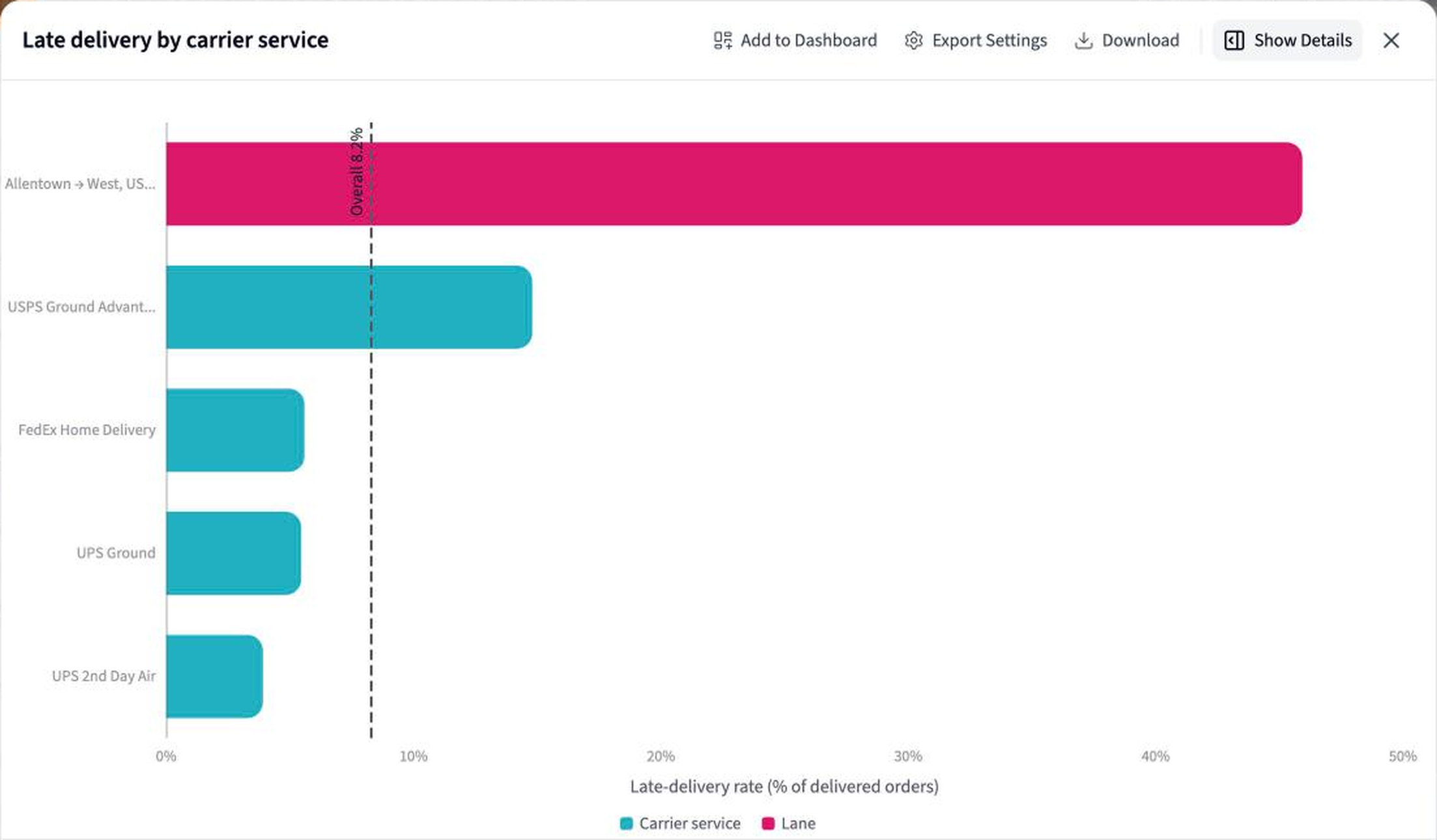
In the sample, warehouse-attributed tickets outnumber carrier-attributed tickets 210 to 55. Orders placed during a two-day warehouse backlog account for 137 of the week's tickets. That puts warehouse recovery ahead of a broad carrier switch on the leadership agenda.
Start by asking whether the fulfillment partner can clear the bottleneck through its existing recovery process, a change in order release, or different coverage around pickup. Each option has a different cost and a different chance of preventing the backlog from returning. The support budget alone will not tell you which to choose.
The 46.7 support hours tied to fulfillment and shipping make the opportunity concrete: fewer recurring order problems would give the team more room to handle growth, resolve difficult cases, and protect response times. That capacity has business value even when payroll stays the same. If the change reduces overtime or postpones an otherwise necessary hire, it also changes the cash commitment.
Keep customers covered during the recovery. Temporary support capacity can be the right bridge while you find out whether the extra demand persists.
Is growth getting more expensive to serve?
A larger queue alongside a larger business can be healthy growth. A rising contact rate on comparable orders is a reason to revisit the operating plan.
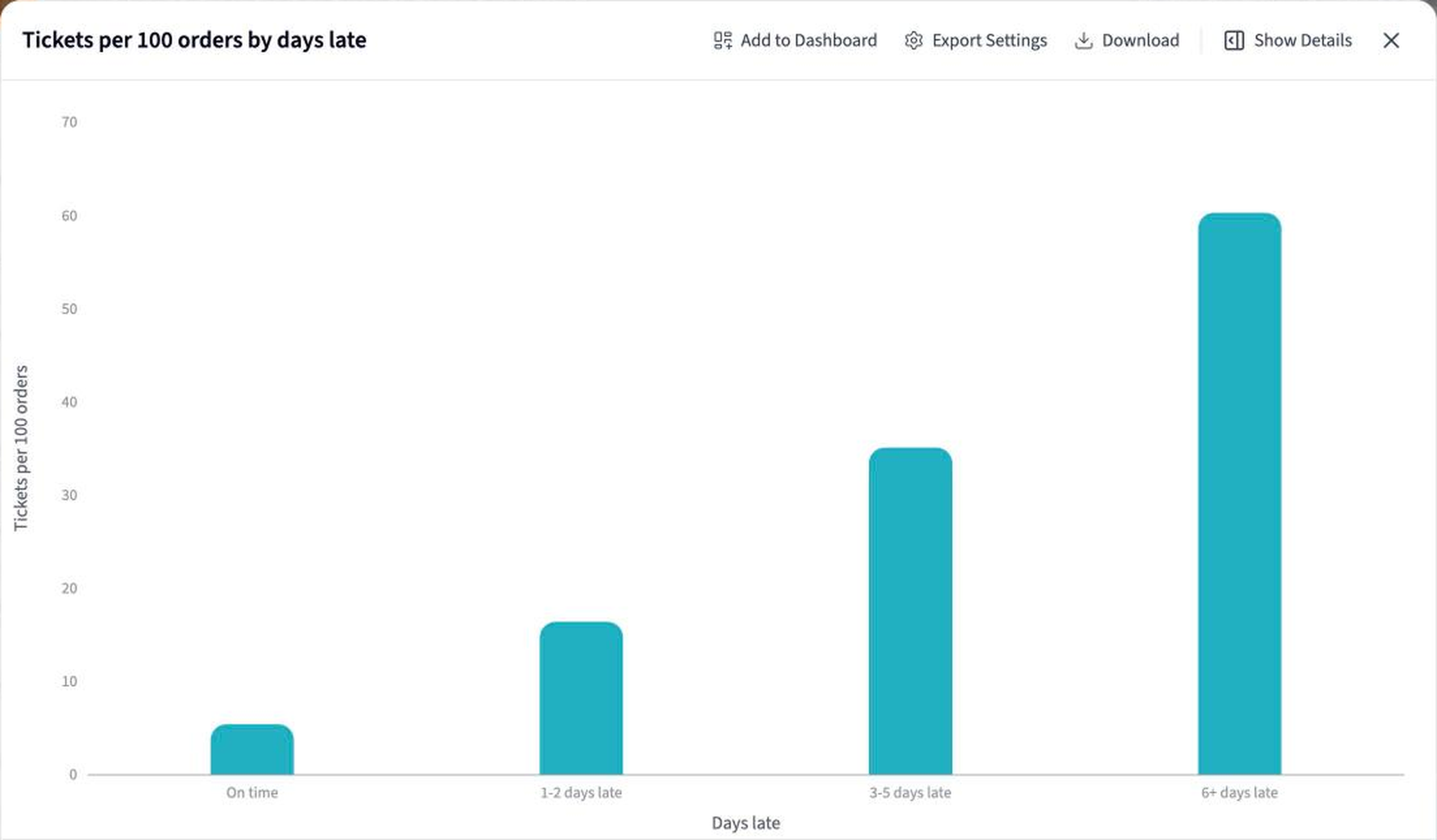
The playbook's sample shows how sharply support work increases with delivery delay:
View the sample figures
| Delivery outcome | Tickets per 100 delivered orders |
|---|---|
| On time | 5.4 |
| 1 to 2 days late | 16.4 |
| 3 to 5 days late | 35.1 |
| 6 or more days late | 60.3 |
Note: This measure counts tickets, including repeat contacts, rather than the percentage of customers who write in.
The leadership implication is clear: allowing delays to deepen exposes the support plan to substantially more work. Review contact rates alongside order growth, so an operational problem does not disappear inside an encouraging sales number.
With Querri, your team can save this analysis as a reusable project and rerun it on each week's exports, putting the answer on your desk every Monday without rebuilding the spreadsheet each time.
Fund the fixes that protect margin
The cheapest shipping label is only one part of the decision. Support time, refunds, and replacements also belong in the comparison. Ask for the expected change in total cost to serve on the affected orders.
For a separate, illustrative comparison, suppose a faster service adds $2 to 500 parcels: $1,000 in shipping spend. Preventing 100 ten-minute tickets at a loaded support cost of $30 an hour would recover about $500 worth of capacity. That comparison tells you to narrow the service test to the problem lanes, include any supported reduction in refunds and reships, and compare it with the warehouse options before approving a wider rollout.
Under the same illustrative assumptions, the sample's 137 backlog-linked tickets represent about 22.8 support hours, or $685 of capacity. If a change to order release or pickup timing prevents that work for less than its value, it earns its cost without adding a premium to every parcel.
The useful outcome is knowing which fixes deserve funding. An operational change that prevents a backlog and a shipping upgrade that rescues a particular lane can both have a place. Give each a budget, an owner, and an expected result; expand the changes that earn their cost.
Get ahead of next week's queue, then reassess the hire
The sample's 343 overdue, undelivered orders give the customer experience and operations leads an immediate recovery list. Prioritize the orders needing a delivery update, a carrier escalation, or another resolution. Leadership can approve a service-recovery approach while the larger operating fix is underway. Those orders represent exposure to further contacts, not a forecast of 343 tickets.
At the next Monday review, ask what changed for the orders affected by the fix. Did they leave on time? Did contacts and repeat contacts fall relative to comparable order volume? What happened to support hours, refunds, replacements, and the added operating spend?
Give those orders time to arrive and generate contacts before judging the result. Keep response times and unresolved cases visible throughout. If recurring demand falls and service holds, you have evidence to revisit the permanent hire. If it persists, you have a clearer basis for funding the capacity the team needs.
Make Monday's decisions comparable week after week
You know what you promised customers. Your team knows what a support hour costs and who can resolve an order problem. Those business judgments give the numbers their meaning. Bringing your knowledge to the review is what turns a ticket count into a decision about where to put people and money.
A recurring operating review lets you see whether growth is getting easier to serve and whether approved fixes are paying off. Agree on delivery promises and ownership rules once, then keep them consistent as the data updates. Flag changes in definitions so they do not look like changes in performance.
Querri's Library keeps your definitions and rules alongside the data, so your team can apply that knowledge to new orders each week. You bring the business judgment; Querri keeps the agreed analysis ready to use, so you can spend the meeting deciding what to fund and checking the result.
For the team building the weekly view, the orders-to-tickets playbook walks through each step.
If you want a funding decision on your desk every Monday, backed by the orders behind the ticket count, talk to us about running this review.
Tags