Querri vs Claude
Claude is one of the best AI models for analysis. Querri gives it your business to work from.
Use both. Querri connects to Claude in one click.
Claude can read your files, reach your apps and build a live dashboard from a sentence. Accurate answers on business data also need someone to decide what your numbers mean, and keep that current. Querri is the question-first data platform: it starts from the questions your business asks and builds what's needed to answer them, then answers inside Claude too.
Time, cost and control
Keep Claude, and give it the numbers your business agrees on
Claude is a strong assistant that many teams already pay for. Querri is the shared understanding of your business that it answers from. Here's what that difference means for the business.
-
Right answers without a data team
Anthropic gets about 95% accuracy on its own business questions with a semantic layer, skill files and evals its data team maintains. In Querri, the people who know the business teach it in plain language.
-
A bill you can plan, with no surprises
A Claude seat is inexpensive; the cost is the people who keep its context current, and the tokens every rerun uses. Querri is one predictable bill: a monthly credit allowance tied to the work your team does, alerts before you reach it, and no automatic overage charges.
-
The same understanding for everyone
When two people ask about revenue, the same definition applies, whether they ask in Querri, on a dashboard or in Claude.
-
Secure, auditable, nothing to rip out
SOC 2 Type II, HIPAA and ISO 27001:2022, and your data never trains a model. Every number shows its query, and Claude stays where your team already works.
Where each one fits
Most teams should use both. Here's what each one is for.
We'd rather you pick the right tool than pick us for the wrong reason. Claude on its own is the right answer for plenty of work.
Claude on its own is enough when
- You want a general assistant for writing, research, code and analysis, not only data questions.
- Your questions are one-off: a spreadsheet to explore, a file to summarize, a quick chart.
- You have a data team that maintains a warehouse, a semantic layer, skill files and evals, the way Anthropic's own team does.
- Your analysts work in code and want Claude Code writing SQL and Python against the warehouse.
- Your data already sits in one well-modeled warehouse, or in one system with a strong connector.
Add Querri when
- The same KPI has to mean the same thing to every person and every AI assistant.
- Your data is spread across CRM, accounting, payments and spreadsheets, with no warehouse in between.
- The people who know what the numbers mean aren't engineers, and shouldn't have to write skill files to say so.
- Dashboards and reports go to people without a Claude seat, or to your own customers.
- You want Claude to stay the front end, answering from your company's definitions.
Feature by feature
The detailed comparison
Every row says where each one is stronger. Where Claude wins, we say so. Facts are current as of October 2026 and linked in the sources.
Claude prices are US list from claude.com/pricing as of October 15, 2026, before tax. Anthropic says prices and usage limits may change at its discretion. The Claude Code comparisons are Querri's own benchmark runs.
Pricing
The seat is the cheap part. Keeping the answers right is the work.
Claude's seat prices are fair, and many teams already pay them. On business data, the bigger cost is the knowledge around the model: definitions, skill files and evals someone keeps current, plus the tokens each fresh answer uses.
How Claude is billed
- Pro is $20 a month ($17 billed annually). Max starts at $100, with 5x or 20x Pro's usage.
- Team Standard is $25 a seat ($20 annually) and Premium $125 ($100), for 2 to 150 seats, with up to $500 a month in pooled API credits.
- Enterprise is $20 a seat billed annually, with a 20-seat minimum, plus usage at API rates. Admins set user and organization spend limits.
- Usage limits reset on a rolling five-hour window, paid plans add weekly limits, and Anthropic may add other caps "at our discretion."
- Claude Dashboards count toward your plan's usage. A warehouse it queries bills its own compute.
- Every rerun is worked out fresh. Anthropic's own review step added 6% accuracy "at the cost of 32% more tokens and 72% higher latency."
When per-seat pricing is the better deal
If your team mostly needs a strong assistant for writing, research, code and one-off analysis, a Claude seat is excellent value, and you may already have it. If you also have a data team that keeps a semantic layer, skill files and evals current, Anthropic's own results show how far that can go: about 95% accuracy on its business questions. If that's your team, the guides below are where to start.
What it takes to keep answers right
Using Claude for data? Build the foundation first.
If Claude is your data tool, these are Anthropic's own guides to accurate answers and safe sharing. Follow them and Claude can do a lot.
- How Anthropic does self-service analytics Canonical datasets, a semantic layer, skills, evals and upkeep, from its data team. Anthropic (vendor)
- Learn how skills work Skills package your methods; owners can provision them to everyone. Claude Help Center
- Deploy a data agent in Slack How Anthropic scopes access for Claude Tag, its shared analytics agent. Anthropic (vendor)
- Get started with Claude Dashboards Sources, sharing, admin settings and what counts toward usage. Claude Help Center
- Keep MCP token use down Anthropic Engineering on code execution with MCP, and why tool calls add up. Anthropic Engineering
- Read the data policies Training defaults and retention for commercial and consumer plans. Claude Code docs
How Querri keeps the bill predictable
- One bill, no surprises. One plan for the whole organization, with the AI, storage and unlimited dashboard viewers included. See plans and pricing.
- One simple credit. A credit is a unit of business work, like answering a question or syncing a source, so usage is easy to understand and easy to plan for.
- Unlimited dashboard viewers on every plan. Viewing, uploads, exports and the Library never cost credits.
- Usage alerts at 80% of the plan, when it's over and on a spike, plus a monthly limit for any person.
- No automatic overage charges. We tell you as you approach your limit, and you decide what happens next.
- Saved answers aren't redone. Reusing one was 4.6x faster than Claude Code, with 2.8x fewer tokens, at 6.1x lower cost.
Total cost
What it takes to get a trusted answer
A first answer from Claude takes minutes. An answer the whole company can rely on takes the work Anthropic's own data team describes. Here's that path, next to Querri.
The seat figure is our arithmetic from Claude's published Team prices, not a quote. People costs depend on your team; if a data team already maintains Claude's context, that's a cost you've already chosen.
Built in, not assembled
Everything between your data and the answer, in one product
On the do-it-yourself path, these are things someone builds around Claude and keeps current. In Querri they're one chain: new data rebuilds the views on it, KPIs recompute and every dashboard refresh replays its saved query, so any number traces back to its source, and Claude reads from all of it.
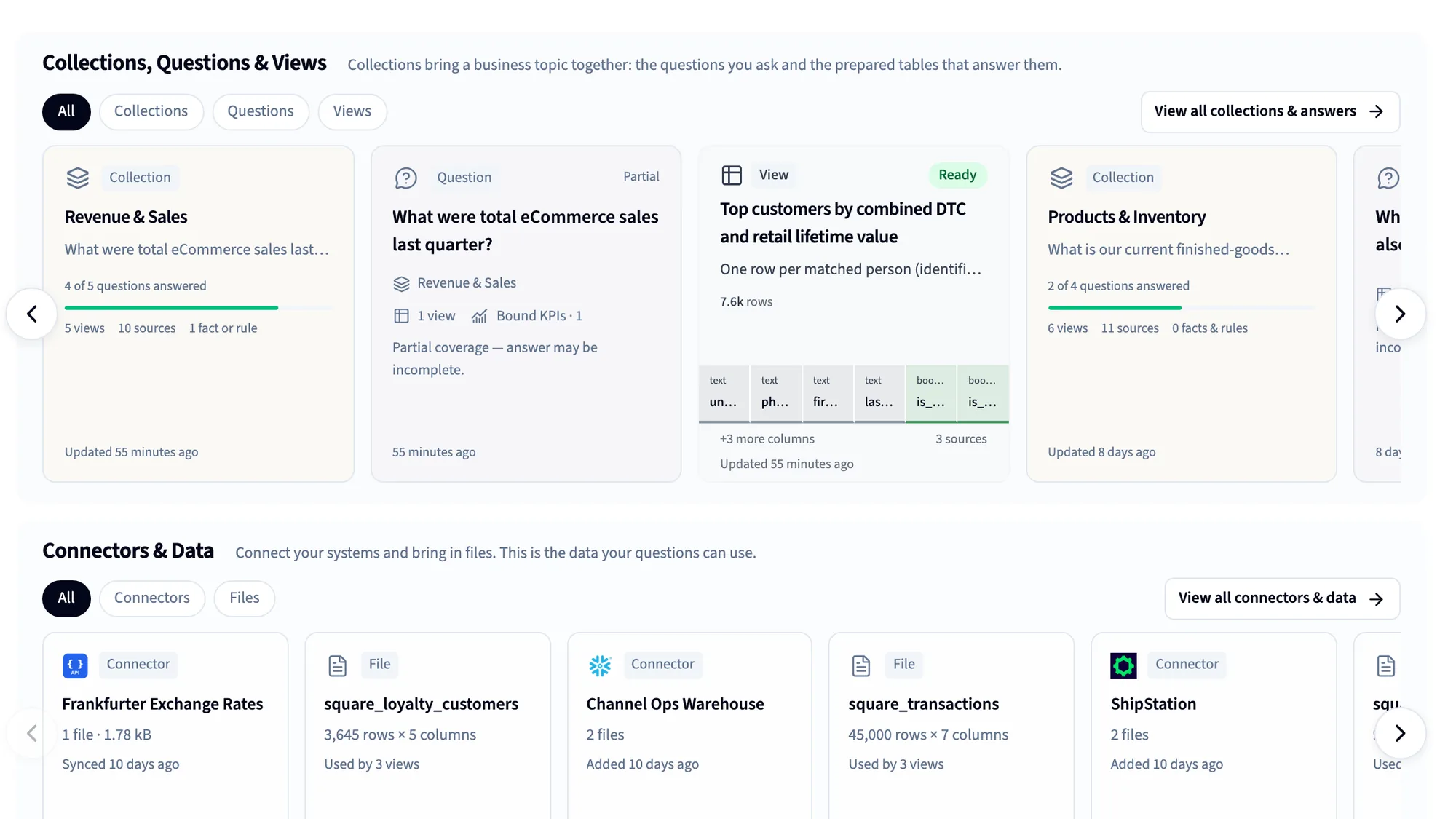
125+ connectors
CRM, accounting, ERP, payments, ads and databases, plus spreadsheets and files.
Automatic data cleaning
More than 180 checks on every table, and the Janitor to fix what they find.
The Library
A business-first semantic layer: definitions, KPIs and rules, taught by saying them.
Dashboards
Built by asking or from a screenshot, shared with unlimited viewers.
Nightly insights and Monitors
Querri works through your data overnight and shows what changed.
MCP for Claude and ChatGPT
Every assistant answers from the same definitions, under each person's access.
Reports and Excel
Scheduled projects, formatted workbooks and decks, delivered for you.
White label and embed
Bring the same understanding inside your own product, under your brand.
Using both
How Claude and Querri work together
Plenty of teams will run both, and we'd recommend it. Keep Claude as the place people write, research and ask. Connect Querri in one click, and Claude answers business questions from Querri's Library, under each person's own access.
Keep in Claude
- Writing, research and code
- A quick look at a one-off file
- Asking questions where you already work
- Claude in Excel, PowerPoint and Slack
Do in Querri
- Definitions the business owns, in plain language
- Data from every system, cleaned and joined
- Dashboards for everyone, with unlimited viewers
- Nightly insights and scheduled reports
How the connection works
-
In Querri, Connect to Claude opens Claude with the connector filled in, and Add for the whole organization installs it across a Claude Team or Enterprise account.
-
Claude signs in as the person, so every answer follows that person's access in Querri, including row-level access policies.
-
Questions go to the same Librarian the Querri app uses, so Claude answers from your definitions, and dashboards, charts and tables appear as cards in the chat.
-
MCP access is on every plan, including Free, and your data is never used to train any model.
FAQ
Questions people ask when comparing Querri and Claude
Is Querri an alternative to Claude?
Not really, and we don't suggest dropping Claude. Claude is a general assistant for writing, research, code and analysis. Querri is the shared understanding of your business data: connections, cleaning, definitions, dashboards and nightly insights. Most teams use both, with Querri connected inside Claude.
How much does Claude cost for a business?
Claude Team is $25 a seat a month, or $20 billed annually, for 2 to 150 seats; Premium seats with 5x the usage are $125, or $100 annually. Enterprise is $20 a seat billed annually, with a 20-seat minimum, plus usage at API rates. For 50 people on Team, that's about $12,000 to $15,000 a year in seats (our arithmetic). Querri is one predictable plan for the organization; see current plans.
Can Claude analyze my business data?
Yes. Claude can analyze uploaded files with code, query connected apps and warehouses, and build dashboards. Accuracy on company-wide questions depends on the business context it has. Anthropic's own data team found Claude "didn't exceed 21%" on its internal analytics evals without skills, and was consistently above 95% with a maintained semantic layer, skills and evals.
Can Claude build dashboards?
Yes. Claude Dashboards, in beta since October 8, 2026 on Pro, Max, Team and Enterprise, builds live dashboards over a warehouse or a connected app, and you can click any number to see its query. Anthropic positions it for quick, exploratory questions. Querri dashboards are built by asking or from a screenshot, run on your Library's definitions and have unlimited viewers.
Why does Claude give different numbers to different people?
Usually because the question leaves room. If revenue, an active customer or a fiscal quarter isn't defined somewhere Claude reads, each chat makes its own reasonable choice. And on a shared Claude dashboard, each viewer's own connections run the queries, so access can differ. Querri keeps one definition in the Library and tells you when a question has more than one reasonable reading.
What are Claude skills, and do I need them for data analysis?
Skills are folders of instructions, scripts and resources that Claude loads for specialized tasks, and they're available on every plan with code execution turned on. For analytics, Anthropic's team uses them to encode its data model and conventions, and says they need active maintenance because the data model keeps changing. In Querri, the same knowledge lives in the Library and is taught by saying it.
Does Claude train on my company's data?
On Team and Enterprise, Anthropic says there's no model training on your content by default, and Enterprise adds custom retention controls. On Free, Pro and Max, training is your choice in settings. Querri never trains a model on your data, on any plan.
How do I connect Querri to Claude?
In Querri, choose Connect to Claude, which opens Claude with the connector filled in, or Add for the whole organization to install it across a Claude Team or Enterprise account. Claude then answers business questions from your Library, under each person's own access, and shows dashboards and charts in the chat. It works on every Querri plan, including Free.
Is Claude or Querri better for a small business?
For general work and one-off questions about a spreadsheet, a Claude Pro or Team seat is great value. When the same numbers need to mean the same thing every week across QuickBooks, your CRM and your payment system, and nobody on the team writes SQL, Querri does that work. Many small businesses run both, starting on Querri's free plan.
Can Claude connect to my CRM, accounting system or warehouse?
Yes. Claude's directory lists 963 connectors, and Claude Dashboards connect to warehouses such as Snowflake, BigQuery, Databricks, Redshift and ClickHouse. Each connector reads its own system when you ask. Querri syncs 125+ sources into one Library on a schedule, so one question can span them.
Claude Code or Querri for analytics?
Claude Code is excellent for analysts and engineers who want to write SQL and Python against a warehouse. In our benchmark, measured against the source data, Querri got 97% of ambiguous questions right versus 80% for Claude Code, and reusing a saved answer was 4.6x faster, with 2.8x fewer tokens, at 6.1x lower cost than Claude Code. Querri is built for people who want the answer without writing the code.
Do people need a Claude seat to see a Querri dashboard?
No. Querri has unlimited dashboard viewers on every plan, including Free, and viewers don't need access to your source systems. People who do use Claude can see the same dashboards inside their chat through Querri's MCP connection.
Can I try Querri on my own data first?
Yes. You can start on the free plan with no credit card, connect a source and ask. See plans for what each includes. Or bring your hardest question to a 20-minute walkthrough, and ask it in Querri and in Claude side by side.
Sources
Where these facts come from
Checked October 15, 2026. Anthropic updates Claude's plans and features often; if something here is out of date, tell us and we'll fix it.
- Claude plans and pricing (seats, usage limits, Enterprise minimum, training defaults) Anthropic
- How Anthropic enables self-service data analytics with Claude (21%, 95%, 65%, skill upkeep, review cost) Anthropic (vendor), Jun 2026
- Self-service data analytics in Slack: how Anthropic deploys Claude Tag Anthropic (vendor), Aug 2026
- Build live dashboards and animate explainers with Claude Anthropic, Oct 8, 2026
- Get started with Claude Dashboards Claude Help Center
- Claude can now build your dashboards (Anthropic spokesperson on sharing and permissions) The New Stack, Oct 2026
- What are skills? Claude Help Center
- Claude connectors directory (963 connectors) Anthropic
- Uploading files to Claude (file limits) Claude Help Center
- Claude release notes (scheduled tasks, memory, Claude Tag, API credits) Claude Help Center
- What certifications has Anthropic obtained? Anthropic Privacy Center
- Data usage and retention (Claude Code) Claude Code docs
- Code execution with MCP Anthropic Engineering, Nov 2025
- Can you build a dashboard with Claude or ChatGPT? Toucan (sells embedded analytics), Sep 2026
- Querri pricing Querri
- Predictable credit use Querri docs
Keep Claude. Give it your business.
Connect a system or drop in a spreadsheet, tell Querri what your numbers mean, then ask the same question in Querri and in Claude. If Claude on its own is the better fit, we'll tell you.