Which customers are paying late, and how long will our cash last?
Join Stripe invoices, NetSuite cash, Salesforce renewal dates and your budget. See who pays late and how late, then run your cash runway as invoiced and as customers actually pay.
Open QuerriWhat you'll need
Querri (Free trial) to join the exports and run the forecast
Stripe, NetSuite, Salesforce and budget exports: Step 1 says what each adds
Your forecast rules: so both runways are built the same way
Free resources
Start your free trial here →Sample data sets
Synthetic data for a made-up software company. Not real customer data.
Need help?
If you have any questions, you can request a demo or email our team.
Before we begin
Every board meeting comes back to the same question: how long will the cash last? Most runway models assume customers pay on the due date, because that's what the billing schedule says. Some customers pay weeks late, every time, and the model never hears about it. The invoices are in Stripe, the cash in NetSuite and the spending plan in a workbook, so building the honest version means rebuilding the model by hand.
This playbook finds who pays late and how late, forecasts collections the way customers actually pay, and runs the runway both ways.
How it works:
- • Upload Stripe, NetSuite, Salesforce and the budget
- • Find who pays late, and how late
- • Forecast collections as customers pay
- • Run the cash runway two ways
- • Build the call list for the week
Follow the steps
Upload NetSuite, Stripe, Salesforce and the budget
Four exports, one project:
- •
Stripe invoices (or Maxio, Chargebee): every invoice with its due date, paid date and failed attempts.
- •
NetSuite (or QuickBooks): the cash balance at month end.
- •
Salesforce (or HubSpot): renewal dates and the owner of each account.
- •
Budget workbook (Excel): planned spending by month.
Add your forecast rules in a small sheet, so it's easy to change. Prefer live data? Querri connects to NetSuite, Stripe and Salesforce directly.
Tip: Pull at least a year of invoices, so every annual customer has paid at least once.
-
 Stripe invoices
-
 NetSuite cash
-
 Salesforce accounts
-
 Budget workbook
 One project
Find who pays late, and how late
Age the overdue invoices, and give every customer a lateness from its own history:
"Show overdue invoices by age and by customer, and each customer's median days past due on the invoices they've paid since January 2025. How do failed card payments recover?"
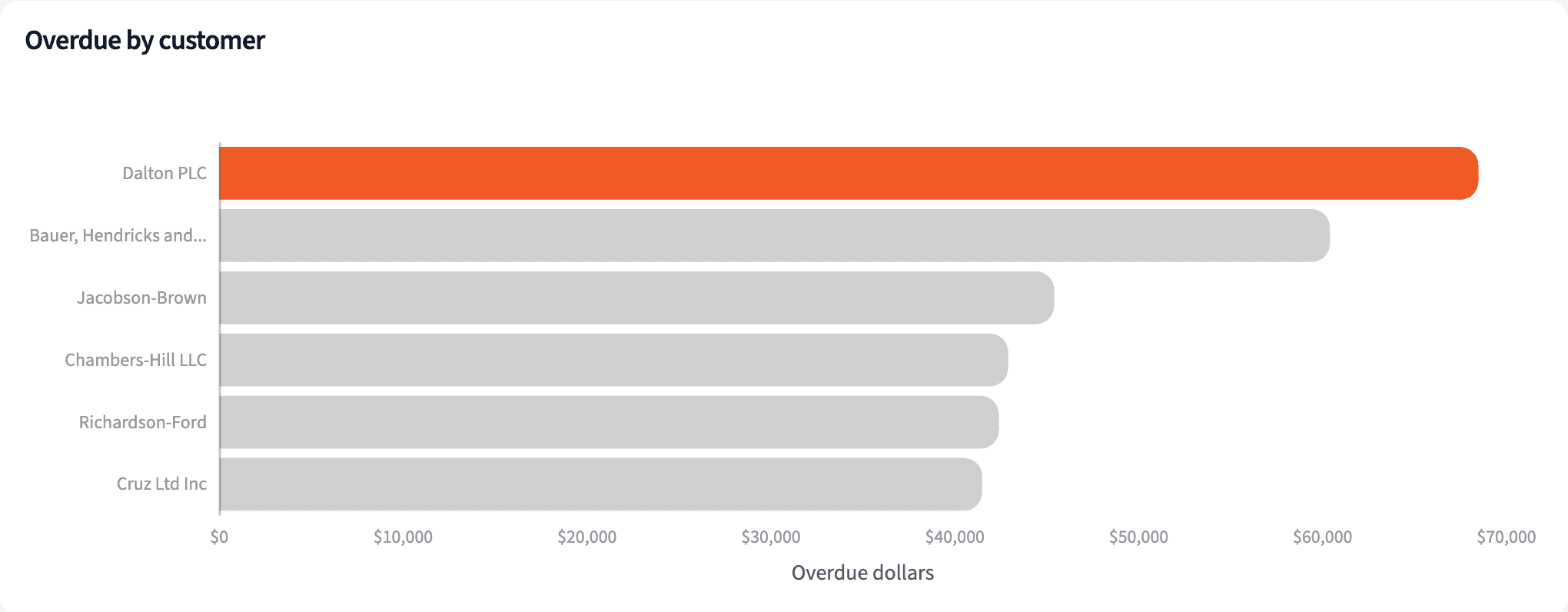
Five customers hold 69% of the overdue money, and each has a history of paying late. 71 of 84 failed card invoices were collected within two weeks; 13 never were.
| Days past due | Invoices | Overdue |
|---|---|---|
| 1 to 30 | 13 | $317,118 |
| 31 to 60 | 2 | $61,515 |
| Over 60 | 0 | $0 |
| Total | 15 | $378,633 |
Overdue invoices on July 5, 2026, by days past due.
Forecast collections the way customers actually pay
Schedule every open and repeating invoice twice: on its due date, and on its due date plus the customer's lateness:
"Forecast collections for July to December from open invoices and the last 12 months of invoices repeated a year later: once on the due date, and once on the due date plus each customer's usual lateness."
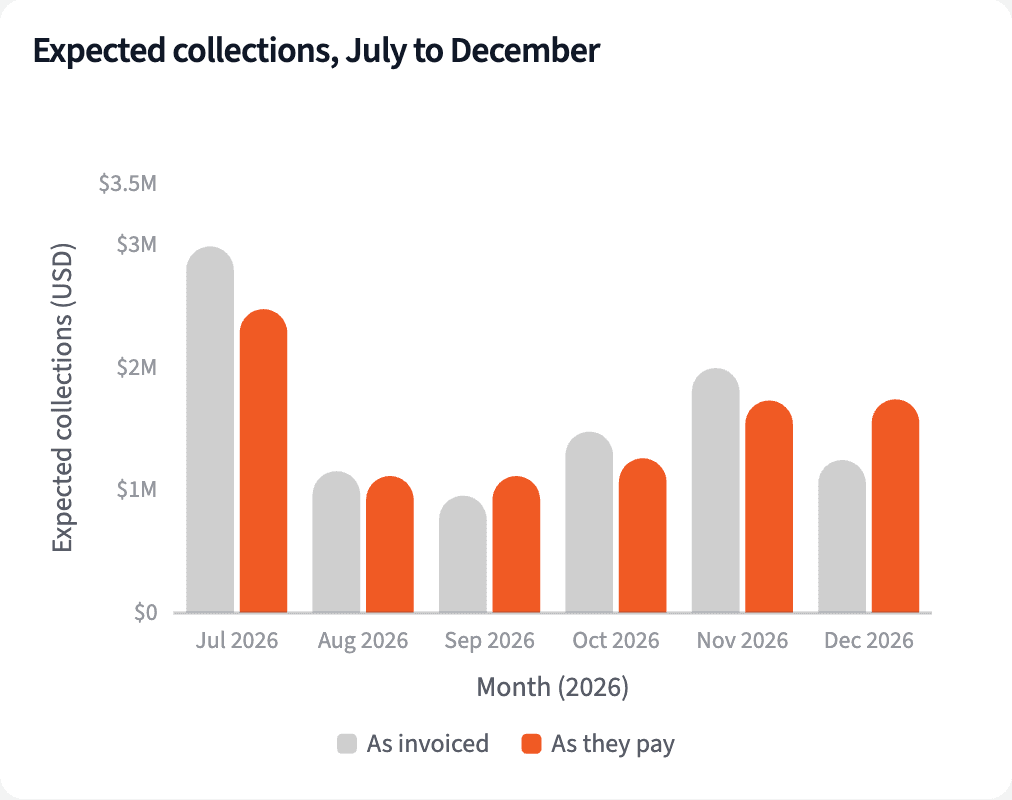
As customers actually pay, July to December brings in $377K less than the invoice schedule says. The money doesn't vanish; it arrives later.
| Month | As invoiced | As they pay |
|---|---|---|
| July 2026 | $2,983,661 | $2,472,565 |
| August 2026 | $1,152,057 | $1,112,406 |
| September 2026 | $952,016 | $1,112,207 |
| July to December | $9,796,949 | $9,419,697 |
Expected collections, as invoiced and as customers pay.
Run the cash runway two ways
Start from the NetSuite cash balance and spend the budget, month by month, both ways:
"Start from June's cash in NetSuite, add collections both ways and subtract the budget, held at December's level after that. Show cash at the end of September and the month cash runs out, both ways."
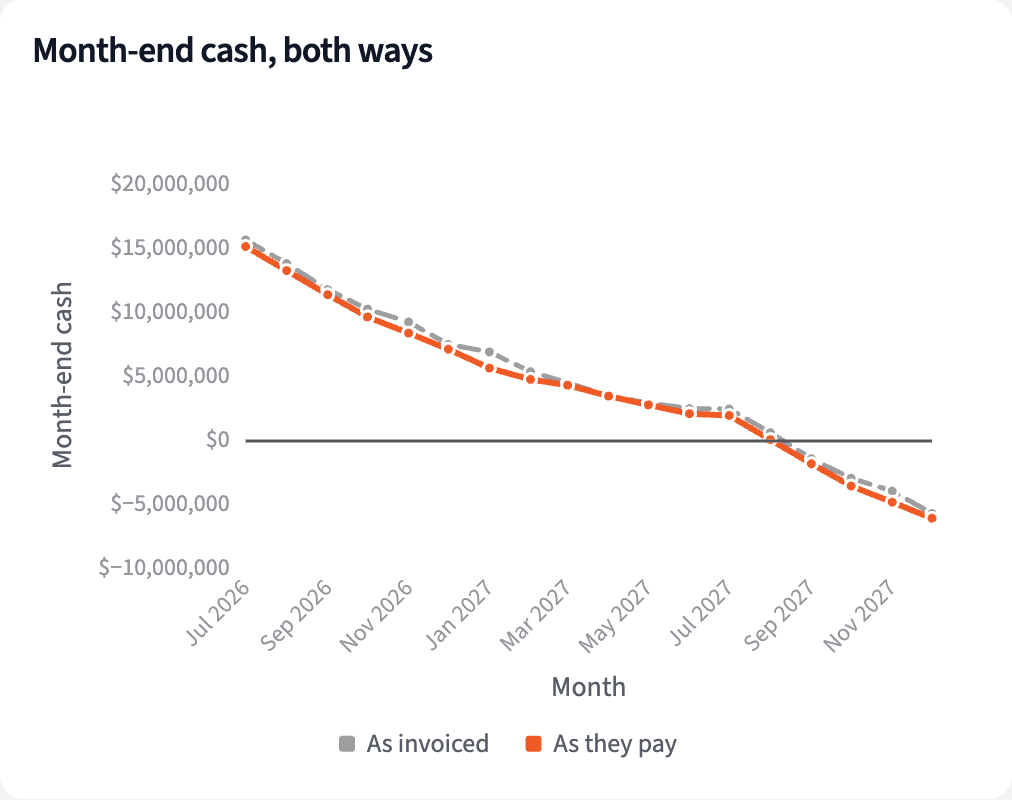
Paying late costs $390,555 of cash by the end of September and brings the month cash runs out forward from September to August 2027.
| Measure | As invoiced | As they pay |
|---|---|---|
| Cash at end of September 2026 | $11,682,755 | $11,292,200 |
| Cash falls below zero | September 2027 | August 2027 |
| Runway | 15 months | 14 months |
Cash runway from $15,568,406 on June 30, 2026.
Produce the cash review
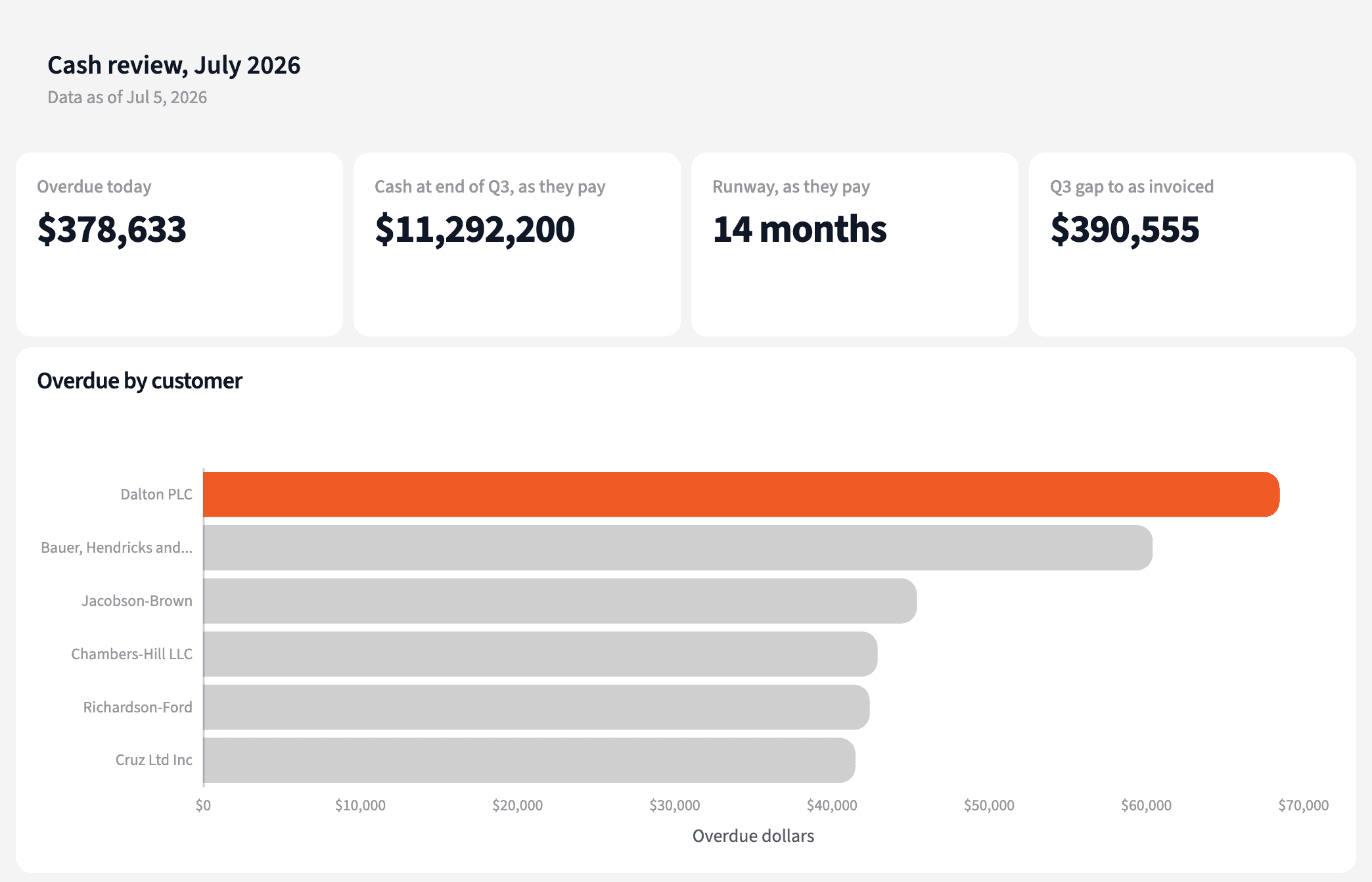
Four numbers for the board pack, and a call list for the week.
The narrative Querri writes:
A few customers who habitually pay late hold most of the overdue money, and their habits cost a month of runway.
What you can create or export:
- The call list, to Excel, CSV or Google Sheets
- A live dashboard that refreshes after each close
- A presentation for the board, to PDF or PowerPoint
| Customer | Overdue | Usually pays |
|---|---|---|
| Dalton PLC | $68,472 | 62 days late |
| Bauer, Hendricks and Hamilton | $60,400 | 43 days late |
| Jacobson-Brown | $45,400 | 28 days late |
| Chambers-Hill LLC | $42,900 | 23 days late |
The four largest overdue invoices on the call list.
Answer the runway question the way your customers actually pay.
Try it on your own dataTips for a cash forecast the board can trust
Forecast from history, not terms
Net 30 is what the contract says. Each customer's own median days late is what the bank account will see, so schedule collections with it.
Show both runways
As invoiced is the plan and as they pay is the evidence. Put them side by side and the gap becomes a collections target, not a surprise.
Teach Querri your rules once. Every answer after that follows them.
What counts as overdue, how lateness is measured, what spending to assume: say each rule once and Querri applies it to every question on that data.
Show me how
Say it in chat
Settle a rule in conversation and the Librarian records it as a fact under Facts & Rules, attached to the table it governs. Every later question on that data applies it, whoever asks, and every view built afterwards carries it.
"A customer's lateness is the median days past due on its paid invoices since January 2025, with early payments counted as zero. Save that as a rule for the Stripe invoices table."
Or bring the document that already says it
Upload your collections policy or month-end close checklist like any other file. Querri files a From a document card in the Inbox with the statements it found, each with its page and exact words; tick the ones to keep and they become facts. The rules this playbook depends on:
- Overdue: an open invoice past its due date
- Days past due: paid date minus due date, early counts as zero
- Lateness: a customer's median days past due since January 2025
- Future billing: the last 12 months of invoices, repeated each year
- As they pay: due date plus the customer's lateness
- Spending: the FY2026 budget, held at December after that
- Runway: months from July 2026 until cash falls below zero
"Read our collections policy and propose the rules it states about payment terms, dunning and when an account goes on hold. I'll review them in the Inbox."
Where the rules reach
A rule is attached to the data, not to one person's chat, so it follows the data everywhere:
- • Every question asked in chat, by anyone on the team
- • Every view the Librarian builds on that data
- • Every step of a project, including the code it writes
- • Dashboards and scheduled runs, each time they refresh
- • Claude and ChatGPT, when they ask Querri
You stay in control
Every rule is listed under Facts & Rules next to the data it governs, where you can edit or remove it. Rules from a document wait for your tick in the Inbox, and a Worth remembering card is how Querri offers one it noticed itself. Workspaces and roles decide who can change what. Company-wide rules go in Settings → Customize; the Library is where the rest lives.
The payoff at the board meeting
The runway question gets two honest answers and a list of the calls that close the gap. Changing the spending assumption is a sentence.
Frequently asked questions
What counts as overdue?
How is a customer's lateness measured?
Do failed card payments hurt cash?
What does as they pay mean?
Which is the right runway number?
How far ahead does the forecast look?
What spending does the runway use?
Who should get a call this week?
How often should this run?
Other popular resources
Playbook
Over budget, and why
Which departments are over budget this month, and why?
Playbook
Booked to billed
Did last quarter's closed-won deals start billing and get used?
Demo
Request a walkthrough
See Querri in action with your own data.
Pricing
Compare plans
Find the right plan for individuals, teams, or enterprise.