Which customers have outgrown what they bought?
Join product usage, Stripe seats and Salesforce owners and renewal dates. Find the customers using nearly every seat they pay for, see which already have an expansion deal open, and hand the rest to their owner before renewal.
Open QuerriWhat you'll need
Querri (Free trial) to join the exports and build the list
Product usage, Stripe and Salesforce exports: Step 1 says what each adds
Your outgrown threshold: so every customer is measured the same way
Free resources
Start your free trial here →Sample data sets
Synthetic data for a made-up software company. Not real customer data.
Need help?
If you have any questions, you can request a demo or email our team.
Before we begin
Sooner or later someone asks RevOps to pull a list of the accounts ready to grow. Usually it gets built from the CRM: big logos, recent wins, whoever the reps mention. Usage against what each customer pays for is the signal, and it sits in two other systems. The seats are in billing and the users are in the product data, so the list ends up built on whoever comes to mind.
This playbook measures every customer's seat use against what it pays for, checks the expansion pipeline against it, and hands each owner the customers to call.
How it works:
- • Upload usage, Stripe and Salesforce
- • Measure seat use for every customer
- • Flag the customers at the ceiling
- • Check them against open expansion deals
- • Hand each owner their list
Follow the steps
Upload BigQuery, Stripe and Salesforce
Four exports, one project:
- •
BigQuery (or Snowflake, Amplitude): who used which core feature, month by month.
- •
Stripe subscriptions (or Maxio, Chargebee): the seats each customer pays for today.
- •
Salesforce accounts (or HubSpot): owner, CSM, ARR and renewal date.
- •
Salesforce open opportunities: the expansion deals already in the pipeline.
Add your outgrown threshold in a small sheet, so it's easy to change. Prefer live data? Querri connects to Salesforce, Stripe and your warehouse directly.
Tip: Export the open opportunities with their type, so expansion deals can be told apart from renewals.
-
 Monthly usage
-
 Subscriptions
-
 Accounts
- Open opportunities
 One project
Measure seat use against what each customer pays for
Count the distinct users from June 1 to 28 and divide by the seats on the Stripe subscription:
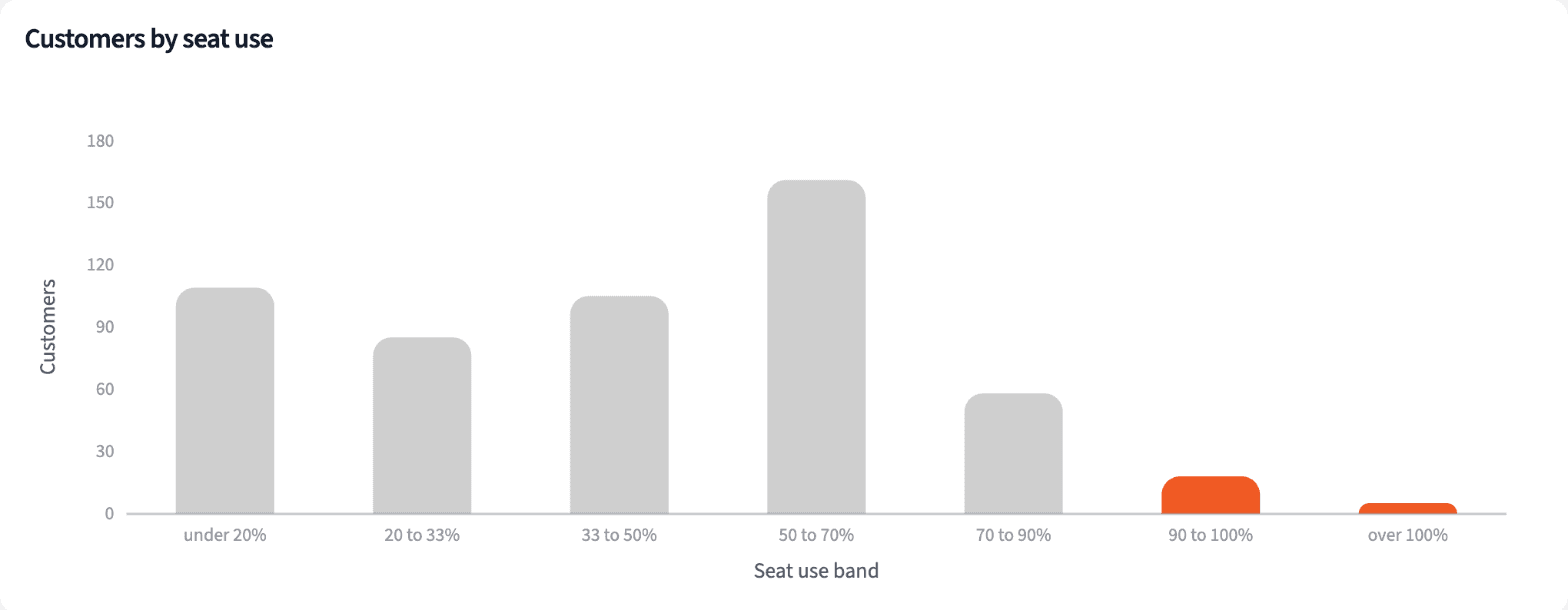
"For every customer with a Stripe subscription, divide the distinct users who ran a core feature from June 1 to 28 by the seats on the subscription. Show the median, and customers by seat use band."
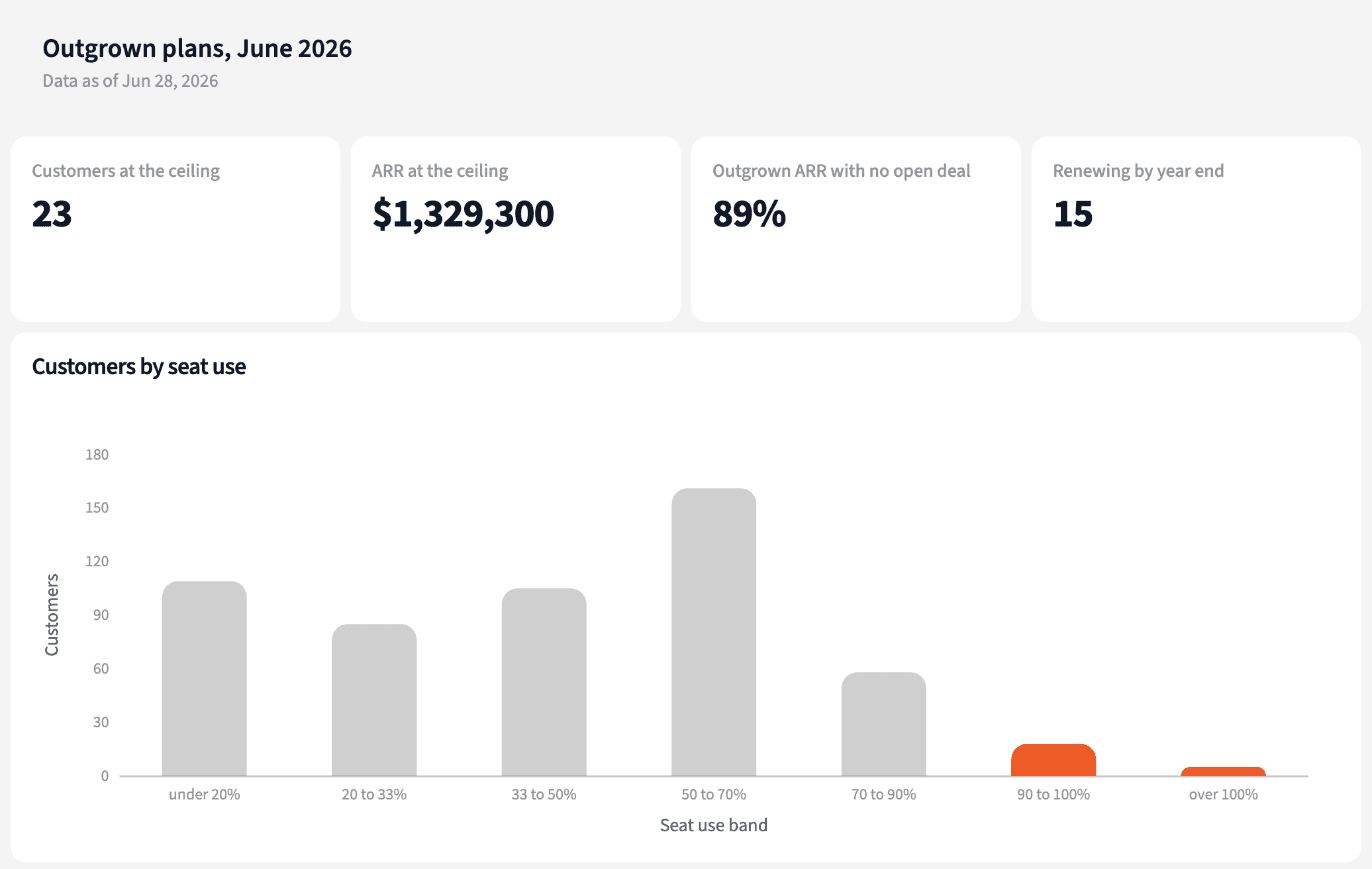
The median customer uses 45.5% of its seats. 23 customers sit at 90% or more, at the top of the chart.
| Seat use | Customers |
|---|---|
| Under 33% | 194 |
| 33 to 70% | 266 |
| 70 to 90% | 58 |
| 90% or more | 23 |
Customers by seat use, June 1 to 28, 2026, 541 with a subscription.
Flag the customers who have outgrown their plan
Flag 90% or more of seats active, and keep the customers over their seats as their own group:
"Which customers use 90% or more of the seats they pay for? Show their ARR, the ones with more active users than seats, and how they split by segment."
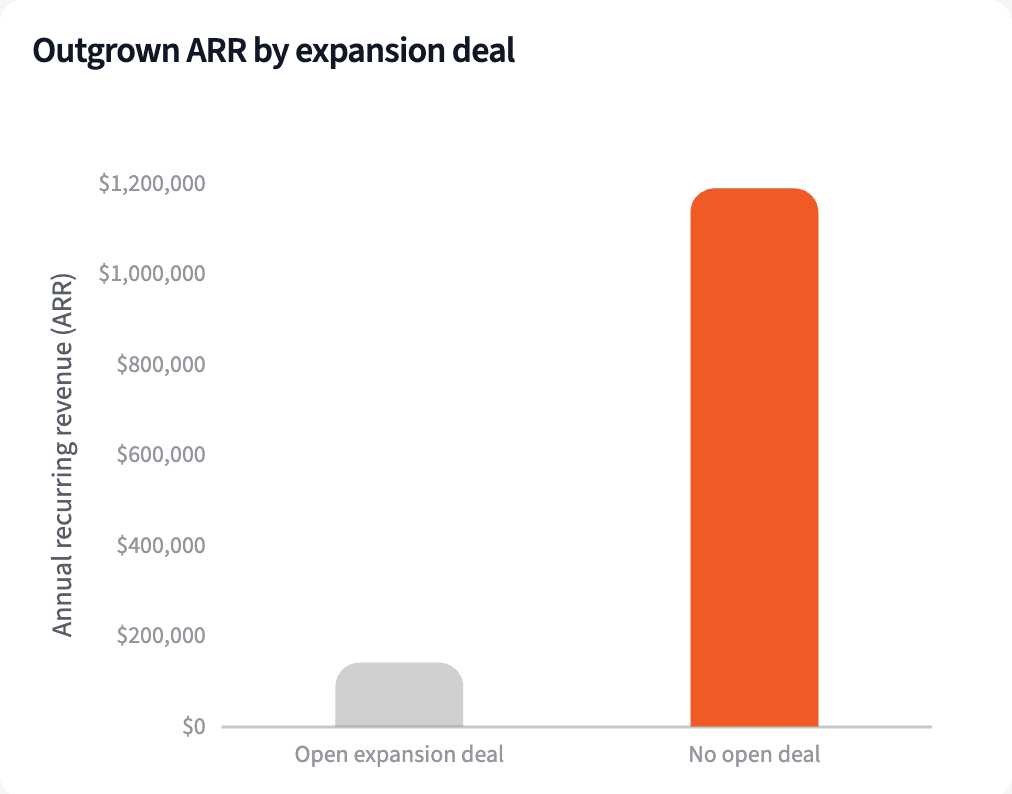
23 customers have outgrown their plan, with $1.33M of ARR. Five use more seats than they pay for.
| Segment | Outgrown | Customers |
|---|---|---|
| Enterprise | 12 | 162 |
| Mid-Market | 11 | 219 |
| SMB | 0 | 160 |
Outgrown customers by segment.
Check which ones already have an expansion deal
Compare the pipeline with the usage, both ways:
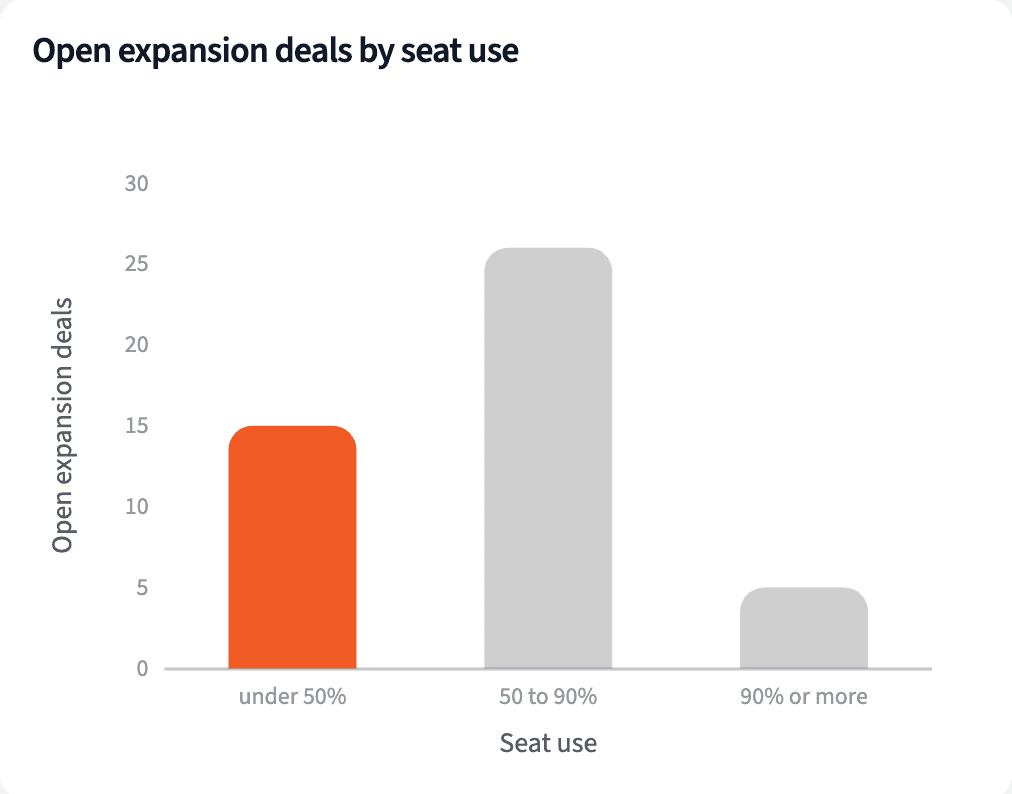
"Which outgrown customers have an open expansion deal in Salesforce, and which don't? And how many open expansion deals sit on customers using under half their seats?"
89% of the outgrown ARR has no expansion deal open. Meanwhile 15 open expansion deals sit on customers using under half their seats.
| Seat use | Open expansion deals | Amount |
|---|---|---|
| Under 50% | 15 | $167,594 |
| 50 to 90% | 26 | $357,319 |
| 90% or more | 5 | $48,375 |
Open expansion deals by the customer's seat use.
Produce the expansion list
Four numbers for the pipeline review, and a list of customers for each owner.
The narrative Querri writes:
The customers using nearly every seat they pay for are mostly missing from the expansion pipeline.
What you can create or export:
- The expansion list, to Excel, CSV or Google Sheets
- A live dashboard that refreshes every month
- A presentation, to PDF or PowerPoint
| Account | Seat use | ARR |
|---|---|---|
| Taylor, Tate and Velazquez | 96% | $175,500 |
| West Inc | 103% | $116,525 |
| Thompson-Robinson | 97% | $84,000 |
| Mason PLC | 100% | $65,000 |
Four of the outgrown customers with no expansion deal open.
Build the expansion list from what customers use, not who comes to mind.
Try it on your own dataTips for an expansion list sales will use
Measure against billing, not the CRM
The seats a customer pays for live in Stripe. Use them as the denominator, so a CRM field that drifted doesn't hide a customer at the ceiling.
Lead with the renewal date
Sort the list by renewal, not ARR. A customer renewing in September needs the conversation before one renewing next spring.
Teach Querri your rules once. Every answer after that follows them.
What counts as active, which seat count to use, what outgrown means: say each rule once and Querri applies it to every question on that data.
Show me how
Say it in chat
Settle a rule in conversation and the Librarian records it as a fact under Facts & Rules, attached to the table it governs. Every later question on that data applies it, whoever asks, and every view built afterwards carries it.
"Seat use is distinct users who ran Builder, Approvals or Reports in the month, divided by the Quantity on the customer's Stripe subscription. Save that as a rule for the monthly usage table."
Or bring the document that already says it
Upload your expansion playbook or account planning guide like any other file. Querri files a From a document card in the Inbox with the statements it found, each with its page and exact words; tick the ones to keep and they become facts. The rules this playbook depends on:
- Active user: ran Builder, Approvals or Reports in the month
- Seats: the Quantity on the customer's Stripe subscription
- Seat use: active users divided by seats, for June 1 to 28, 2026
- Outgrown: seat use of 90% or more
- Over seats: more active users than seats
- Open expansion deal: an open opportunity of type Expansion
- Renewing: Renewal Date from July to December 2026
"Read our expansion playbook and propose the rules it states about seat limits, when an account is ready to grow and who owns the conversation. I'll review them in the Inbox."
Where the rules reach
A rule is attached to the data, not to one person's chat, so it follows the data everywhere:
- • Every question asked in chat, by anyone on the team
- • Every view the Librarian builds on that data
- • Every step of a project, including the code it writes
- • Dashboards and scheduled runs, each time they refresh
- • Claude and ChatGPT, when they ask Querri
You stay in control
Every rule is listed under Facts & Rules next to the data it governs, where you can edit or remove it. Rules from a document wait for your tick in the Inbox, and a Worth remembering card is how Querri offers one it noticed itself. Workspaces and roles decide who can change what. Company-wide rules go in Settings → Customize; the Library is where the rest lives.
The payoff at the pipeline review
The review starts on customers already using everything they bought, not on a list pulled from memory. Moving the threshold is a sentence.
Frequently asked questions
What counts as outgrown?
Why measure seats in Stripe and not the CRM?
How can a customer use more seats than it pays for?
Does high seat use mean the customer will expand?
Why check the expansion pipeline against usage?
Why look at renewal dates?
What about customers paying for seats they don't use?
Who should call the outgrown customers?
How often should this run?
Other popular resources
Playbook
Booked to billed
Did last quarter's closed-won deals start billing and get used?
Playbook
Renewals below target
Which accounts renewing next quarter are below our usage target?
Demo
Request a walkthrough
See Querri in action with your own data.
Pricing
Compare plans
Find the right plan for individuals, teams, or enterprise.