Skip to content

Salesforce + NetSuite

Salesforce + NetSuite reporting,one number for sales and finance.

Ask what was booked, billed and collected, and get one answer that crosses your CRM and your ERP. Querri copies both into one Library on a schedule, matches accounts to customers, and follows the definitions your CRO and CFO agreed on.

Querri only reads from Salesforce and NetSuite and never changes a record. Your Salesforce password stays with Salesforce, and the Connector Agent never sees your NetSuite tokens. SOC 2 Type II, HIPAA and ISO 27001:2022 certified.

Why Salesforce + NetSuite reporting gets hard

Sales counts it in Salesforce. Finance counts it in NetSuite.

Both systems are right about their own half. The trouble starts when the CRO and the CFO ask the same question and each opens a different system.

01

There's no shared customer key

"Alder Health" in Salesforce is "Alder Health Group Ltd" under a UK subsidiary in NetSuite, and one parent account maps to three billing customers. Every report starts with someone's matching spreadsheet.

02

Booked, billed and collected are three numbers on three dates

A deal closes in September, invoices in October and is recognized over twelve months. Each date is correct, so each team's quarter is correct, and they still don't agree.

03

Currencies don't add up on their own

Deals are quoted in one currency and invoices post in the subsidiary's. A total that sums dollars, euros and pounds without converting looks fine and is wrong.

04

What you closed isn't what you kept

Credit memos, refunds, partial invoices and amended orders live in NetSuite. The closed-won amount in Salesforce never hears about them, so win reports overstate revenue.

05

The integration moves records, not answers

A connector or iPaaS sync can push orders from Salesforce into NetSuite. It doesn't tell you which deals went unbilled or why the totals differ, so both sides still export to Excel.

What you can finally answer

Eight CRM-to-ERP questions that used to need a reconciliation

Each is a question RevOps, controllers and the CRO/CFO pair ask every quarter, what stands in the way today, and how Querri answers it.

How much of last quarter's closed-won has been invoiced, and how much collected?

Why it's hard

Opportunities sit in Salesforce, invoices and payments sit in NetSuite's transaction tables, and the bridge between them is a manual match someone redoes every close.

With Querri

Querri follows each closed-won deal to its invoices and payments. Define booked, billed and collected once in Facts & rules and track the gap as a KPI that updates on every sync.

Which Salesforce accounts are which NetSuite customers?

Why it's hard

Names differ, subsidiaries split one buyer into several customers, and a parent account in the CRM may bill as five children in the ERP.

With Querri

Querri matches accounts to customers, says how it matched them and adds a caveat when a match could be off. State a pairing it got wrong as a rule in Facts & rules and every later answer follows it. See data cleansing.

Who were our biggest customers last year, across every subsidiary and currency?

Why it's hard

Revenue for one customer is spread across subsidiaries billing in USD, EUR, GBP and CAD. Add the amounts as they are and the ranking is meaningless.

With Querri

Querri checks the currency column before it adds anything up and tells you when a total blends currencies, instead of handing you a confident wrong number. See how Querri checks its work; the steps stay open in a project you can rerun.

Which deals we booked this quarter won't bill until next quarter?

Why it's hard

Close date is on the opportunity; invoice date and accounting period are in NetSuite. Seeing the timing gap means lining up two calendars by hand.

With Querri

Ask by close date, invoice date or accounting period and Querri says which calendar it used. Save the method as a skill so the next quarter's review runs the same way.

Which customers' net revenue dropped after credit memos and refunds?

Why it's hard

Credit memos post in NetSuite weeks after the win is celebrated in Salesforce. Nobody looks at them by account, so a shrinking customer goes unnoticed.

With Querri

Track net revenue per customer, and Nightly insights checks each one against its own history every night. A customer whose credits jump shows up in your Inbox the next morning.

Can the month-end bookings-to-billings pack build itself?

Why it's hard

Two exports, a mapping tab, a currency tab and a pivot: the same workbook is rebuilt by hand every month, and the formulas break when a row moves.

With Querri

Build the pack once as a project and put it on a schedule. Querri reruns it on fresh data and sends a formatted Excel workbook to finance and sales leadership. More on scheduled reports.

Which marketing channels bring customers who actually pay?

Why it's hard

The source is in HubSpot or on the Salesforce lead, the cash is in NetSuite, and the path between them crosses three systems and two matching problems.

With Querri

Connect HubSpot alongside Salesforce and NetSuite and follow a channel through to collected revenue, with a caveat wherever a match is uncertain. The channel-to-revenue playbook shows the steps.

Can our CFO ask Claude or ChatGPT about bookings vs. billings and trust it?

Why it's hard

An assistant pointed at two systems guesses which amount, which date and which currency to use, and gives a different answer each time.

With Querri

Link Claude or ChatGPT to Querri a single time. From then on the assistant answers from your Library with the agreed definitions and the account-to-customer mapping, under each person's access in Querri.

Salesforce + NetSuite plus the rest

Add the systems around the deal and the invoice

Bookings and billings are half the story. Store orders, budgets, FX rates and product usage sit elsewhere. Querri puts them in the same Library as your CRM and ERP, so a revenue question can reach all of them at once.

Salesforce + NetSuite pair well with

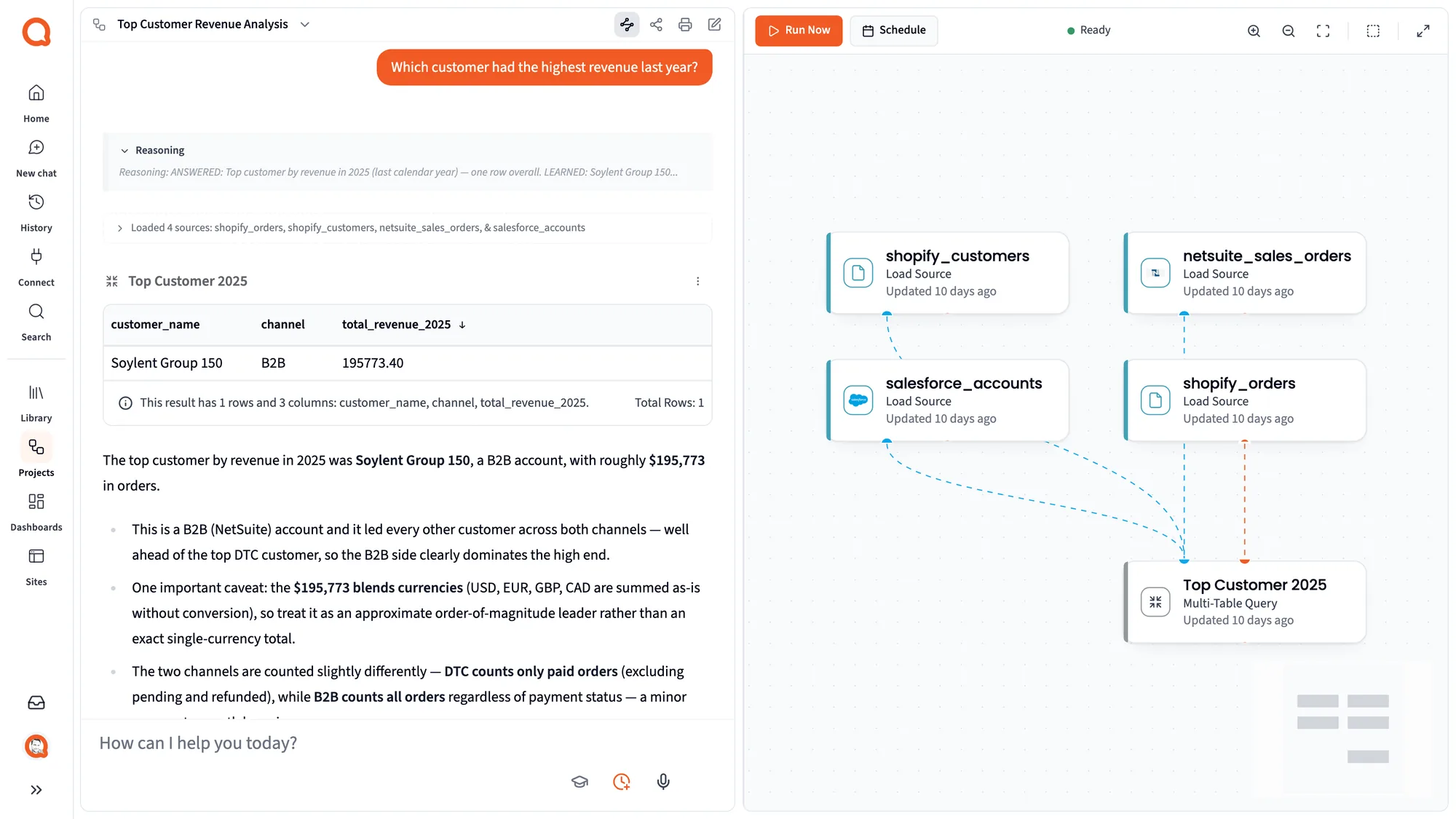
A Querri project joining salesforce_accounts, netsuite_sales_orders, shopify_customers and shopify_orders to find which customer had the highest revenue last year, with a caveat that the total blends USD, EUR, GBP and CAD without conversion
Salesforce, NetSuite and Shopify joined into one answer, and a warning you'd want: the total mixes four currencies without converting them.

Answers you can stand behind

"Revenue" means one thing to sales and another to finance. Querri tells you which it used.

Ask what EMEA sold in Q3 and there are two fair answers: deals closed in Salesforce, or invoices posted in NetSuite. Querri picks one, says which, and shows the other beside it, so the forecast call and the close meeting stop arguing past each other. See how answers work.

Wake up to what changed

Querri notices when billing falls behind bookings

Each night Querri compares bookings, billings and collections for every subsidiary with that subsidiary's own history, using arithmetic. Anything unusual is in your Inbox by morning, and nothing changes without your OK.

Custom Salesforce + NetSuite dashboards

One dashboard the CRO and the CFO can both read

Ask for a bookings-to-cash dashboard, or begin from a screenshot of the board pack you have today. Pipeline and invoices share one screen and one set of definitions, and a regional VP can be limited to their own region's rows.

  • Pipeline, bookings, billings and cash on one screen
  • Changed by asking, undone in one click
  • Each person sees only their own rows
Every change is a sentence. One request turns the Monthly Sales Review dark, and the undo is right there.

Reports you can stop rebuilding

Six Salesforce + NetSuite reports, built once

What comes over

Your CRM objects and your ERP tables, side by side

Pick the Salesforce objects and NetSuite tables that matter; each lands in your Library and refreshes on its own schedule. Each side can only sync what its connected user or role is allowed to see.

Among the defaults from each side

  • Account (Salesforce)
  • Opportunity (Salesforce)
  • OpportunityLineItem (Salesforce)
  • Contract (Salesforce)
  • Order (Salesforce)
  • Product2 (Salesforce)
  • User (Salesforce)
  • customer (NetSuite)
  • opportunity (NetSuite)
  • transaction (NetSuite)
  • transactionline (NetSuite)
  • transactionaccountingline (NetSuite)
  • item (NetSuite)
  • subsidiary (NetSuite)
  • accountingperiod (NetSuite)
  • currency (NetSuite)
  • Plus any Salesforce custom object the connected user can query

Both sides stay current

Incremental syncs read changed Salesforce records by LastModifiedDate and changed NetSuite rows by lastModifiedDate, as often as hourly. A daily, weekly or monthly full refresh drops rows deleted at either source.

Large orgs, full ledgers

Salesforce objects of 100,000 records or more load through the Bulk API 2.0. NetSuite tables are read with SuiteQL, 27 of them by default.

Read only, on both

Querri never creates, edits or deletes anything in Salesforce or NetSuite. It reads, and that's all.

Credentials out of sight

Salesforce uses its own sign-in. NetSuite token-based credentials go into a secure form; the Connector Agent only knows whether they're set.

How to connect Salesforce and NetSuite

Both systems connected in one conversation

  1. 1

    Tell the Connector Agent

    Open Connect and say "connect Salesforce and NetSuite." The agent plans both and works through them one at a time.

  2. 2

    Sign in to Salesforce

    Approve access on Salesforce's sign-in page for your production org. Your password stays with Salesforce.

  3. 3

    Add NetSuite tokens

    Enter your NetSuite token-based authentication details in the secure form, for production or a sandbox account.

  4. 4

    Approve tables and schedules

    Review the preselected Salesforce objects and NetSuite tables, then approve the load and how often each syncs.

  5. 5

    Ask across both

    Ask your first bookings-to-billings question. Querri says how it matched accounts to customers.

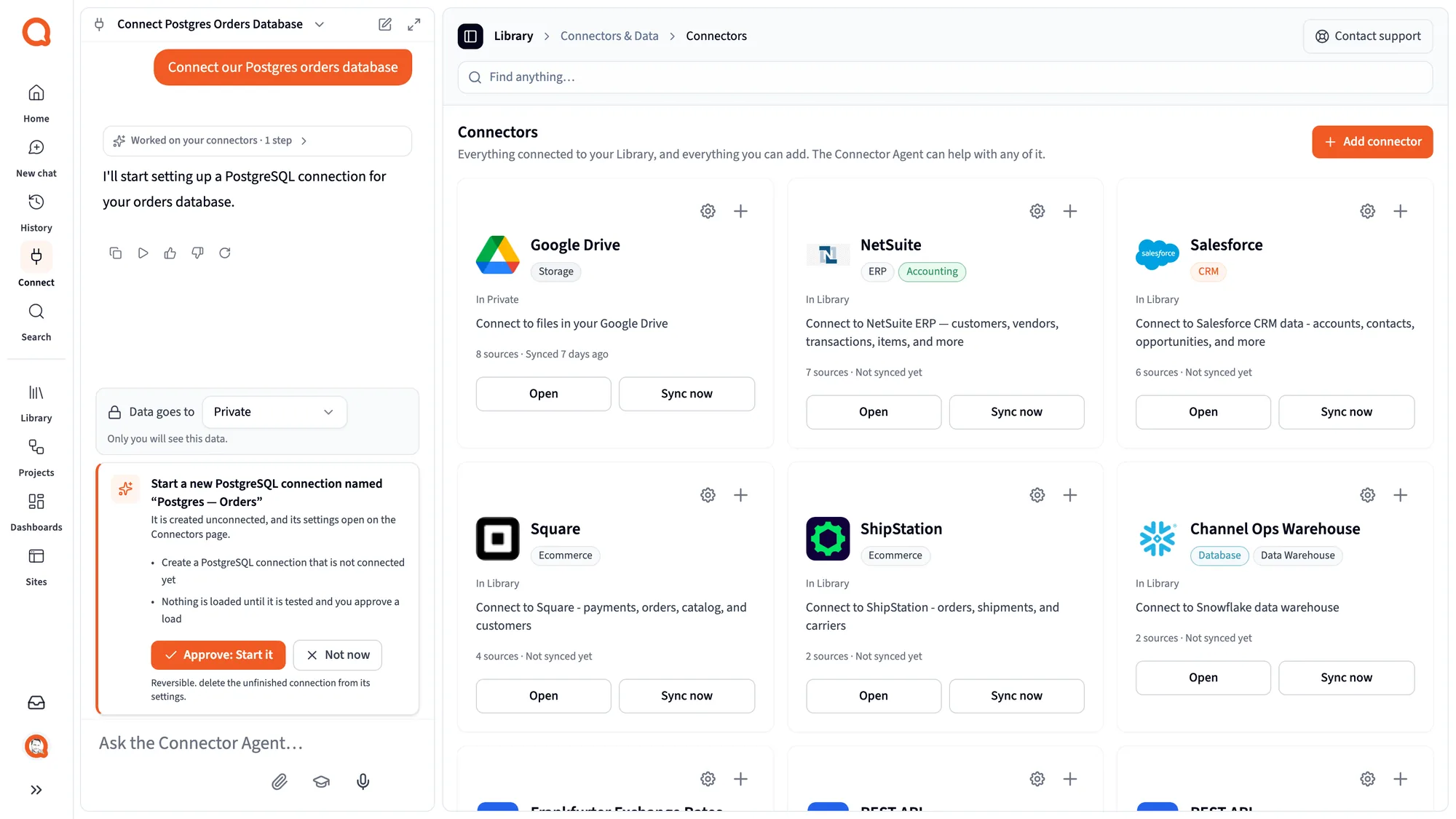
Querri's Connect page: the Connector Agent asks for approval before starting a connection, next to connector cards for Google Drive, NetSuite, Salesforce, Square, ShipStation and Snowflake
Nothing is created or loaded until you approve it in the Connector Agent.

Salesforce + NetSuite FAQ

Questions about Salesforce, NetSuite and Querri

How do I connect Salesforce and NetSuite to Querri?

Ask the Connector Agent in Querri to connect both, or pick each from the catalog. Sign in to Salesforce in its own window, then enter NetSuite token-based authentication credentials in a secure form the agent never sees. Approve the objects, tables and schedules, and both land in your Library.

What Salesforce and NetSuite data does Querri sync?

From Salesforce, 20 standard objects are preselected, including Account, Opportunity, OpportunityLineItem, Contract and Order, plus any custom object the connected user can query. From NetSuite, 27 tables come over through SuiteQL, including customer, transaction, transactionline, transactionaccountingline, subsidiary, accountingperiod and currency.

How often do Salesforce and NetSuite sync?

Incremental syncs can run hourly, daily or weekly and pick up records changed since the last run on each side. A full refresh can run daily, weekly or monthly and also removes rows deleted at the source, which incremental syncs don't see. You can start a sync manually whenever you like.

Does Querri write to Salesforce or NetSuite?

No. Querri only reads from Salesforce and NetSuite. It never creates, updates or deletes a record, an opportunity, a transaction or anything else in either system. Your answers run on a copy of the data inside Querri.

How do Salesforce and NetSuite permissions carry over?

They don't carry over person by person. Querri can sync only what the connected Salesforce user and NetSuite role can see, so choose those accounts carefully. Inside Querri, sharing and row-level access decide who sees which rows, and a person's row filter follows them into chat, dashboards, Claude, ChatGPT and the API.

How do I match Salesforce accounts to NetSuite customers?

Querri does the matching and says how it matched each account, with a caveat where a pairing could be off. When one is wrong, or a parent account bills as several subsidiary customers, say the correct pairing once in Facts & rules and every answer, dashboard and report follows it.

How do I get a bookings vs. billings report from Salesforce and NetSuite?

Connect both, agree on what booked and billed mean, and say it once in Facts & rules. Querri follows each closed-won opportunity to its NetSuite invoices, lists deals that are unbilled or billed short, and can send the report on a schedule as email or a formatted Excel workbook.

How do I get a cash collected vs. closed-won report?

Ask for it. Querri reads closed-won deals from Salesforce and payments from NetSuite's transaction tables, matches them through your account mapping, and shows collected against booked by region, rep or subsidiary. Track the gap as a KPI and its history builds from the day you start.

How does Querri handle multiple currencies across Salesforce and NetSuite?

Querri checks currency columns before it totals anything. If an answer would add USD, EUR, GBP and CAD together without converting, it says so in a caveat rather than presenting the sum as fact. Tell it which rates to use, from NetSuite or a sheet, and the rule applies everywhere.

How do I combine Salesforce, NetSuite and Shopify data?

Connect all three and Querri joins them in the Library: accounts and opportunities from Salesforce, sales orders and invoices from NetSuite, customers and orders from Shopify. You can rank customers by revenue across every channel, with a warning wherever matching or currencies could skew the result.

How do I combine Salesforce, NetSuite and HubSpot data?

Add HubSpot as a third connection. Querri links HubSpot contacts and companies to Salesforce accounts and on to NetSuite customers, so you can follow a marketing channel all the way to collected cash. Where a match rests on a weak signal, such as a different email domain, the answer says so.

Can I build a custom Salesforce + NetSuite dashboard?

Yes. Ask for a bookings-to-cash view in plain words, or hand Querri a screenshot of the board pack you use today. Pipeline, invoices and collections share one screen and one set of definitions, later edits are requests in chat, and a regional VP can be limited to their region's rows.

Can I ask ChatGPT or Claude about Salesforce and NetSuite data?

Yes. Link Querri to Claude or ChatGPT a single time and the assistant answers from your Library, using the agreed definitions of booked and billed and your account-to-customer pairings. Each person gets only the rows their Querri access allows, so the CFO's answer in Claude matches the finance dashboard.

Can I export Salesforce + NetSuite reports to Excel automatically?

Yes. Save the bookings-to-billings analysis as a project and put it on a schedule. After each sync Querri can rerun it and send a formatted Excel workbook, an email or a deck, with a separate version for each region, rep or client if you want one.

Can I connect a Salesforce sandbox or a NetSuite sandbox?

NetSuite sandbox accounts are supported, so you can try Querri on sandbox data first. Salesforce sandbox orgs are not supported today: Querri connects to Salesforce through its standard sign-in at login.salesforce.com, which reaches production orgs.

Does Querri sync NetSuite custom records?

Not today. Querri syncs NetSuite's standard tables through SuiteQL, including customers, transactions, transaction lines, items, accounts and subsidiaries, but not custom records. On the Salesforce side, any custom object the connected user can query can be added to the sync.

Is my Salesforce and NetSuite data secure in Querri?

Querri is SOC 2 Type II, HIPAA and ISO 27001:2022 certified, and your data is never used to train a model. You sign in to Salesforce directly, NetSuite tokens go into a secure form the Connector Agent can't read, and Querri only ever reads from either system.

Do we still need our Salesforce-NetSuite integration?

Yes, if you run one. An integration keeps orders and customers moving between the two systems so operations run. Querri reads both and answers questions across them, such as which deals went unbilled or why sales and finance totals differ, without changing a record on either side.


Get sales and finance looking at the same number.

Connect Salesforce and NetSuite in one conversation. Querri reads your data and never changes a record.