Querri vs Metabase
Metabase is the open-source BI developers love. Querri starts where your data actually lives.
Same dashboards. A different starting line.
Metabase is fast to stand up on a database you already have, and free if you host it yourself. It starts once your data is in SQL and someone has modeled it. Querri is the question-first data platform: it starts from the questions your business asks and builds what's needed to answer them, from your CRM, accounting and spreadsheets to the dashboard, in one product.
Time, cost and control
Answers from every system, a bill you can plan, and nothing to host
Metabase is a good window onto a database someone has already built. Querri is the path from your business systems to an answer. Here's what that difference means for the business.
-
Answers from the systems you run
Metabase starts once the data is in a SQL database. Querri connects HubSpot, Salesforce, QuickBooks, NetSuite, Stripe and spreadsheets directly, so you can ask the same day.
-
One bill that includes the data work
Metabase's license is modest. The pipeline, the database and the person who models it are billed somewhere else. Querri is one predictable bill: a monthly credit allowance tied to the work your team does, alerts before you reach it, and no automatic overage charges.
-
No servers and no analyst required
There's nothing to host, upgrade or back up. The people who already know the business decide what the numbers mean, in plain language, and every answer uses it.
-
Secure, auditable, nothing to rip out
SOC 2 Type II, HIPAA and ISO 27001:2022, and your data never trains a model. Every number shows its query, and if Metabase reads your PostgreSQL or MySQL database, Querri can connect to the same one.
Where each one fits
Pick by the team and the timeline you have
We'd rather you pick the right tool than pick us for the wrong reason. Here's where each one fits.
Choose Metabase when
- Your data already lives in PostgreSQL, MySQL or a warehouse, and someone on the team can model it.
- You want open source: free to self-host with unlimited users, code you can inspect, or an air-gapped install.
- You want live queries against your own database, with data that stays on your servers.
- Developers are embedding analytics in your product and want modular components, a React SDK and free guest embeds.
- Your team is technical and the budget is close to zero.
Choose Querri when
- Your data lives in business systems and spreadsheets, not one database, and the hard part is joining them.
- Nobody has time to build pipelines, model tables and keep a server patched.
- You want plain-language answers that check their own work and show the query behind every number.
- You want data cleaning, definitions, dashboards, reports, nightly insights and MCP in one product.
- You want a finished white-label product for your clients, not components to assemble.
Feature by feature
The detailed comparison
Every row says where each one is stronger. Where Metabase wins, we say so. Facts are current as of October 2026 and linked in the sources.
Metabase prices are US list from Metabase's pricing page and documentation as of October 15, 2026, monthly unless noted. Annual billing is about 10% less. Contract prices vary.
Pricing
A low license price, and the data work billed somewhere else
Metabase's pricing is published and fair: free if you host it, then a base fee plus a price per user in the cloud. The license is rarely the big number. The pipeline, the database and the person who models the data are separate costs, and none of them shows up on Metabase's invoice.
How Metabase is billed
- Open source is free with unlimited users. You run it, and Metabase's own comparison lists upgrades, backups, monitoring and SSL as "Manual" when you self-host.
- Starter is $100 a month with 5 users, then $6 a user. Pro is $575 a month with 10 users, then $12 a user, or $6,210 a year billed annually.
- Enterprise "starts at $20,000/yr." Vendr's median Metabase contract is $39,000 a year, before infrastructure, implementation and data work.
- AI: bring your own model key and pay your provider, or use Metabase's AI service at $3.75 per million tokens after the first million. Metabase says it doesn't charge an add-on for AI.
- On Cloud, transforms cost $0.01 a run after 1,000, and stored rows start at $2 per million after the first million.
- Every SSO-embedded viewer counts as a billed user. 1,000 of them on Pro is about $135,000 a year billed annually, at list (our arithmetic). Guest embeds create no accounts.
When Metabase's pricing is the better deal
If your data already sits in PostgreSQL or MySQL, an engineer is happy to run a Docker container, and you want unlimited internal users, open source Metabase is very hard to beat on price. Starter at $100 a month for five people costs less than any paid Querri plan. If that's your team, the guides below will keep it running well.
Free to download, real work to run
Choosing Metabase? Set it up to last.
If Metabase is the right call for you, these are Metabase's own guides to running it well.
- Cloud or self-hosting Metabase's table of what you run yourself, and what it costs. Metabase docs
- Use PostgreSQL for the app database The built-in H2 database isn't meant for production. Metabase docs
- Back up before every upgrade The first step in Metabase's upgrade guide, for good reason. Metabase docs
- Get SaaS data into a database Which sources connect directly, and which need an ETL tool first. Metabase
- Set up AI with your own model Connect a provider and see where usage is tracked. Metabase docs
- Pick the right kind of embedding Guest embeds or SSO, and which viewers you pay for. Metabase docs
How Querri keeps the bill predictable
- One bill, no surprises. One plan for the whole organization, with the AI, storage and unlimited dashboard viewers included. See plans and pricing.
- One simple credit. A credit is a unit of business work, like answering a question or syncing a source, so usage is easy to understand and easy to plan for.
- Unlimited dashboard viewers on every plan. Viewing, uploads, exports and the Library never cost credits.
- Usage alerts at 80% of the plan, when it's over and on a spike, plus a monthly limit for any person.
- No automatic overage charges. We tell you as you approach your limit, and you decide what happens next.
- Nothing to host. Connectors, storage, cleaning and the AI are in the plan, with no server to upgrade, patch or back up.
Total cost
What it takes to get the first answer
Metabase starts once your data is in a SQL database. If it already is, the path is short. If it lives in business systems, here's the typical Metabase path for a team of 25, next to Querri.
The Metabase path is our arithmetic from Metabase's list prices, its own hosting estimates and the salary data in the linked sources, not a quote. If your data is already in one database and an engineer already looks after it, your Metabase path is much cheaper.
Built in, not assembled
Everything between your data and the answer, in one product
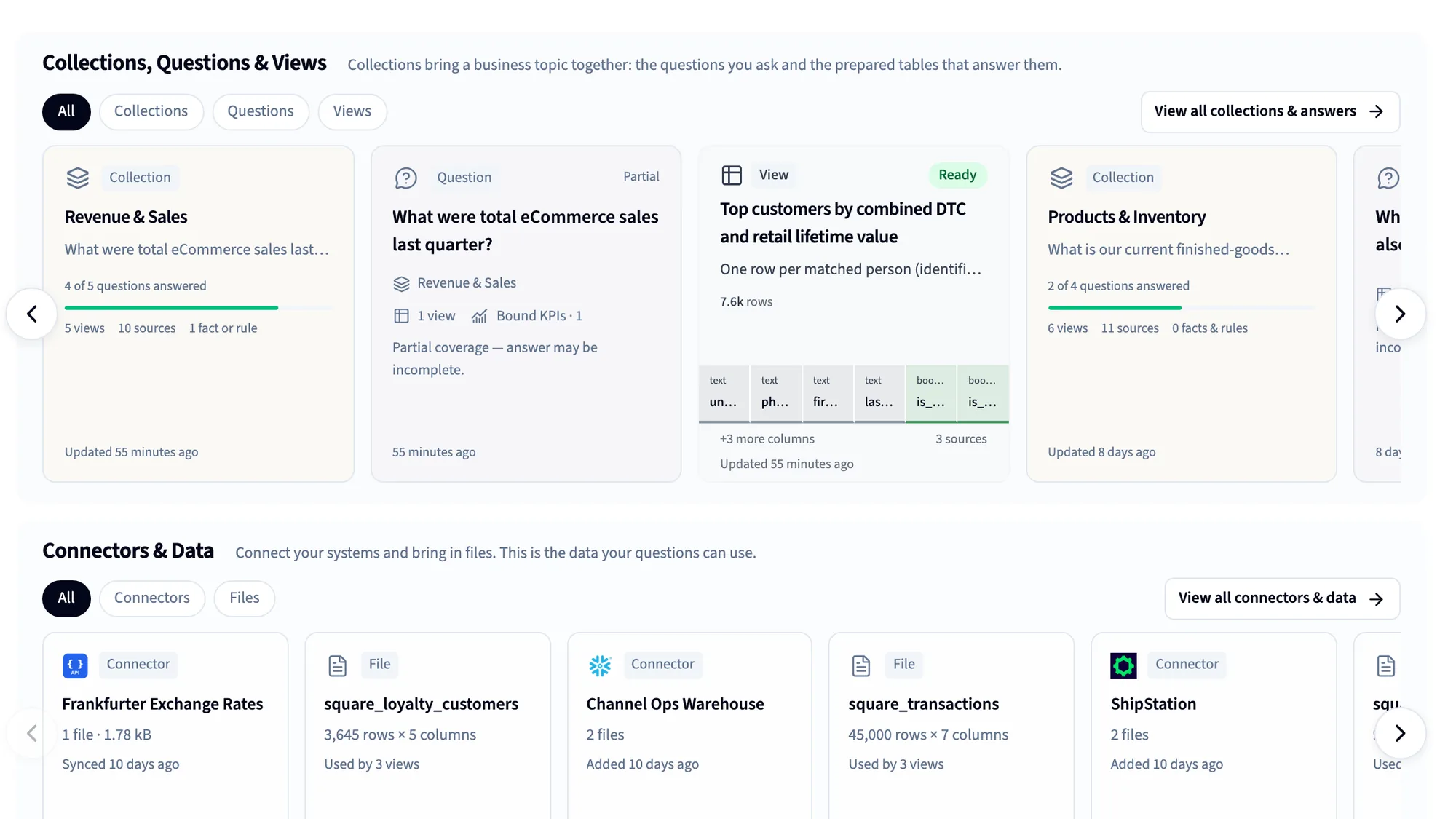
On the Metabase path, the pipeline, the database, the models and the BI tool are separate pieces to set up, connect and keep in sync. In Querri they're one chain: new data rebuilds the views on it, KPIs recompute and every dashboard refresh replays its saved query, so any number traces back to its source.
125+ connectors
CRM, accounting, ERP, payments, ads and databases, plus spreadsheets and files.
Automatic data cleaning
More than 180 checks on every table, and the Janitor to fix what they find.
The Library
A business-first semantic layer: definitions, KPIs and rules, taught by saying them.
Dashboards
Built by asking or from a screenshot, shared with unlimited viewers.
Nightly insights and Monitors
Querri works through your data overnight and shows what changed.
MCP for Claude and ChatGPT
Every assistant answers from the same definitions, under each person's access.
Reports and Excel
Scheduled projects, formatted workbooks and decks, delivered for you.
White label and embed
Bring the same understanding inside your own product, under your brand.
Using both
How Metabase and Querri work together
Plenty of teams will run both, and that's a sensible setup. Keep Metabase on the database your engineers already query, and let Querri be where the business asks across every system. Querri doesn't read from Metabase itself. It connects to the same databases Metabase reads, plus the business systems that never made it into one.
Keep in Metabase
- Live dashboards on your production database
- Embedded charts your developers already built
- SQL exploration for engineers and analysts
- Self-hosted or air-gapped deployments
Do in Querri
- Questions that join your CRM, accounting and database
- Definitions the business owns, in plain language
- Dashboards for everyone, with unlimited viewers
- AI answers in Querri, Claude and ChatGPT
How they fit together
-
Querri connects to the databases Metabase reads, including PostgreSQL, MySQL, SQL Server, MongoDB, Snowflake, BigQuery and Redshift, with credentials you provide. A read-only database user is good practice.
-
It syncs a copy of the tables you choose on the schedule you set, from hourly to monthly, rather than querying live. Everyday questions in Querri run on that copy, not on your database.
-
Querri also brings in HubSpot, Salesforce, QuickBooks, NetSuite, Stripe and spreadsheets, so a question can join them to your database without a separate pipeline.
-
Querri never writes back to your database, and your data is never used to train any model.
FAQ
Questions people ask when comparing Querri and Metabase
Is Metabase really free?
The open-source edition is free to self-host with unlimited users, and it's a capable product. You run the servers, upgrades, backups and security patches yourself, and you still need your data in a SQL database. Metabase Cloud starts at $100 a month for 5 users. Querri has a free cloud plan with nothing to host.
How much does Metabase cost?
Open source is free. Starter is $100 a month with 5 users, then $6 a user. Pro is $575 a month with 10 users, then $12 a user ($6,210 a year billed annually), and Enterprise starts at $20,000 a year. Vendr reports a median contract of $39,000 a year, before infrastructure and data work.
How much does Metabase embedding cost?
Guest embeds are view-only, work on every plan including open source, and create no user accounts. SSO embeds need Pro or Enterprise, and every embedded viewer needs an account that counts toward your billed users, so 1,000 SSO-embedded users on Pro is about $135,000 a year billed annually, at list (our arithmetic). Querri's embed and white label are on the Scale plan, priced with you.
Does Metabase have AI or natural language questions?
Yes. Metabot turns plain-language questions into charts and SQL, fixes queries and works in Slack, in every edition including open source, on the model you choose. Metabase also runs an official MCP server for Claude, ChatGPT and Cursor. Its docs say "you'll always need to double-check results." Querri checks its own work before you see it and shows the query behind every number.
Can Metabase connect to HubSpot, Salesforce or QuickBooks?
Not directly. Metabase's official connectors are databases and warehouses, and for SaaS tools it recommends syncing the data into a database first with a tool such as Airbyte or Fivetran. Querri connects to HubSpot, Salesforce, QuickBooks, NetSuite, Stripe, Shopify and more than 125 sources in all.
Do I need a data warehouse to use Metabase?
You need a SQL database, not necessarily a warehouse: Metabase reads PostgreSQL and MySQL as happily as Snowflake. Its own 2025 survey found half of teams skip a warehouse or lake for analytics. Data from SaaS apps still has to be loaded into that database, and Metabase can't join across separate databases.
Should I self-host Metabase or use Metabase Cloud?
Self-host if you have an engineer, want unlimited users for free, or need data to stay on your own servers. Use Cloud if you'd rather Metabase handle upgrades, backups and monitoring, which its own docs list as manual when you self-host. Either way, use PostgreSQL for the application database, not the built-in H2.
Is Metabase good for non-technical users?
Its query builder is friendlier than SQL, and business users at many companies use it daily. It works on the tables someone has connected and modeled, and Metabot's SQL needs a reviewer. In Querri, the people who know the business teach it definitions in plain language, and it tells you when a question has more than one reading.
Is Metabase good for a small business?
If the business has a developer and its data is in one database, yes: it's cheap and quick to start. If the numbers live in QuickBooks, HubSpot, Shopify and spreadsheets and nobody writes SQL, the pipeline and modeling become the project. That's the situation Querri is built for.
What's the best Metabase alternative for a team without a data engineer?
One that doesn't need a pipeline, a database and a modeling layer before the first answer. Querri connects your business systems, cleans the data automatically, learns your definitions in plain language and builds dashboards by asking, on one predictable plan. You can start on the free plan.
Can Querri connect to the same database as Metabase?
Yes. Querri connects to PostgreSQL, MySQL, SQL Server, MongoDB, Snowflake, BigQuery, Redshift and Databricks, among others. Many teams keep Metabase on their production database and use Querri for questions that join it to the CRM, accounting system and spreadsheets.
Does Querri query my database live like Metabase does?
No. Querri syncs a copy of the tables you choose on the schedule you set, from hourly to monthly, and answers from that copy. If you need every chart to reflect the database second by second, Metabase's live queries are the better fit.
Can I self-host Querri?
No. Querri is a cloud service and isn't open source. It holds SOC 2 Type II, HIPAA and ISO 27001:2022, and each organization has its own database and storage. If your data must never leave your own servers, self-hosted Metabase is the better choice.
Can I try Querri on my own data first?
Yes. You can start on the free plan with no credit card, connect a source and ask. See plans for what each includes. Or bring your hardest question to a 20-minute walkthrough.
Sources
Where these facts come from
Checked October 15, 2026. Metabase ships often and updates its pricing; if something here is out of date, tell us and we'll fix it.
- Metabase pricing (plans, per-user prices, AI tokens, transforms, storage) Metabase
- Metabot (limitations, "double-check results") Metabase docs
- Metabase MCP server Metabase docs
- AI settings (bring your own provider) Metabase docs
- AI for everyone, with confidence Metabase, Jun 2026
- Metabase releases 57 to 64 Metabase
- Meet Data Studio Metabase, Mar 2026
- Data sources (official and community connectors, SaaS via ETL) Metabase
- Combining data from different databases Metabase Learn
- Embedding introduction (guest and SSO, billed accounts) Metabase docs
- Metabase Cloud versus self-hosting Metabase docs
- Migrating from H2 Metabase docs
- Upgrading Metabase Metabase docs
- Metabase security (SOC 2 Type II, regions, self-hosting) Metabase
- Metabase contract data (median contract) Vendr
- Community Data Stack Report 2025: key analysis Metabase (vendor survey), Sep 2025
- "Well-received and dare I say even a bit adored" Hacker News, Feb 2024
- "Starts to feel clunky once you care about UX, permissions, and embedding" Hacker News, Feb 2026
- Self-hosted Metabase "took only a few minutes to set up" Hacker News, Feb 2024
- Metabase reviews PeerSpot, Nov 2024
- Fivetran usage-based pricing Fivetran docs
- Data engineering salaries Axial Search, 2026
- Querri pricing Querri
- Predictable credit use Querri docs
See your business systems answer before you stand up a database
Connect a system or drop in a spreadsheet, ask the question that matters most, and see the query behind the answer. If Metabase is the better fit, we'll tell you.