Querri vs Sisense
Sisense is a deep toolkit for developers who embed analytics. Querri is built for the people who ask.
Same goal: analytics people trust. Very different builds.
Sisense has spent two decades helping software teams build analytics into their products, with data models, an SDK and now an AI assistant. Querri is the question-first data platform. It starts from the questions your business asks and builds what's needed to answer them, for your own team or, under your brand, for your customers.
Time, cost and control
Answers without a build project, a bill you can plan, and engineers who stay on your product
Sisense gives a software team the parts to build analytics. Querri is the finished path from your data to an answer, for your team or your customers. Here's what that difference means for the business.
-
Answers in days, not after a modeling project
On Sisense, someone builds a data model and the dashboards before users see a number. With Querri, you connect a system or upload a file and ask the same day.
-
A bill you can plan before you sign
Sisense quotes every deal, and Vendr's median contract is about $57,000 a year. Querri is one predictable bill: a monthly credit allowance tied to the work your team does, alerts before you reach it, and no automatic overage charges.
-
Your engineers stay on your product
Embedding Querri takes one backend call and a component. Your product team decides what customers see from a configurator, and nobody writes chart code.
-
Secure, auditable, nothing to rip out
SOC 2 Type II, HIPAA and ISO 27001:2022, and your data never trains a model. Every number shows its query, and the Sisense dashboards you rely on can be rebuilt from a screenshot.
Where each one fits
Pick by who will build it and who will ask
We'd rather you pick the right tool than pick us for the wrong reason. Here's where each one fits.
Choose Sisense when
- You have developers who want to code analytics into your product in React, Angular or Vue, with control over every widget.
- You need to run it on-premises, in a dedicated cloud or in your own AWS, Azure or GCP account.
- You want dashboards to query your warehouse live, or in-memory models built for heavy dashboards on large data.
- You have a data modeler who will build and maintain ElastiCubes or Live models and the formulas on top.
- Your security review asks for ISO 42001 for AI, or a 99.99% SLA written into the contract.
Choose Querri when
- You want your people, or your customers, asking in plain language instead of waiting for the next dashboard.
- The data lives in business systems like HubSpot, Salesforce, QuickBooks and spreadsheets, not in a warehouse.
- You'd rather keep developers on your own product and make embedding one backend call.
- You want a bill you can plan for your own team, and to start free before you talk to sales.
- You want the AI to say when a question has two readings, check its numbers and show the query.
Feature by feature
The detailed comparison
Every row says where each one is stronger. Where Sisense wins, we say so. Facts are current as of October 2026 and linked in the sources.
Sisense publishes no prices. Contract figures are Vendr's transaction data and self-serve prices are from S&P Global 451 Research, as of October 15, 2026; neither appears on Sisense's site. Your quote will vary by deployment, users and data.
Pricing
A quote, a data model and a pool of AI credits
Sisense doesn't publish prices. Each contract is built from your deployment, your users and your data, so two companies can pay very different amounts for the same product. That's normal for enterprise software, and it means the real number arrives late in the process, after the evaluation is done.
How Sisense is priced
- The plans page lists no prices: Enterprise is "Talk to us," and Self-serve offers a free trial.
- Vendr's median contract is $56,831 a year, from $18,139 to $178,681, across 126 purchases.
- The price moves with deployment, user type (viewer, designer, developer), data volume and ElastiCubes, and embedding and white label.
- Self-managed licenses add 18% to 22% a year for maintenance, on top of your own servers: 8 CPUs and 32 GB of RAM for under 50 million rows, up to 256 to 512 GB per node for a billion.
- AI runs on Sisense Credits, metered per action, with alerts at 85% and 100%; at the limit, features pause until the next refresh. Your own OpenAI key uses no credits, and OpenAI bills you instead.
- 451 Research reports self-serve tiers at $399 a month (Launch, view-only embeds) and $1,299 (Grow, editing, basic SSO and white label). Sisense's site doesn't list them.
When a quoted contract is the better deal
If you embed analytics for thousands of viewers, have developers to build it and can negotiate a multi-year contract, a quoted license can cost less per user than anything priced from a list. Vendr says Sisense's first quotes often run well above what buyers end up paying, and its buyers save about 12% on average. And Sisense's credits pause rather than overcharge, which is a real safeguard. If that's your situation, the guides below are where to start.
Where the effort and the cost show up
Choosing Sisense? Get the setup and the contract right.
If Sisense is the right call for you, these are the guides that keep the build on track and the cost where you expect it.
- Choose the right data model Sisense's guide to ElastiCube, Live and hybrid models, and when each fits. Sisense docs
- Watch credit usage The Credit Usage Analytics dashboard, by tenant, group and feature. Sisense docs
- Size self-managed servers Minimum CPU, memory and SSD requirements by data size. Sisense docs
- Plan your upgrades Quarterly releases, each supported for 12 months. Sisense docs
- Prevent cube build failures Sisense's community guide to memory and Safe-mode errors. Sisense Community
- Benchmark the quote Vendr's Sisense contract data, before you negotiate. Vendr (negotiates software contracts)
How Querri keeps the bill predictable
- One bill, no surprises. One plan for the whole organization, with the AI, storage and unlimited dashboard viewers included. See plans and pricing.
- One simple credit. A credit is a unit of business work, like answering a question or syncing a source, so usage is easy to understand and easy to plan for.
- Unlimited dashboard viewers on every plan. Viewing, uploads, exports and the Library never cost credits.
- Usage alerts at 80% of the plan, when it's over and on a spike, plus a monthly limit for any person.
- No automatic overage charges. We tell you as you approach your limit, and you decide what happens next.
- No servers to size or cubes to build. Storage, the engine and the AI are in the plan.
Total cost
What it takes to get the first answer
A Sisense license is where the work starts. Before a user, or one of your customers, sees a trusted number, someone builds the model, the dashboards and the embed. Here's the typical Sisense path, next to Querri.
The Sisense path is our estimate from Vendr contract data, Sisense's published requirements and salary ranges in the linked sources, not a quote. A small, careful deployment costs less; if your team already builds in Sisense, the people line is a cost you've already chosen.
Built in, not assembled
Everything between your data and the answer, in one product
On the Sisense path, the data model, dashboards, embed code and AI are separate pieces to build and keep in step. In Querri they're one chain: new data rebuilds the views on it, KPIs recompute and every dashboard refresh replays its saved query, so any number traces back to its source.
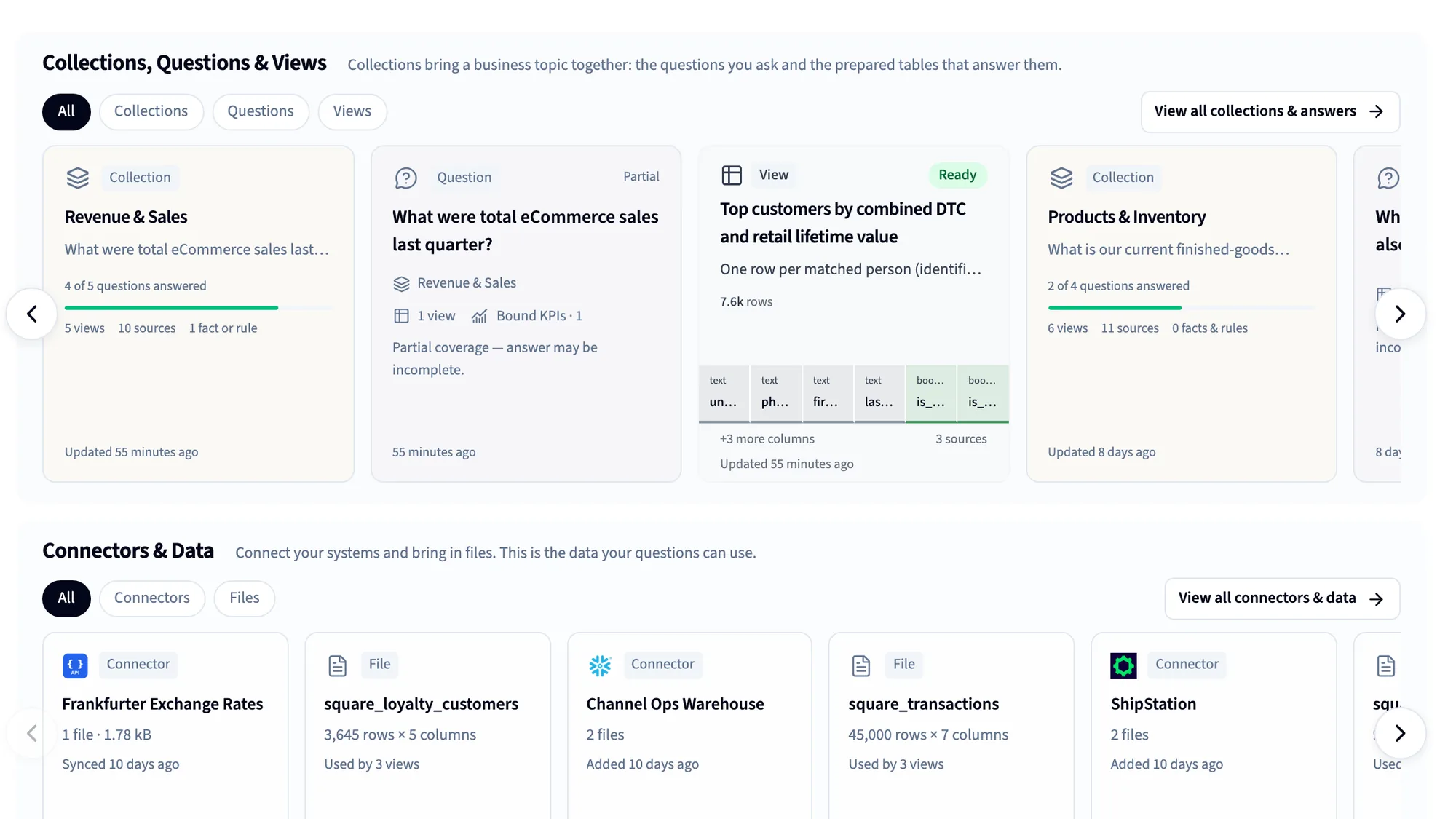
125+ connectors
CRM, accounting, ERP, payments, ads and databases, plus spreadsheets and files.
Automatic data cleaning
More than 180 checks on every table, and the Janitor to fix what they find.
The Library
A business-first semantic layer: definitions, KPIs and rules, taught by saying them.
Dashboards
Built by asking or from a screenshot, shared with unlimited viewers.
Nightly insights and Monitors
Querri works through your data overnight and shows what changed.
MCP for Claude and ChatGPT
Every assistant answers from the same definitions, under each person's access.
Reports and Excel
Scheduled projects, formatted workbooks and decks, delivered for you.
White label and embed
Bring the same understanding inside your own product, under your brand.
Using both
How Sisense and Querri work together
Plenty of teams will run both for a while, and that can be a sensible setup. Keep the Sisense dashboards that are coded into your product and working, and let Querri answer the questions those dashboards weren't built for. Querri doesn't connect to Sisense itself; it connects to the same sources Sisense reads.
Keep in Sisense
- Dashboards coded into your product with Compose SDK
- Custom widgets and plugins your developers built
- Deployments that must run on-premises or in your cloud
- Live models over a large warehouse
Do in Querri
- Questions the dashboards weren't built to answer
- Data from HubSpot, QuickBooks and spreadsheets
- Definitions the business owns, in plain language
- AI answers in Querri, Claude and ChatGPT
How they fit together
-
Connect Querri to the warehouse or databases your Sisense models read from, such as Snowflake, BigQuery, Redshift, PostgreSQL or SQL Server, with read-only access to the tables you choose.
-
Add the business systems that never made it into a Sisense model through Querri's 125+ connectors, or drop in a CSV or Excel export from Sisense.
-
Paste a screenshot of a Sisense dashboard your team uses, and Querri rebuilds it on your data, so you can compare the two side by side.
-
Querri syncs a copy on the schedule you set, never writes back to your sources, and never uses your data to train any model.
FAQ
Questions people ask when comparing Querri and Sisense
How much does Sisense cost?
Sisense doesn't publish prices; every Enterprise deal is quoted. Vendr's contract data shows a median of $56,831 a year, ranging from $18,139 to $178,681, depending on deployment, user types, data volume and embedding. Querri is one predictable plan with AI and dashboards included; see current plans.
Does Sisense have a self-serve or startup plan?
Yes. Sisense lists a Self-serve plan "for startups and growing teams" with a free trial, but no price on its site. S&P Global 451 Research reports two tiers: Launch at $399 a month for view-only embeds, and Grow at $1,299 a month with editing, basic SSO and white label. Both include credits for AI.
What are Sisense Credits?
Sisense Credits are the consumption model for Sisense's AI features. One pool covers every AI action, each action is metered per use, admins get alerts at 85% and 100%, and when a workspace hits its limit, AI features pause until the next refresh. Using your own OpenAI key doesn't consume credits, though OpenAI bills you for it.
Does Sisense have AI or natural language features?
Yes. Sisense Intelligence includes an assistant that's been generally available since January 2026, AI search for existing widgets, a Data Modeling Agent that went generally available in August 2026, and an MCP server in beta. Querri works differently: asking in plain language is how everything gets built, AI is included in every plan, and every answer shows its query.
Does Sisense work with Claude or ChatGPT?
Sisense's MCP Server, in beta as of its 2026.3 release, lets external AI agents query Sisense's semantic models over OAuth 2.1. Querri's MCP connection works with Claude and ChatGPT on every plan, including Free, and dashboards and charts appear inside the chat under each person's own access.
What is an ElastiCube?
An ElastiCube is Sisense's in-memory data model: data is imported from your sources, joined and modeled, and rebuilt on a schedule so dashboards query it fast. The alternative is a Live model that queries your warehouse every time a dashboard loads. Either way, someone designs and maintains the model. In Querri, you teach definitions in plain language in the Library, and the data is cleaned and checked as it arrives.
Does Sisense require developers?
For embedding, mostly yes: the Compose SDK is built for developers in React, Angular and Vue, and reviewers note some features can only be added with JavaScript. Business users can view and use dashboards once they're built. With Querri, dashboards are built by asking, and an embed takes one backend call and a component.
What's the best Sisense alternative for embedded analytics?
It depends on who will build it. If your developers want to code every widget into your app, Sisense is one of the strongest toolkits there is. If you'd rather your customers ask questions about their own data in plain language, without a modeling project first, Querri's white label and embed on the Scale plan puts the whole product under your brand, and each customer sees only their own rows.
Is Sisense good for small businesses?
Sisense now offers self-serve plans for startups, reported at $399 to $1,299 a month, and its Enterprise plan is quoted. Its reviewers often mention a learning curve, and some say it's expensive for a tight budget. Querri starts free and runs on one predictable plan, built for teams without developers or data engineers.
How long does it take to implement Sisense?
It depends on the build. Reviewers report anywhere from a day for a simple setup to four months, and one described two months with four or five people. Most of the time goes into the data model and the embed. With Querri, you connect a source or upload a file and ask the same day; for an embed, engineering makes one backend call and the rest is configured in settings.
Can Sisense be self-hosted or run on-premises?
Yes, and it's a real strength. Sisense runs as SaaS, in a dedicated cloud, in your own AWS, Azure or GCP account, or on-premises. Self-managed licenses add 18% to 22% a year for maintenance, according to Vendr, and you run the servers and the quarterly upgrades. Querri is SaaS only, with each organization's data in its own database and storage.
Can Querri connect to Sisense?
Not directly. Querri connects to the same sources Sisense reads, including Snowflake, BigQuery, Redshift, PostgreSQL, MySQL and SQL Server, plus 125+ business systems. You can also drop in CSV or Excel exports from Sisense, or paste a screenshot of a Sisense dashboard and Querri rebuilds it on your data.
Can I move from Sisense to Querri?
Yes. Connect the same sources, then paste screenshots of the Sisense dashboards your team uses most, and Querri rebuilds each one on your data, calculations included. You can keep the embedded Sisense dashboards that work while you compare. Querri's prices are published, so you can weigh a renewal quote against them.
Can I try Querri on my own data first?
Yes. You can start on the free plan with no credit card, connect a source and ask. See plans for what each includes. Or bring your hardest question to a 20-minute walkthrough, including a look at white label and embed.
Sources
Where these facts come from
Checked October 15, 2026. Sisense updates its products often and doesn't publish prices; if something here is out of date, tell us and we'll fix it.
- Sisense plans (Enterprise and Self-serve, deployment, SLA, white label) Sisense
- Sisense contract data (median, range, pricing factors, maintenance) Vendr (negotiates software contracts)
- Sisense reinforces AI-driven embedded analytics focus (self-serve tiers, customers, MCP) S&P Global 451 Research (hosted by Sisense), Feb 2026
- Product updates 2026.2 (Sisense Credits, assistant, dashboard-to-code) Sisense, Apr 2026
- Product updates 2026.3 (MCP Server beta, AI search, Data Modeling Agent GA, SDK Plugins) Sisense, Aug 2026
- Assistant, MCP Server and flexible LLM (assistant generally available) Sisense, Jan 2026
- The semantic harness (verified analytics in 2026.4.1) Sisense, Oct 2026
- Credit Usage Analytics Sisense docs
- Choosing the right data model (ElastiCube, Live, hybrid) Sisense docs
- Minimum requirements for Sisense in Linux environments Sisense docs
- Sisense version release and support schedule Sisense docs
- Compose SDK developer guides (React, Angular, Vue) Sisense developer docs
- Sisense Trust Center (SOC 2 Type 2, ISO 27001, 27701, 42001, HIPAA) Sisense
- Resolving build failures due to memory issues (Safe-mode) Sisense Community
- Sisense reviews (cost, deployment time, JavaScript, performance) PeerSpot reviews
- Data engineering salaries Axial Search, 2026
- Querri pricing Querri
- Predictable credit use Querri docs
See your own data answer before you sign a Sisense renewal
Connect a system or drop in a spreadsheet, ask the question that matters most, and see the query behind the answer. Then look at what your customers would see under your brand. If Sisense is the better fit, we'll tell you.