Skip to content

Square + Querri

Square reporting,past the end-of-day export.

Ask about hours, wages, loyalty members and your item library in plain language, and get answers that sit next to your sales figures and your books. Querri copies the Square tables you choose in on a schedule, so the weekly numbers are ready when you are.

Querri only reads your Square data and never changes a sale, a shift or a customer. You paste your Square access token into a secure form the agent can't read. SOC 2 Type II, HIPAA and ISO 27001:2022 certified.

Why Square reporting gets hard

Square rings up the day. Making sense of the week is on you.

Owners and managers on Square run into the same walls once they want more than today's totals. None of them is a flaw in the register; they show up when a question spans locations, subscriptions and the systems around Square.

01

Labor against sales sits behind another subscription

Square's Labor vs. sales report needs a Square Shifts Plus subscription and a wage on every profile, and shifts clocked before a wage was added don't fill in later.

02

Every report ends in a CSV

Custom reports can be exported but not printed, so the weekly review starts with downloads, a spreadsheet and the same formulas rebuilt by hand.

03

The rest of the P&L lives elsewhere

Rent, food cost, payroll taxes and vendor bills are in your accounting system. Square can tell you what sold, but not whether the week made money.

04

The item library drifts

The same latte is entered three ways, a category gets reorganized mid-season, and one location quietly charges a different price. Totals by item are only as clean as the catalog.

05

Loyalty data stays in its own corner

Loyalty reporting lives only in Square Dashboard, filtered by date and location. Tying members to your email list, your labor or your margins means another export.

What you can finally answer

Eight Square questions that used to mean a spreadsheet

Each is a question owners, general managers and finance leads at restaurants, shops and service businesses ask, why it's hard on Square alone, and how Querri handles it.

What is labor costing us as a share of sales, by location, every week?

Why it's hard

Hours and wages are in Square's team tools, while the sales figure you trust for the week may come from your books or a weekly export. Lining them up is a Monday-morning ritual.

With Querri

Querri reads shifts and wages from Square and joins them to sales from QuickBooks or a sales sheet. Define labor percent once and track it as a KPI that keeps its weekly history from the week you set it up.

Which locations are drifting into overtime before payroll closes?

Why it's hard

Overtime shows up after the pay period, when it's too late to move a shift. Nobody adds up each person's hours across locations every day.

With Querri

Querri totals clocked hours per team member across every location they work. Nightly monitors compare each location to its own usual pattern and leave what stands out in your Inbox the next morning.

Which shifts were never clocked out, and how much did they inflate labor?

Why it's hard

A forgotten clock-out turns a seven-hour shift into a nineteen-hour one, and it sits in the totals until someone spots it on a timecard.

With Querri

Querri checks the shift data before it answers: open shifts, impossible lengths, breaks marked paid that your policy says are unpaid. It tells you what it set aside and how much that moved the number. See data cleansing and how answers are checked.

Which loyalty members are sitting on points they've never redeemed?

Why it's hard

Square shows loyalty visits and spend, but a list of members whose balance has never dropped, with an email next to each, is something you build yourself.

With Querri

Loyalty accounts come over with balances and lifetime points, and each carries its Square customer ID, so Querri can link it to the customer record. Match those members to HubSpot contacts by email to see who your campaigns can reach.

How many distinct customers do we actually have?

Why it's hard

The same person is in the directory once from a receipt, once from an appointment and once from the loyalty sign-up, so every customer count runs high.

With Querri

Say once in Facts & rules what makes two records the same customer, such as a shared email or phone number. Every count after that uses the rule, and Querri says how many records it merged to get there.

Can every location manager get their own labor summary on Monday?

Why it's hard

One summary per location means one filtered export per location, and the version that gets forwarded is never the latest one.

With Querri

Build the summary once as a project. A schedule reruns it after the weekly sync and sends each manager only their location, as an email or a formatted Excel workbook.

Is every item set up the same at every location?

Why it's hard

Square lets an item be sold at some locations and not others, and each variation carries its own price. Finding the one that's missing or mispriced means opening items one by one.

With Querri

Items come over with their variations, prices and the locations each one is sold at. Ask in chat for items missing from a location or variations priced unlike the rest, and keep the check as a project you can rerun after each menu change.

Can I ask Claude or ChatGPT about our Square data and get the right numbers?

Why it's hard

Paste a timecard export into an assistant and it guesses what counts as paid time. Ask again next week and it may guess differently.

With Querri

Connect Querri to Claude or ChatGPT once. The assistant answers from your Library, with your labor rules and each person's access, so a manager asking from Claude sees only their own location.

Square plus the rest

The register is one part of the business

Square knows who worked, who joined the loyalty program and what's on the menu. Your books know the costs, your email tool knows the audience, and a sheet somewhere holds the targets. Querri brings them into one Library, so a question about a location doesn't stop at the edge of Square.

Square pairs well with

Answers you can stand behind

When a question has two fair readings, Querri tells you which one it used

"How many hours did the team work?" can mean every minute between clock-in and clock-out, or only paid time once unpaid breaks come off. Both are reasonable, and the gap can be dozens of hours a week. Querri answers with one, names it and shows you the other, so the conversation is about staffing, not arithmetic. See how answers work.

Wake up to what changed

Querri keeps an eye on every location overnight

Each night Querri measures your KPIs against their own history and looks for the location or role nobody has checked lately. What it finds is in your Inbox before the morning shift, and nothing changes without your OK.

Custom Square dashboards

A dashboard for each location, made by describing it

Say what the owner wants to see, or start from a screenshot of the dashboard you already use. Changes after that are requests in plain words, every chart reads from the same Library as chat, and each manager can be limited to their own location.

  • Labor, loyalty and catalog in one view
  • Square next to your books and your targets
  • Each manager sees only their location
Every change is a sentence. Ask for a dark theme and the Monthly Sales Review follows, with undo one click away.

Reports you can stop rebuilding

Six Square reports, set up once

What comes over

Sales, team, customers and catalog, location by location

Querri reads the Square tables you pick and keeps them current on the schedule you set. It can only read what your access token is allowed to see. Many owners still take the week's sales total from QuickBooks or a sheet, and Querri can line either one up with Square.

Tables you can pick

  • Payments
  • Orders
  • Refunds
  • Customers
  • Locations
  • Shifts
  • Team members
  • Team member wages
  • Items
  • Categories
  • Discounts
  • Taxes
  • Modifier lists
  • Inventory counts
  • Loyalty accounts
  • Cash drawer shifts
  • Bank accounts
  • Every location your access token can see is included

Refreshed in full

Each sync reloads the tables you picked and replaces the previous copy, daily, weekly or monthly, or by hand any time. For dated tables such as payments, orders and refunds, a start date you choose sets how far back it reads.

Paged and patient

Square's data comes over page by page, waiting out rate limits instead of failing. Each sync runs apart from the rest of Querri and is stored in a columnar format, ready for questions.

Read only

Querri only reads from Square. It never creates, edits or deletes a customer, item, shift or anything else.

Your token, kept sealed

You paste a Square access token into a secure form. It's stored encrypted, and the Connector Agent only ever knows whether it's set.

How to connect Square

Connected in a few minutes, with an agent walking you through it

  1. 1

    Ask the Connector Agent

    Tell the agent in Querri's Connect page to "connect our Square account," or pick Square from the catalog.

  2. 2

    Copy an access token from Square

    In the Square Developer Console, copy the access token for an application on your account. Its permissions decide what Querri can read.

  3. 3

    Paste it into the secure form

    Add the token, pick a start date and choose whether to include deleted items. Querri tests the connection when you save.

  4. 4

    Pick tables and approve

    Choose the tables to load and how often to refresh them. Querri loads nothing until you say yes.

  5. 5

    Ask your first question

    Your Square data lands in the Library, ready for questions, dashboards and scheduled reports.

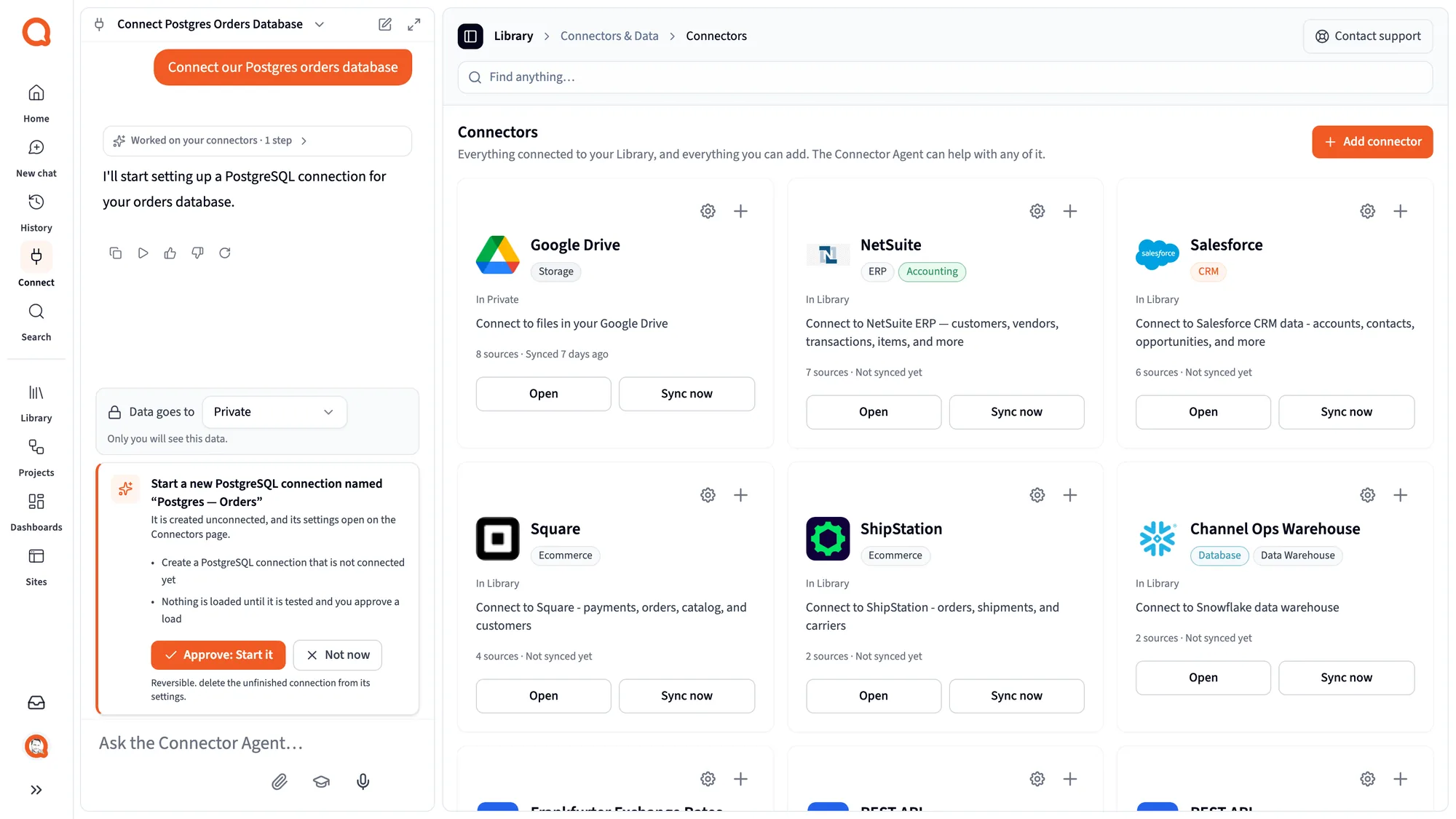
The Connect page in Querri, where the Connector Agent asks for approval before starting a connection, next to connector cards for Google Drive, NetSuite, Salesforce, Square, ShipStation and Snowflake
The Connector Agent asks before it creates a connection or loads a single row.

Square FAQ

Questions about Square and Querri

How do I connect Square to Querri?

Open Connect and ask the Connector Agent to connect Square, or pick it from the catalog. Paste a Square access token into the secure form, set a start date, and Querri tests the connection. Then choose your tables and a refresh schedule and approve the load. There is no Sign in with Square option today.

What Square data does Querri sync?

Payments, orders, refunds, customers, locations, shifts, team members, wages, items, categories, discounts, taxes, modifier lists, inventory counts, loyalty accounts, cash drawer shifts and bank accounts. It covers every location your access token can see, and you can include deleted catalog entries. Querri can only read what the token's permissions allow.

Can Querri sync Square payments, orders or transactions?

Yes. Payments, orders and refunds are tables you can pick, along with inventory counts and cash drawer shifts. Each one refreshes in full on your schedule, and a start date limits how far back they go. If your trusted weekly sales figure lives in QuickBooks or a sheet instead, Querri can use that and join it to Square labor and loyalty data.

How often does Square data sync?

Square tables refresh in full on the schedule you pick: daily, weekly or monthly. You can also start a sync by hand at any time. Each refresh replaces the previous copy, so records removed in Square disappear from Querri too. Hourly incremental syncs aren't available for Square.

Does Querri change anything in my Square account?

No. Querri only reads from Square. It never creates, edits or deletes a customer, item, shift, wage or loyalty account, and nothing you do in Querri reaches your point of sale.

How do Square permissions carry over to Querri?

Querri reads with the access token you provide, so it sees what that token is allowed to see. If the token lacks a permission, that table comes back empty rather than showing an error, so check the token if a table looks bare. Inside Querri, who sees which rows is set by Querri's own sharing and row-level access.

How do I combine Square and QuickBooks data?

Connect both. Querri brings Square shifts and wages into the same Library as your QuickBooks income and expenses, so you can ask what labor cost against revenue at each location, or how labor moved next to food and supply costs. Say once how locations map to your books, and every answer follows it.

How do I combine Square labor data with sales from a spreadsheet?

Keep weekly sales by location in Google Sheets, or drop your Square sales exports into a Google Drive folder, and connect it. Querri joins the sheet to Square shifts and wages by location and week, and keeps the combined numbers current as both refresh.

How do I combine Square loyalty members with HubSpot contacts?

Connect Square and HubSpot. Querri links each loyalty account to its Square customer record, then matches customers to HubSpot contacts by email. You get members who aren't on your email list, or members with unredeemed points you can invite back, and the answer says how the match was made.

How do I get a labor cost percentage report by location?

Connect Square for shifts and wages, plus QuickBooks or a sales sheet for weekly sales. Tell Querri how labor is counted, for example paid hours times hourly wage, and track labor percent as a KPI. Querri keeps its history from that day and can send it every Monday.

How do I get an overtime report from Square data?

Ask Querri for hours per team member per week across all locations, with anything past 40 hours flagged. Save it as a project to rerun after each sync, or let a nightly monitor watch overtime and leave a note in your Inbox when a location runs well above its usual week.

How do I see how many loyalty points are unredeemed?

Loyalty accounts come over with current balances and lifetime points. Ask Querri for the total outstanding balance, or members who have never redeemed a reward, and track the outstanding total as a KPI so you can see it build over time.

Can I build custom Square dashboards?

Yes. Say what it should show, or start from a screenshot of a dashboard you already use. You change it by asking, it can show Square next to your books and targets, and each location manager can be limited to their own rows.

Can I ask ChatGPT or Claude about my Square data?

Yes. Connect Querri to Claude or ChatGPT once, and the assistant answers from your Querri Library, with your definitions of paid hours and labor cost and each person's own access. A location manager asking from Claude gets the same number they'd see in Querri.

Can I export Square data to Excel automatically?

Yes. Build the report once as a project in Querri and put it on a schedule. After each refresh Querri reruns it and sends a formatted Excel workbook by email, one version per manager or location if you want, so nobody downloads a CSV and rebuilds the formulas.

Can each location manager see only their own location?

Yes. Set a row filter per person once in Querri, for example by location. It follows them into chat, dashboards, scheduled reports, Claude and ChatGPT, and the API, so nobody needs a separate copy of the data.

What are the limits of the Square connector today?

It connects with an access token, not a Square sign-in. Every sync is a full refresh, with no hourly incremental option, so large payment and order histories reload each time; a later start date keeps that smaller. And a token missing a permission returns an empty table rather than an error.

Can I connect a Square sandbox account?

Yes. Turn on the Sandbox option in the connection form and use a sandbox access token, and Querri reads from Square's sandbox instead of your production account. It's a handy way to try questions and dashboards on test data first.

Is my Square data secure in Querri?

Querri is SOC 2 Type II, HIPAA and ISO 27001:2022 certified. Your Square access token is stored encrypted, and the Connector Agent never sees it, only whether it's set. Querri only reads from Square, and your data is never used to train a model.

Ask Square the question you usually answer with a spreadsheet.

Connect it in a few minutes. Querri reads your Square data and leaves it exactly as it is.