Skip to content

MongoDB + Querri

MongoDB reporting,without a pipeline to build first.

Ask about your application data in plain language, straight from the collections your product already writes. Querri copies MongoDB into one place with billing, CRM and support data, keeps it current, and answers with your definitions.

Querri reads your collections and never edits, adds or removes a document. Your connection string is typed into a secure form, out of the agent's view. SOC 2 Type II, HIPAA and ISO 27001:2022 certified.

Why MongoDB reporting gets hard

MongoDB is built for the app. Reporting asks it to be something else.

Product and ops teams hit the same walls on document data. MongoDB is doing its job in every case. The trouble starts when an operational store is asked to act like a reporting one.

01

BI tools want rows; MongoDB stores documents

Nested objects and arrays don't map to a chart's columns. MongoDB set September 2026 as end of life for its legacy BI Connector, so teams either move to a SQL interface or build a job that flattens everything first.

02

No two documents have to agree

A field that was a number in 2023 is a string today, a newer one is missing from older documents, and status is spelled three ways. Reports either break or quietly skip the odd ones.

03

Every question is an aggregation pipeline

$unwind, $group and $lookup are an engineer's tools. When ops wants churn by plan or orders by warehouse, the request joins the sprint backlog.

04

Analytics competes with the app

Heavy reporting queries run on the cluster your customers use. Each aggregation stage gets 100 MB of memory before it has to spill to disk or fail, and big scans slow everything else down.

05

The rest of the business isn't in Mongo

Invoices sit in the accounting system, deals in the CRM, tickets in the help desk. Linking an account ID in a document to a customer anywhere else is a spreadsheet job.

What you can finally answer

Eight MongoDB questions that used to wait on an engineer

Each one is a request product, ops and finance teams make of application data, why it stalls today, and what Querri does with it.

Where do new accounts drop out of onboarding?

Why it's hard

Setup progress lives in an array inside each user document. Counting who reached which step means an $unwind pipeline that someone has to write and maintain.

With Querri

The array arrives as a JSON column, and Querri unpacks it in the analysis when the question needs it. Make activation a KPI so its trend is recorded from that day on, and use the signup-to-first-value playbook to lay out each step from signup onward.

Who is using more than they pay for?

Why it's hard

Seats and usage are counted in the app's database; the plan and price are on an invoice in another system. The two share an account ID and nothing else.

With Querri

Connect QuickBooks or Salesforce next to MongoDB and Querri matches workspaces to customers in the Library, then lists the accounts whose usage runs past their plan.

Which orders are stuck, and where?

Why it's hard

A document sitting in "processing" for three days looks just like one that arrived an hour ago, unless someone queries by age every morning.

With Querri

Monitors compare each warehouse or queue to its own history every night and put the outliers in your Inbox before the morning standup. Read more about Nightly insights and monitors.

Why does the same metric come out different in two reports?

Why it's hard

Years of schema changes leave a status field holding "shipped", "Shipped" and "SHIPPED", and a price stored as text in some documents and as a number in others.

With Querri

Querri keeps every value, even when types are mixed, and checks the columns before it queries. Three spellings of shipped get counted as one, and the answer notes that it did so and how many documents it affected. The method is on the data cleansing and trusted answers pages.

Can ops get a MongoDB export in Excel every week, without asking engineering?

Why it's hard

Today it's a script someone runs with mongoexport, then a CSV that gets reformatted by hand before it goes out.

With Querri

Turn the mongoexport routine into a project. On its schedule it runs again against the latest sync and mails a formatted workbook, split into one copy per team or client when that helps. See reports and automation.

Which features are behind the support queue?

Why it's hard

Feature usage is in MongoDB and conversations are in the help desk, so tying a spike in tickets to a feature means two exports and a guess.

With Querri

Connect Intercom alongside MongoDB and ask which features the noisiest accounts use. The ticket volume playbook takes it further.

Which customers are going quiet before renewal?

Why it's hard

Customer success sees the renewal date in the CRM but not that logins halved last month, because that number only exists in the app's event documents.

With Querri

Put HubSpot or Salesforce beside MongoDB and build a health score from real usage. Say once what "active" means in Facts & rules, and the health score playbook walks through the rest.

Is it safe to point Claude or ChatGPT at our MongoDB data?

Why it's hard

Handing an assistant a production connection string is a non-starter, and even then each prompt would invent its own idea of an active user.

With Querri

Give Claude or ChatGPT Querri as its source. Questions are answered from the copy Querri already synced, using your rules and limited by each person's access in Querri; no connection string ever reaches the assistant.

MongoDB plus the rest

Usage is in your app. Revenue is somewhere else.

MongoDB holds usage, orders and events. Billing, deals and tickets live elsewhere. Querri loads both sides into one Library and lines records up on the account IDs they have in common, so one question can reach usage and money together.

MongoDB pairs well with

Answers you can stand behind

When "active" can mean two things, Querri tells you which it counted

"Active users in September" might mean anyone who logged in, or only people who did something that matters, like creating a project. Both are fair, and the gap between them is large. Querri answers with the reading it chose, names it, and puts the second number right under it. See how answers work.

Wake up to what changed

Querri watches your application data overnight

Overnight, Querri holds each KPI up to its own track record and goes looking for the queue, warehouse or plan that no one put on a report. What it finds sits in your Inbox at the start of the day, and acting on any of it stays your call.

Custom MongoDB dashboards

MongoDB dashboards your ops team can change themselves

Say what the ops board should show, or hand Querri a screenshot of a layout your team likes as the starting point. Moving a filter or swapping a chart type is one more message. Charts and chat draw on one Library, and access can be cut down to a single team's or client's rows.

  • Made and reshaped through chat
  • Application data beside billing, CRM and support
  • Each team or client sees only its rows
A single typed request restyles the whole dashboard, and an undo bar appears in case you want it back.

Reports you can stop rebuilding

Six MongoDB reports, built once

What comes over

Every collection you choose, as a table you can ask about

Pick a database, then all of its collections and views or just the ones you need. Each becomes a table, typed from every document read rather than a sample. The roles on the MongoDB user you connect with set the limit on what Querri can reach.

How documents arrive

  • Collection → table
  • View → table
  • Top-level field → column
  • _id → primary key
  • Nested document → JSON column
  • Array → JSON column
  • ObjectId, UUID, Decimal128 → text
  • Binary → base64
  • System collections and the admin, local and config databases are left out

Staying current

Run a full refresh, or an incremental sync on one top-level field (updatedAt by default). Deleted documents linger after incremental runs and drop out on the next full refresh.

No value dropped

A field with one type stays typed. Integers mixed with decimals become decimal, and any other mix becomes text. Large collections are read in 50,000-document chunks.

Read only

Querri lists your databases and reads collections, and that is all. No document is written, edited or removed.

Credentials stay sealed

The connection string or password goes into a secure form. All the Connector Agent can tell is whether a value is there. Username and password over SCRAM, with TLS on by default.

How to connect MongoDB

From connection string to first question in a few minutes

  1. 1

    Start with the Connector Agent

    On the Connect page, type a request for MongoDB to the Connector Agent, or open the MongoDB card in the catalog.

  2. 2

    Paste a connection string

    Use a mongodb:// or mongodb+srv:// string (in Atlas, Connect → Drivers), or fill in host, port, user and auth database. It goes into a secure form.

  3. 3

    Make sure Querri can reach it

    The cluster needs a public address. A server on a private network connects through the VPN Tunnel (Advanced) option.

  4. 4

    Pick a database and collections

    Choose all collections or a list, then full refresh or incremental on a field like updatedAt.

  5. 5

    Approve the load and a schedule

    The agent waits for your go-ahead before it creates the connection or reads a document. After that, the collections show up in your Library.

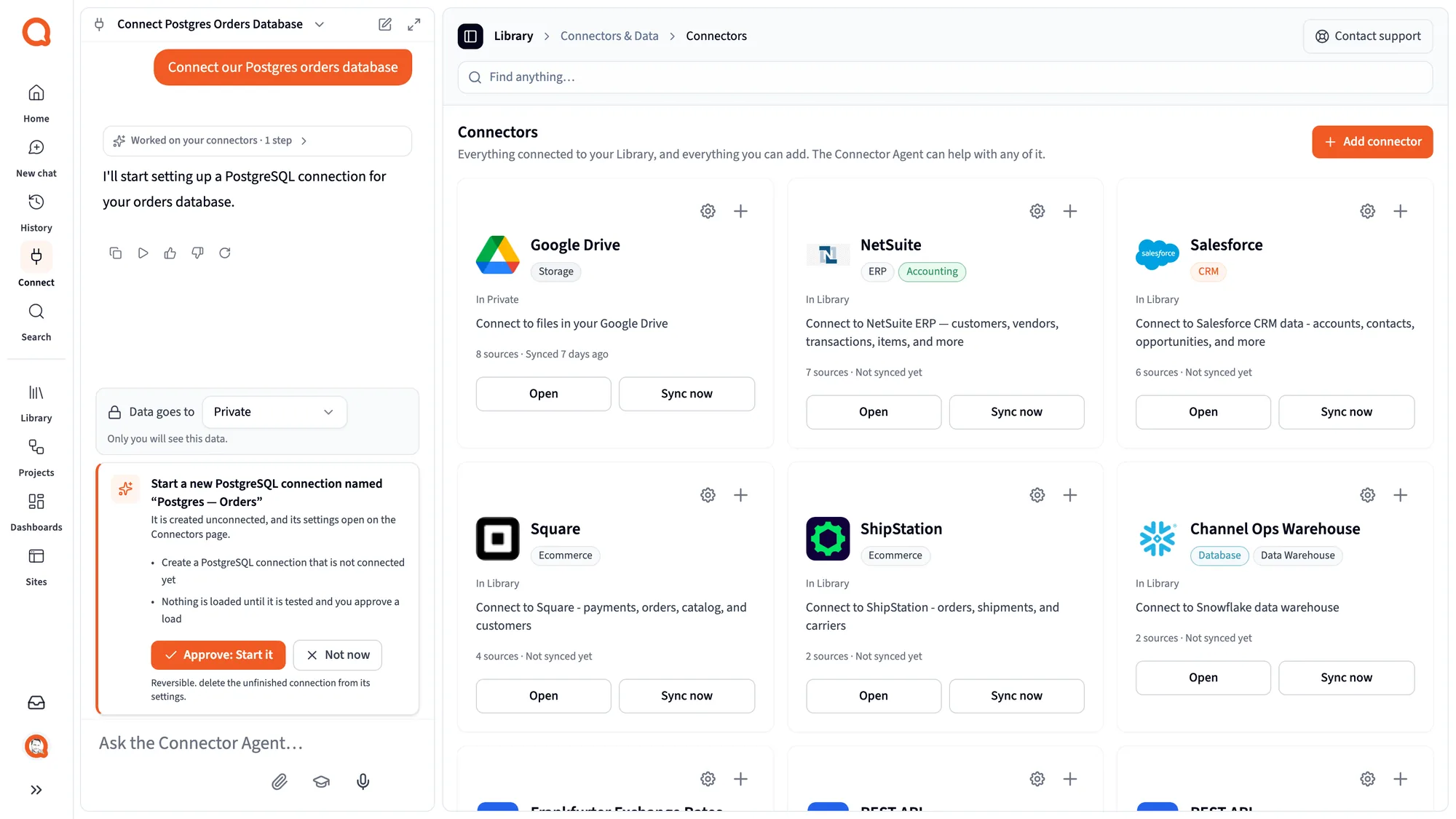
The Connect page with the Connector Agent asking for approval before it starts a connection, next to connector cards for Google Drive, NetSuite, Salesforce, Square, ShipStation and Snowflake
The Connector Agent pauses for your approval before a connection exists.

MongoDB FAQ

Questions about MongoDB and Querri

How do I connect MongoDB to Querri?

Tell the Connector Agent you want MongoDB connected, or select MongoDB in the catalog. Paste a mongodb:// or mongodb+srv:// connection string, or enter host, port, user, password and auth database. Then pick a database and collections, and approve the load and a schedule. The agent never sees your credentials.

What MongoDB data does Querri sync?

The collections and views you choose in one database, or all of them. Each collection becomes a table, each top-level field a column, and _id the primary key. System collections and the admin, local and config databases are skipped. The connected MongoDB user's roles cap what Querri can read.

Does Querri flatten nested MongoDB documents and arrays?

Not into separate tables. Top-level fields become columns, and each nested document or array is stored as JSON text in a single column. Querri can unpack that JSON during an analysis when a question needs a nested value, so you don't have to build a flattening pipeline first.

How often does MongoDB data sync?

Incremental syncs can run hourly, daily or weekly, reading documents whose cursor field (updatedAt by default) has moved on since the last run. A full refresh runs on a daily, weekly or monthly schedule, and a manual sync is available at any time. Answers come from that copy in Querri; your cluster isn't queried when someone asks a question.

Does Querri write to or change my MongoDB data?

No. Querri only reads from MongoDB: it lists databases and collections, samples documents for setup and reads them during a sync. It never inserts, updates or deletes a document, and it doesn't create indexes or collections.

How do MongoDB permissions carry over to Querri?

Querri can only sync the databases and collections the connected MongoDB user is allowed to read, so connect with a user whose roles match what you want in Querri. Once the data is in Querri, row visibility follows Querri's sharing and row-level access settings rather than any individual's MongoDB roles.

How do I combine MongoDB and QuickBooks data?

Connect both, and Querri matches app accounts to QuickBooks customers on the ID or name they share. Then you can ask which workspaces are active but unbilled, or how usage compares to what each customer pays. Where a pairing is a guess, the answer says so.

How do I combine MongoDB and Salesforce or HubSpot data?

Connect MongoDB and your CRM, and Querri links app accounts to companies and deals in the Library. That lets customer success see real product usage next to renewal dates, and lets marketing follow a signup source through to an activated account.

How do I get an onboarding funnel report from MongoDB?

Ask for it. If setup steps are stored in an array on each user, Querri reads that JSON column and counts who reached each step by plan or signup week. Save activation as a KPI to keep its history, and follow the signup-to-first-value playbook for the full version.

How do I get a report of stuck or failed orders from MongoDB?

Ask which orders have sat in a status longer than you'd expect, grouped by warehouse, region or queue. Save it as a project and schedule it for each morning, or set a nightly monitor that flags any location running well above its own normal.

Can I export MongoDB to Excel automatically?

Yes. Do the export once in Querri, keep it as a project, and choose when it runs. Each run uses the most recent sync and sends a formatted Excel workbook by email, and you can send a separate version to each team or client without maintaining a mongoexport script.

Can I build custom MongoDB dashboards without writing aggregation pipelines?

Yes. Tell Querri what to chart, or begin from a screenshot of a dashboard your team already looks at. You change it by asking, it can mix MongoDB with billing, CRM and support data, and each person can be limited to the rows they should see.

Can I ask ChatGPT or Claude about my MongoDB data?

Yes. Add Querri as a connection in Claude or ChatGPT, and the assistant answers from your synced data in the Querri Library, with your definitions and each person's access in Querri, and it never connects to your MongoDB cluster directly.

Does Querri capture deleted MongoDB documents?

Not on an incremental sync. Querri doesn't read change streams or the oplog, so a document deleted at the source stays in the copy until the next full refresh, which removes it. If deletes matter for a collection, schedule a regular full refresh for it.

What MongoDB authentication does Querri support?

Username and password over SCRAM (SCRAM-SHA-1 or SCRAM-SHA-256), with TLS on by default. X.509 client certificates, AWS IAM, OIDC, Kerberos and LDAP are not supported today, and neither are proxy settings or certificate files in the connection string.

Can Querri connect to MongoDB on a private network?

Yes, through the VPN Tunnel (Advanced) option, which uses OpenVPN. Without it, every host in the connection string, including Atlas SRV targets and replica-set members, must resolve to a public address. Unix socket connections are not supported.

Can I run my own aggregation pipeline or query in Querri?

Not as part of the connection. Querri syncs whole collections or a selected list rather than custom queries. Once the data is in Querri, you ask the question in plain language and Querri writes the analysis, including any grouping or joining across collections.

Is my MongoDB data secure in Querri?

Querri is SOC 2 Type II, HIPAA and ISO 27001:2022 certified. Your connection string goes into a secure form the Connector Agent never sees, connections use TLS by default, and your data is never used to train a model.
Ask MongoDB the question that's been sitting in the backlog.

Setup takes a few minutes, and Querri only ever reads your data. It never changes a document.