Skip to content

Querri for eCommerce brands

Every channel.One set of numbers.

Shopify, Amazon, your retailers and your ERP each report their own slice of the business, and none of them agree on margin. Querri joins every channel with your ad spend and your ERP or books, learns what you mean by net sales and contribution, and checks every number before you see it.

Querri only reads data from the systems you connect and never changes an order, a listing or a record. SOC 2 Type II, HIPAA and ISO 27001:2022 certified, and your data is never used to train a model.

Connect the whole business

Where you sell, where you advertise, where the money and the stock live

A multichannel brand runs on a dozen systems. Querri copies each one into a single Library on a schedule you choose, so a question about margin can read the store, the marketplace, the ad platforms and the ledger at once. Pick from the catalog or ask the Connector Agent, and browse every connector.

Retailer and distributor reports count too

Sell-through and on-hand reports, retailer POs, EDI and portal exports, chargeback and deduction statements: most of it arrives as spreadsheets in a different layout from each account. Upload Excel or CSV files, or point Querri at a Google Drive folder. Data cleansing finds buried header rows and sideways tables, and next week's file gets the same treatment.

Why multichannel reporting breaks

Every tool sees one slice. Nobody sees the business.

Selling through your own store, Amazon, distributors and retail is how brands grow. It also splits the truth across systems that were never meant to agree, and the work of putting it back together lands on whoever owns the spreadsheet.

01

Each channel reports only itself

The store knows its orders, Amazon knows its fees, the ad platforms know their spend and the ERP knows cost. Each has its own dashboard and its own assistant, and none can answer a question that needs two of them.

02

Three reports, three margins

The store shows one revenue figure, the books another, and the ad platforms together claim more sales than either. Someone checks the numbers by hand before every board meeting, and the meeting still opens with whose number is right.

03

Real margin lives in a spreadsheet

Margin after marketplace fees, shipping, returns and ad spend gets rebuilt by hand each month from a stack of exports. It takes days, one person knows how the formulas work, and the number is a month old by the time anyone reads it.

04

Retailer data arrives as messy files

Distributor and retailer reports come in their own layouts, with headers halfway down the sheet, units in cases on one and eaches on the next, and product codes that don't match yours. Sell-through by account means cleaning every file first.

05

The capable tools need an analyst

Tools that can join channels expect someone who writes queries or models data, and fixed reports only let you filter what someone else built. Many also price on revenue or order volume, so the bill climbs every time the business grows.

Questions by role

Ask it the way you'd ask your team

Everyone at a growing brand has a question that crosses systems. These are the ones that come up most, in the words people use.

Founders and CEOs

  • Which channel actually makes us money once fees, returns and freight come out?
  • Are we growing, or just spending more on ads to stand still?
  • What changed this week that I should know about before Monday?
Nightly insights

Finance (controllers, fractional CFOs)

  • Why doesn't Shopify revenue match what landed in the bank?
  • Can I reconcile Amazon settlements to orders without a week in Excel?
  • Can every board number trace back to the ERP?
Querri for finance

eCommerce and growth

  • What's MER and blended CAC this month, against last month?
  • Which first products bring back repeat buyers?
  • Is AOV moving because of discounts, or because of the mix?
Querri for marketing

Operations and inventory

  • How many weeks of cover do we have per SKU across the warehouse, the 3PL and Amazon?
  • Which retailers' sell-through is slipping, and where?
  • Which open POs land after we'll have stocked out?
Querri for logistics

What you can finally answer

Eight multichannel questions you can stop rebuilding by hand

Each one needs more than one system, and today each one costs an afternoon of exports. Here is why it's hard and how Querri answers it.

What's our contribution margin by SKU and by channel?

Why it's hard

The selling price is in Shopify, marketplace fees in Amazon's reports, unit cost in NetSuite or QuickBooks and ad spend in two ad platforms. The answer only exists once a month, in a spreadsheet.

With Querri

Querri joins orders, fees, unit cost and spend by SKU and channel and applies your margin ladder, saved once in Facts & rules. Keep CM1, CM2 and CM3 as KPIs so chat, dashboards and reports quote the same number.

Do our Amazon settlements tie back to the orders we shipped?

Why it's hard

Amazon pays in settlements that net sales against fees, refunds and adjustments, so a deposit never lines up with the orders behind it. Amazon profit stays an estimate.

With Querri

Connect Amazon and its orders, fees, refunds and settlements sit beside your other channels. Ask Querri to tie each settlement to the orders and refunds it covers, and it lists the lines that don't match instead of forcing a total.

Are we growing, or just buying revenue with ads?

Why it's hard

Each ad platform reports its own return on spend, and added together they claim more sales than the store recorded. Nobody sees total spend against total contribution.

With Querri

Querri puts Meta Ads and Google Ads spend, as the platforms report it, beside revenue and contribution from every channel, and tracks MER and blended CAC week by week. It reports spend and results side by side; it doesn't attribute sales to ads.

How many weeks of cover do we have per SKU, everywhere we hold stock?

Why it's hard

Stock sits in Shopify locations, the ERP, a 3PL's export and Amazon's warehouses, each counted its own way. A stockout shows up in the monthly review after it has cost sales.

With Querri

Querri reads stock from Shopify and NetSuite, Amazon inventory and the 3PL's file, and divides by recent sales per SKU and location. A monitor flags a SKU whose cover falls well below its usual level.

Which retailers' sell-through is slipping?

Why it's hard

Every retailer and distributor sends a weekly report in its own layout, some in cases and some in eaches, with their item codes instead of yours. Comparing accounts means cleaning each file first.

With Querri

Drop the reports in or connect a Google Drive folder. Data cleansing straightens each layout, a rule converts cases to units, and sell-through by account and SKU is one question away.

Why doesn't Shopify revenue match what landed in the bank?

Why it's hard

Shopify Payments deposits a payout net of fees, refunds and adjustments, days after the orders. The bookkeeper sees one deposit; the store sees hundreds of orders.

With Querri

Querri lines up Shopify payouts and their fees with deposits in QuickBooks or NetSuite and shows the gap payout by payout, down to the orders and refunds inside each one. The Shopify + QuickBooks page walks through it.

Which first products and channels bring customers back?

Why it's hard

Repeat rate by first product needs every customer's order history grouped by first-order month, and the store's built-in reports stop at the cohorts they were built to show.

With Querri

Ask for repeat rate by first product, first channel or first discount code from Shopify orders. Save it as a project that reruns the same steps each month.

Once promos and deductions are counted, does wholesale pay as well as DTC?

Why it's hard

Discount codes live in Shopify, retailer promo allowances and deductions in the ERP, and shipping cost in the shipping tool. Each team defends its own channel with its own number.

With Querri

Querri compares DTC orders net of discounts and ShipStation shipping cost with wholesale invoices net of deductions, on one definition of margin. The Shopify + NetSuite page goes deeper.

One product, every channel

Map SKU, ASIN and UPC once. Every answer uses it.

The same mug is a SKU in your store, an ASIN on Amazon, a UPC on a retailer's report and an item in NetSuite. Upload your mapping file or tell Querri how they line up, and it's saved as a Fact & rule. From then on, margin by SKU and sell-through by product count every channel, and you can ask which SKUs still have no match.

Combinations brands ask about

See it in the product

Real product screens, on a demo brand's data

These are real Querri screens from Curio Supply, our demo brand, which sells online, on marketplaces and in its own stores. The data is made up; the product isn't.

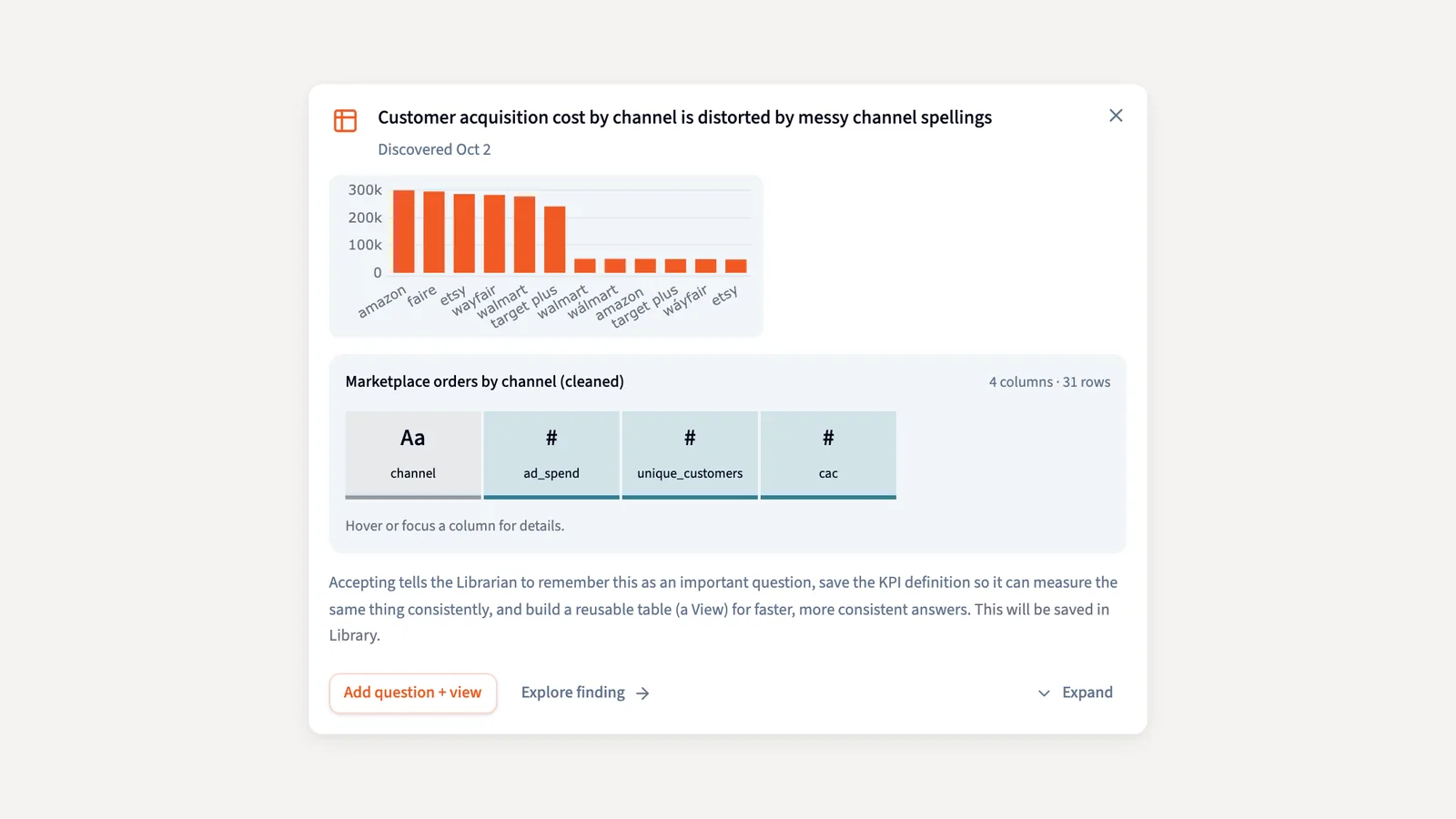
A Library finding titled "Customer acquisition cost by channel is distorted by messy channel spellings", discovered Oct 2, with a bar chart by channel in which marketplaces such as amazon, etsy, wayfair, walmart and target plus appear more than once under different spellings, a cleaned table "Marketplace orders by channel (cleaned)" with channel, ad_spend, unique_customers and cac columns, and an "Add question + view" button
Querri noticed the same marketplaces spelled more than one way, splitting their numbers across rows, and offered a cleaned table that puts CAC by channel back together.
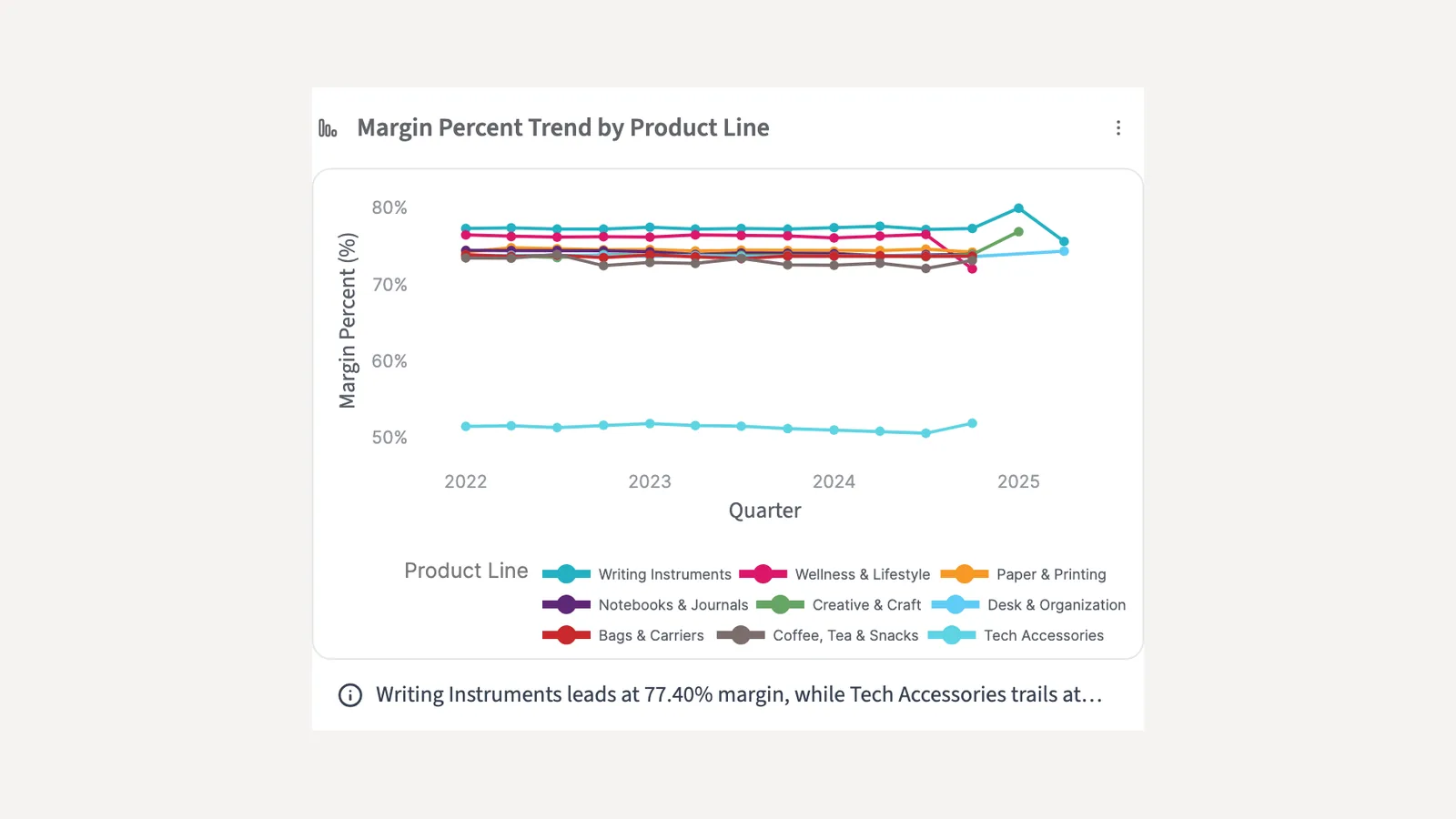
A chart titled "Margin Percent Trend by Product Line" showing margin by quarter from 2022 to 2025 for each product line, with a note reading "Writing Instruments leads at 77.40% margin, while Tech Accessories trails at…"
Margin by product line, quarter by quarter since 2022, with the leader and the laggard called out in words.
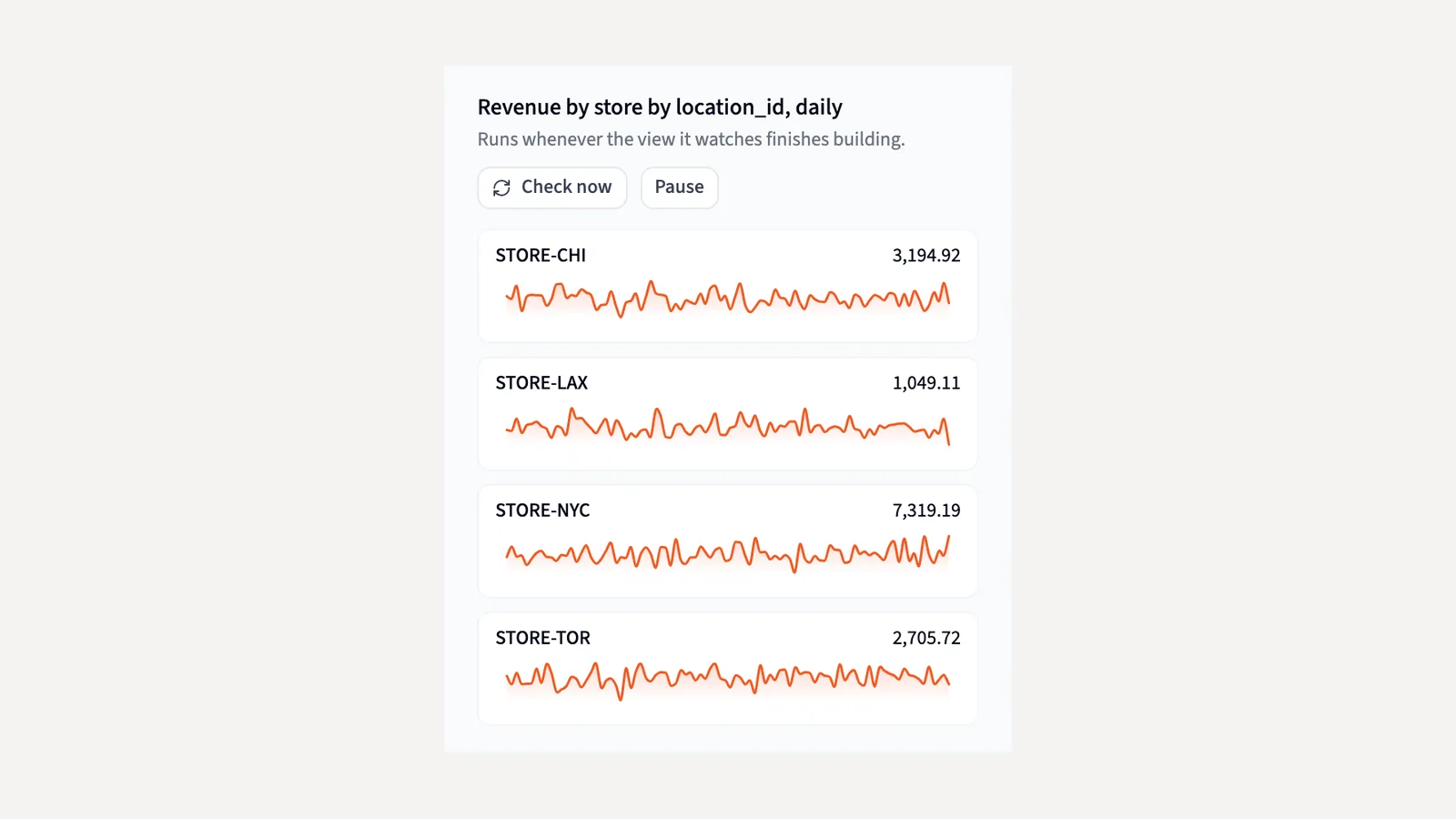
A monitor titled "Revenue by store by location_id, daily" with a sparkline for each of four stores, STORE-CHI, STORE-LAX, STORE-NYC and STORE-TOR, the note "Runs whenever the view it watches finishes building", and Check now and Pause buttons
A monitor on daily revenue for each store location, checked every time its data rebuilds.

Answers you can stand behind

"What's our Amazon margin?" has two fair answers. Querri tells you which one it gave.

Merchandising means price minus product cost. Finance means what's left after Amazon's fees, fulfillment and the ads that drove the sale. Both are fair readings, and on a marketplace the gap between them is wide. Querri answers with the definition you saved, names it, and puts the other beside it. See how answers work.

Wake up to what moved

Querri notices a slipping account before the reorder is late

Ask Querri to keep an eye on sell-through, stock cover or margin by channel, retailer or SKU. Each time the data refreshes, a monitor checks every slice against its own history, using arithmetic, and each night Querri looks for what nobody has asked yet. What moved waits in your Inbox in the morning, and nothing changes without your OK.

For brands that make what they sell

The data that tells you what sold also tells you what it cost to make

If you make your own product, the same Library answers production questions that live in ERP exports and Excel today. Querri reads work orders, BOMs, batch costs, yield and scrap as they're recorded in your ERP or production exports, and joins them to channel sales. More on the manufacturing page.

Margin by SKU or batch, with real cost

Put the cost each batch actually came in at, from your ERP records, against what each channel sold it for, instead of a standard cost set last year.

Recipe and BOM cost variance

Compare what a run used against the recipe or bill of materials, by product line and month, and see which inputs drive the gap.

Demand plan against production plan

Forecast demand by SKU from sales across every channel and set it beside what you plan to make, with a range, so short runs show up early.

Yield and scrap by line

Track yield and scrap from production records and exports, and let a monitor flag a line drifting from its usual rate.

Dashboards and reports

One channel dashboard everyone reads the same way

Build a dashboard by asking for it, then change it the same way. Every chart reads from the Library, so the founder, the controller and the channel leads see the same contribution margin, each with only the rows their access allows.

  • Ask for a weekly channel P&L and get a dashboard you can edit by asking.
  • Start from a screenshot of a report you already use.
  • Share with the whole team; dashboard viewers are unlimited on every plan.
Change a dashboard by asking, and undo it from the bar if you change your mind.

Reports that run themselves

Six reports brands set up once and stop rebuilding

For agencies and fractional CFOs

Report for every brand you serve, under your own name

Agencies, fractional CFOs and retail-analytics firms that report for many brands can run Querri as their own. White label puts your domain, logo and colors on it, each client brand gets its own workspace and data, and one report built once goes to every client as its own copy. Put dashboards inside your own portal with embedded analytics.

eCommerce FAQ

Questions about eCommerce analytics and Querri

What is ecommerce analytics software?

Ecommerce analytics software brings sales, marketing, inventory and finance data together so a brand can see what it sold, what it cost and what it kept. Querri does that across every channel: your store, Amazon, wholesale and retail reports, ad spend and your ERP or books, answered in plain language.

How is Querri different from Shopify's built-in reports?

Shopify's reports and assistant are good at questions about your Shopify store. Querri answers the questions that need more than one system, such as margin after Amazon fees, ad spend and product cost from NetSuite, and checks each number against the data before you see it. Keep using Shopify's reports for store-only questions.

Which channels and systems can I connect?

Shopify, Amazon Seller Central, Meta Ads, Google Ads, Google Analytics, NetSuite, QuickBooks Online, ShipStation, Square, Stripe, WooCommerce and more, out of 125+ connectors, plus Excel and CSV files and Google Drive for retailer and distributor reports. See all connectors.

Can Querri report on Amazon sales and fees?

Yes. The Amazon connector reads orders, order items, fees, settlements, refunds and returns, and inventory from Seller Central, refreshed in full on a schedule. Querri joins them with your other channels, so Amazon margin after fees sits beside your store and wholesale.

Does Querri do ad attribution for Meta and Google Ads?

No. Querri reads campaigns, ad sets, ads and daily spend and results as Meta Ads and Google Ads report them, and puts them beside revenue and margin from every channel. That gives you MER, blended CAC and spend against contribution. It doesn't track pixels or attribute individual sales to ads.

How do I analyze retailer and distributor reports?

Upload the Excel or CSV files, or connect the Google Drive folder they land in, and replace them as each new week arrives. Querri's data cleansing finds buried headers and sideways tables, a rule you state once converts cases to units, and sell-through by account and SKU joins your other channels.

Does Querri work with NetSuite and QuickBooks?

Yes. Querri connects to NetSuite and QuickBooks Online and reads invoices, payments, items and the ledger beside your store and marketplace data. That's how wholesale revenue, item cost and deposits reach the same answer as your online orders.

How do I calculate contribution margin by channel?

Connect your channels, ad platforms and ERP or books, then tell Querri your margin ladder once: for example, CM1 after product cost, CM2 after fees and shipping, CM3 after ad spend. It saves the definition, applies it to every channel and SKU, and shows which costs it subtracted.

Can Querri use our COGS and landed cost?

Yes, from wherever you keep them: unit cost on Shopify inventory items, item cost in NetSuite or QuickBooks, or a landed-cost spreadsheet with freight and duty you upload. Tell Querri which source is right for which SKUs and it uses that in every margin answer.

Can Querri track inventory across warehouses, 3PLs and Amazon?

Yes. Querri reads stock levels by location from Shopify and your ERP, inventory from Amazon, and your 3PL's on-hand exports, then works out weeks of cover per SKU from recent sales. A monitor flags a SKU whose cover falls well below its usual level.

Does Querri change anything in our store or systems?

No. Querri only reads data from the systems you connect. It never creates, edits or deletes an order, a listing, a product, an invoice or any other record, and it doesn't reprice or reorder. Questions run on the copy inside Querri, so your systems stay exactly as they were.

How long does setup take?

Most systems connect in one sitting: ask the Connector Agent or pick from the catalog, sign in on the vendor's own page (NetSuite takes token credentials from your admin instead), and approve the first load. You don't need a data team, a warehouse or anyone who writes SQL to start asking questions.

How is Querri priced?

Querri is priced on usage, in monthly credits for the work it does, such as answering a question. It isn't priced on your revenue or order count, dashboard viewers are unlimited on every plan, and you're alerted before you reach your limit. See pricing.

Is our sales and customer data secure in Querri?

Querri is SOC 2 Type II, HIPAA and ISO 27001:2022 certified, and your data is never used to train a model. Inside Querri, sharing and row-level access decide who sees which rows, in chat, dashboards and the API. Details are on the security page.

Can I ask ChatGPT or Claude about our ecommerce numbers?

Yes. Connect Claude or ChatGPT to Querri once and they answer from your Library, using the margin definitions and SKU mappings your team saved. Each person only gets the rows their Querri access allows.

Can agencies and fractional CFOs use Querri for client brands?

Yes. Give each client brand its own workspace with its own data and dashboards, run Querri under your own brand with white label, and send every client its own monthly report from one report you built once. Each client sees only its own rows.

Can Querri handle multiple Shopify stores and currencies?

Yes. Connect each Shopify store as its own connection and Querri joins them in one Library. Orders keep the store currency and the currency the shopper paid in, an answer that adds up different currencies says so, and you can ask for one currency when you need a single total.


See what every channel actually made.

Connect your store, Amazon, your ad platforms and your ERP or books in one conversation. Querri only reads your data; every order, listing and record stays as it was.