Skip to content

Shopify + NetSuite

Shopify + NetSuite reporting,DTC and wholesale in one answer.

Ask what your store and your wholesale accounts each made after cost, and get one answer that reads Shopify orders and NetSuite costs together. Querri copies both into one Library on a schedule, matches SKUs to items, and uses the definition of net sales your finance team signed off on.

Querri only reads from Shopify and NetSuite and never changes an order, an item or a record. You approve Querri on Shopify's own screen, and the Connector Agent never sees your NetSuite tokens. SOC 2 Type II, HIPAA and ISO 27001:2022 certified.

Why Shopify + NetSuite reporting gets hard

The store takes the order. NetSuite keeps the books.

Brands on this pair usually run an integration app that pushes Shopify orders into NetSuite as sales orders or cash sales. It moves the records. Nobody gets told where the two systems stopped agreeing.

01

Failed orders wait quietly in a queue

When an order hits a SKU with no NetSuite item, an unknown tax code or a customer that won't match, the integration can park it in an error log. Shopify counts the sale, NetSuite doesn't, and the gap turns up at month-end.

02

A payout is not a day of sales

Shopify Payments takes processing fees out before a payout is sent, deducts refunds from the next payout, and takes back disputed amounts plus their dispute fees. A refund doesn't give back the original processing fee. Matching one bank deposit in NetSuite means taking the payout apart.

03

Discounts, shipping and tax get mapped differently

Shopify keeps a discount code, a shipping line and tax on the order. Depending on how the integration was set up, NetSuite may see a discount item, a lower unit price or a shipping charge on a different line. Both totals are right and they still don't tie.

04

Two systems count the same stock

Shopify tracks available, committed and on-hand units per location. NetSuite keeps its own inventory balance per location. Fulfillments, transfers and returns reach each one at a different time, so oversells and phantom stock show up before anyone notices the drift.

05

Margin needs cost that Shopify doesn't have

Shopify's profit reports only count products and variants that had a cost recorded when they sold, and Shopify asks for that cost without taxes, shipping or other costs. Landed cost, and every wholesale order, lives in NetSuite.

What you can finally answer

Eight Shopify + NetSuite questions that used to mean a spreadsheet

Each one is a question controllers and ecommerce operators ask every month, why it's hard with the two systems apart, and what Querri does with it.

Which Shopify orders never made it into NetSuite?

Why it's hard

The integration's error log shows what failed today. It doesn't give finance a dollar total of every order Shopify has and NetSuite doesn't, for the whole month.

With Querri

Querri lines up Shopify orders with NetSuite cash sales and sales orders by order number and amount, and lists the ones with no match, with the reason it can see. A monitor checks the gap every night.

How do I reconcile Shopify payouts to NetSuite deposits?

Why it's hard

A payout bundles many orders, minus fees, refunds and adjustments. The deposit in NetSuite is one number, and the bookkeeper rebuilds the payout from a CSV.

With Querri

Querri reads Shopify Payments payouts and every balance transaction behind them, so each deposit breaks down into sales, fees and refunds next to the matching NetSuite deposit. The finance team starts from the differences, not from the CSV.

What's our margin by SKU across DTC and wholesale, using landed cost?

Why it's hard

Shopify knows DTC price and discounts. NetSuite knows wholesale price and landed cost. Margin by SKU takes both, plus agreement on what net sales means.

With Querri

Say once in Facts & rules that net sales is gross sales minus discounts and refunds, and which cost to use. Querri joins Shopify line items to NetSuite items by SKU and keeps margin as a KPI.

Do Shopify and NetSuite agree on stock, location by location?

Why it's hard

Each system shows its own count. Comparing them means two exports, a SKU lookup and a guess about which one is late.

With Querri

Querri puts Shopify inventory levels next to NetSuite inventory balances for each location and SKU, and flags where they differ. Add ShipStation to see which shipments haven't reached either side yet.

Were refunds and returns recorded on both sides?

Why it's hard

A refund issued in Shopify should become a credit or refund in NetSuite. When it doesn't, revenue in the books runs high and nobody sees it until an audit.

With Querri

Querri matches Shopify refunds and returns to NetSuite refund and credit transactions and lists the ones with no partner. It checks for duplicates and odd values first, and says how much that changed the answer. See how Querri checks its work.

What's our MER and spend against contribution, with Amazon in the mix?

Why it's hard

Ad spend sits in the ad platforms, marketplace sales in Seller Central, store sales in Shopify and cost in NetSuite. Each tool reports its own slice.

With Querri

Connect Meta Ads, Google Ads and Amazon beside Shopify and NetSuite. Querri puts spend, as each platform reports it, next to revenue and margin from every channel.

Can finance get the Shopify-to-NetSuite check in Excel every Monday?

Why it's hard

Someone exports orders from Shopify, runs a saved search in NetSuite and does the VLOOKUP again. Every week, by hand.

With Querri

Build the check once as a project. A schedule reruns it on freshly synced data and sends a formatted workbook. See reports and automation.

Can I ask Claude or ChatGPT about Shopify and NetSuite together?

Why it's hard

Each platform's own assistant knows its own system. A question about DTC margin needs both, and the same definition every time it's asked.

With Querri

Connect Querri to Claude or ChatGPT once. Questions asked there are answered from your Library, using your net sales rule and only the rows that person may see, so the margin Claude quotes is the one finance sees on the dashboard.

Shopify + NetSuite plus the rest

Add the marketplace, the ad spend and the retailer reports

Your store and your ERP cover DTC and wholesale. Amazon, the ad platforms, the shipping tool and the reports retailers send cover the rest. Querri puts them in the same Library, so a question about one SKU can reach every channel it sells through.

Shopify + NetSuite pair well with

Answers you can stand behind

"Online sales" has a Shopify number and a NetSuite number. Querri says which it gave you.

The ecommerce lead means orders placed in Shopify that month. The controller means revenue posted in NetSuite. Each is a fair reading, and refunds, timing and failed syncs keep them apart. Querri picks one, tells you which, and puts the other figure next to it. See how answers work.

Wake up to what changed

Querri notices when the stock counts drift apart

Each night Querri compares Shopify and NetSuite inventory for every location with that location's own history, using arithmetic. A location that drifts further than usual is in your Inbox by morning. Querri flags it and leaves both systems as they are; nothing changes without your OK.

Custom Shopify + NetSuite dashboards

One dashboard for the store, the ledger and the warehouse

Ask for the dashboard in a sentence, or hand Querri a screenshot of the report your team already reads. You adjust it the same way, the charts draw on the Library your chat questions use, and a channel manager or subsidiary lead can be kept to their own rows.

  • Built and changed by asking
  • Shopify orders beside NetSuite cost, stock and wholesale
  • Row-level access per person, set once
One sentence in the chat turns the dashboard dark, and the undo is one click away.

Reports you can stop rebuilding

Six Shopify + NetSuite reports, built once

What comes over

Your store tables and your ERP tables, side by side

Shopify brings its orders, catalog, inventory and Shopify Payments tables; you pick the NetSuite tables that matter. Each lands in your Library and refreshes on its own schedule. NetSuite shares only what the role behind your token can see.

Among the tables from each side

  • Orders (Shopify)
  • Order line items (Shopify)
  • Order refunds (Shopify)
  • Order returns (Shopify)
  • Order transactions (Shopify)
  • Order fulfillments (Shopify)
  • Product variants (Shopify)
  • Inventory items (Shopify)
  • Inventory levels (Shopify)
  • Payouts (Shopify)
  • Balance transactions (Shopify)
  • Customer (NetSuite)
  • Transaction (NetSuite)
  • Transaction Line (NetSuite)
  • Transaction Accounting Line (NetSuite)
  • Item (NetSuite)
  • Inventory Balance (NetSuite)
  • Location (NetSuite)
  • Subsidiary (NetSuite)
  • Shopify loads every table your store has data in; NetSuite offers 27 to choose from

Both sides stay current

Shopify orders sync by their last update, and an edited order brings its lines, refunds and fulfillments along. NetSuite rows sync by last-modified date. Incremental syncs on both sides can run as often as hourly. Rows deleted in Shopify or NetSuite leave Querri at the next full refresh, which runs daily, weekly or monthly.

Whole history, big stores included

Querri has Shopify's approval to read every order a store has, not only the last 60 days, and it loads them through bulk operations on Shopify's GraphQL Admin API so large stores don't stall on rate limits. NetSuite comes over through SuiteQL.

Read only, on both

Querri asks Shopify for read-only access and reads NetSuite with SELECT queries. It never edits an order, a product, an item or a journal.

Credentials out of sight

You approve Querri on Shopify's own screen. Your NetSuite token details are typed into a secure form. The Connector Agent can tell whether they're filled in, never what they say.

How to connect Shopify and NetSuite

One chat with the Connector Agent sets up both

  1. 1

    Tell the Connector Agent

    Open Connect and say "connect Shopify and NetSuite," or pick each from the catalog. It handles Shopify first, then NetSuite.

  2. 2

    Approve Querri in Shopify

    Type the store as acme or acme.myshopify.com, then grant read-only access when Shopify asks. Installing from the Shopify App Store works too.

  3. 3

    Add NetSuite tokens

    Paste your account ID and token-based authentication keys into the secure form. A sandbox account connects the same way as production.

  4. 4

    Approve the load and schedules

    Shopify brings every table it has data for. Pick your NetSuite tables, then approve the first load and how often each side syncs.

  5. 5

    Ask across both

    Ask which orders are missing from NetSuite. Querri tells you how it matched them.

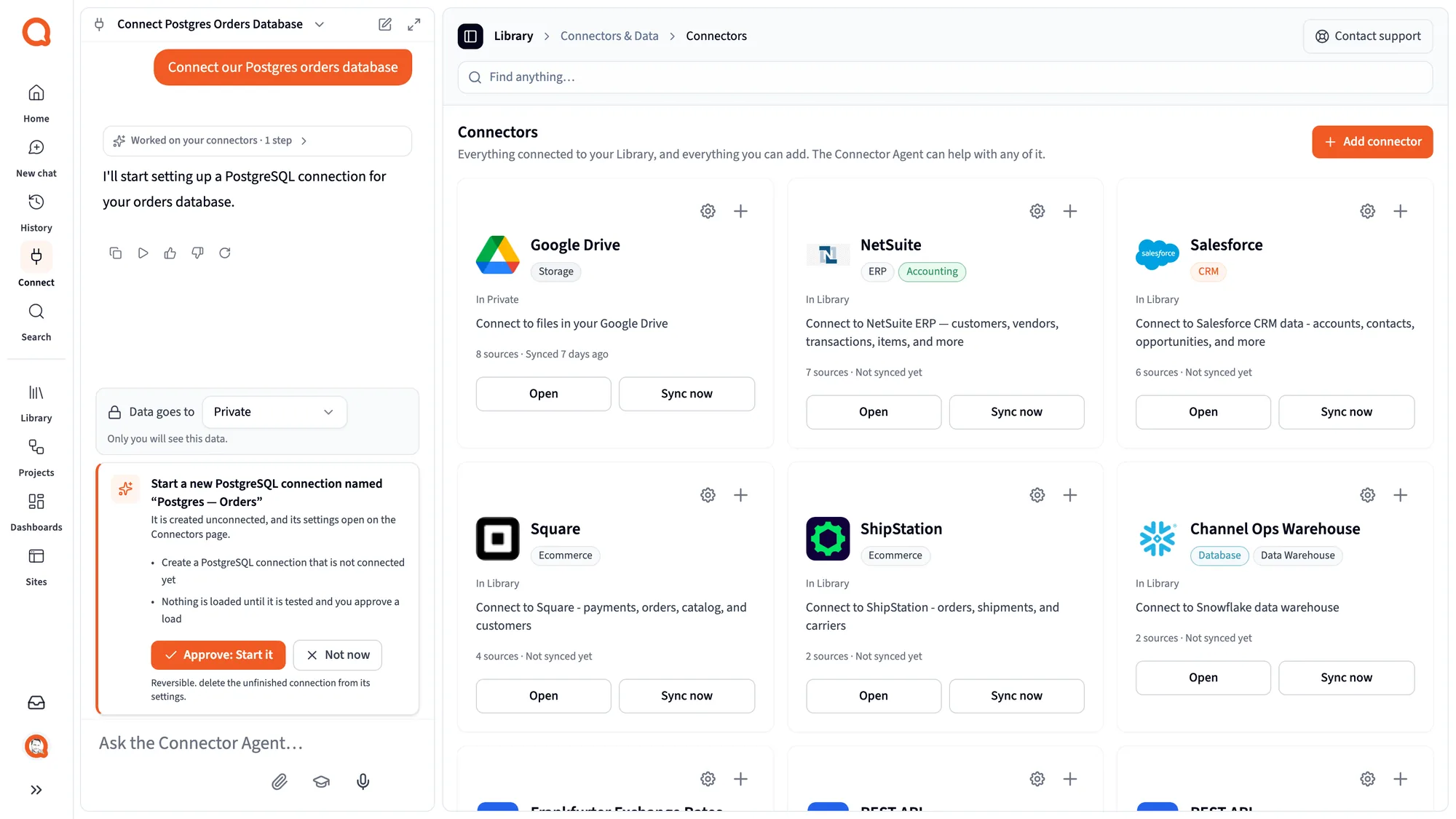
The Connect page in Querri, with the Connector Agent asking for approval before it starts a connection, next to connector cards for Google Drive, NetSuite, Salesforce, Square, ShipStation and Snowflake
The Connector Agent creates nothing and loads nothing until you approve it.

Shopify + NetSuite FAQ

Questions about Shopify, NetSuite and Querri

How do I connect Shopify and NetSuite to Querri?

Ask the Connector Agent to connect Shopify and NetSuite. For Shopify, enter your store name and approve read-only access on Shopify's screen. For NetSuite, enter your token-based authentication details in a secure form. Then choose NetSuite tables and approve the first load and a schedule for each.

Is Querri an integration app that syncs Shopify orders into NetSuite?

No. Querri doesn't move data between Shopify and NetSuite, and it never creates a sales order or cash sale. It reads a copy of both into its Library and shows where they disagree, so it works beside whatever integration you already run.

What Shopify and NetSuite data does Querri sync?

From Shopify: orders with line items, shipping lines, refunds, transactions, fulfillments and returns, plus products, variants, customers, locations, inventory, discounts, gift cards and Shopify Payments payouts. From NetSuite: up to 27 tables, including customers, transactions and their lines, accounting lines, items, inventory balances, locations and subsidiaries.

How often does Shopify and NetSuite data sync?

You choose. Incremental syncs run hourly, daily or weekly and pick up changed Shopify orders and changed NetSuite rows. A full refresh runs daily, weekly or monthly. You can run a manual sync anytime, and questions run on Querri's copy rather than live against either system.

Does Querri change anything in Shopify or NetSuite?

No. Querri only reads data from connected systems. It asks Shopify for read-only access and reads NetSuite with SELECT queries, so it can't edit an order, a product, an item, a customer or a journal, and it never adjusts inventory in either system.

How far back do Shopify orders go?

All the way. Querri has Shopify's approval to read a store's full order history, so it loads every order rather than the last 60 days that apps see by default. Older orders are there for year-over-year and cohort questions from the first sync.

How do I find Shopify orders that are missing from NetSuite?

Connect both and ask. Querri matches Shopify orders to NetSuite cash sales and sales orders by order number and amount, lists the ones with no match, and totals the dollars. Set it up as a monitor and the gap is checked every night.

How do I reconcile Shopify Payments payouts with NetSuite deposits?

Querri syncs Shopify Payments payouts and the balance transactions behind each one: charges, refunds, fees and adjustments. It puts each payout beside the matching NetSuite deposit, so you can see which part of a difference is fees, which is refunds and which is an order that never posted.

How do I get margin by SKU across Shopify and NetSuite?

Tell Querri once how you define net sales and which NetSuite cost to use, such as landed cost. It joins Shopify line items to NetSuite items by SKU, adds wholesale orders from NetSuite, and keeps margin by SKU and channel as a KPI with its history.

How do I compare Shopify and NetSuite inventory by location?

Connect both and ask for the difference. Querri sets Shopify's available and on-hand units per location beside NetSuite inventory balances per location, SKU by SKU, and a nightly monitor can flag a location whose gap is out of line with its own history.

How do I combine Shopify, NetSuite and Amazon data?

Connect Amazon Seller Central next to Shopify and NetSuite. Querri brings Amazon orders, fees, settlements, refunds and inventory into the same Library, so you can ask for net sales and margin by channel with marketplace fees and NetSuite cost in the same answer.

How do I combine Shopify and NetSuite with Meta Ads spend?

Add the Meta Ads connector, plus Google Ads if you buy search. Daily spend lands in the Library exactly as each platform reports it, and Querri sets it against Shopify revenue and NetSuite cost to give MER, blended CAC and contribution after ad spend. It doesn't attribute sales to ads or track pixels.

Can I build custom Shopify + NetSuite dashboards?

Yes. Ask for it in plain language, or start from a screenshot of a report you already use. You edit it by asking too, it can mix Shopify, NetSuite and any other connected source, and each person can be limited to their own channel, location or subsidiary.

How do I export Shopify and NetSuite data to Excel automatically?

Set up the report a single time and give it a schedule. After each sync Querri runs it again and delivers a formatted Excel workbook, and a subsidiary controller or channel manager can get a copy cut to only their rows.

Can I ask ChatGPT or Claude about my Shopify and NetSuite data?

Yes. After a one-time link, Claude or ChatGPT answers from your Querri Library, applying your net sales and margin definitions and each person's row access. Ask Claude for September wholesale margin and you get the number your Querri dashboard shows.

Can I connect more than one Shopify store?

Yes. Connect each store separately; every one gets its own tables and carries the store's name. Querri can join them in the Library, so you can compare stores or add them up against a single NetSuite account.

What doesn't Querri sync from Shopify and NetSuite?

From Shopify: disputes, refund line items (refund totals do sync), per-order discount applications (discount codes and totals do sync), metafields and B2B company records. From NetSuite: custom records. Deleted records stay in incrementally synced tables until the next full refresh, so schedule one regularly.

Is my Shopify and NetSuite data secure in Querri?

Querri is SOC 2 Type II, HIPAA and ISO 27001:2022 certified, and your data is never used to train a model. You approve Shopify access on Shopify's own screen, NetSuite tokens go into a secure form the Connector Agent never sees, and Querri only reads.


Find out where Shopify and NetSuite disagree before month-end does.

Connect both in a few minutes. Querri only ever reads your data.