Skip to content

Salesforce + HubSpot

Salesforce + HubSpot reporting,one funnel from first touch to closed-won.

Ask how marketing's leads turned into sales pipeline and get one answer that reads both systems. Querri copies HubSpot and Salesforce into one Library on a schedule, matches people across them, and uses the funnel definitions your CMO and CRO agreed on.

Querri reads Salesforce and HubSpot and leaves every record in both exactly as it was. Each connection is a sign-in on the vendor's own screen, so no password passes through Querri. SOC 2 Type II, HIPAA and ISO 27001:2022 certified.

Why Salesforce + HubSpot reporting gets hard

Marketing works in HubSpot. Sales works in Salesforce. The funnel runs through both.

HubSpot's own Salesforce integration keeps records flowing between the two. Getting one honest funnel out of them is a separate job, and it lands on marketing ops and RevOps.

01

One person, three stages

A buyer has a lifecycle stage in HubSpot, a lead status in Salesforce and, later, an opportunity stage. HubSpot only moves a contact to Opportunity when the Salesforce contact is tied to the deal through a contact role, and changing the lifecycle stage never touches the Salesforce record.

02

Two fields both called "source"

HubSpot records original source itself; Salesforce has Lead Source, often typed by reps. Lead Source is mapped between the two by default, and under a two-way rule whichever system edited it last wins, so the value sales reports on can change after the fact.

03

Duplicates break the match

Salesforce allows two leads or contacts with the same email; HubSpot doesn't. HubSpot syncs with whichever matching record was updated most recently, so one contact can be overwritten by two different Salesforce records.

04

Some MQLs never reach sales

Contacts outside the inclusion list don't sync, and records stall on validation rules, picklist mismatches or missing field permissions. Each one waits in HubSpot's sync errors list, and no Salesforce report ever shows it.

05

Marketing and sales credit different touches

Campaign influence in Salesforce and attribution reports in HubSpot each give credit their own way. The CMO and the CRO walk into the same meeting with two sourced-pipeline numbers.

What you can finally answer

Eight funnel questions that used to need both admins in the room

Each one is a question marketing ops, RevOps and the CMO/CRO pair ask every quarter, what makes it hard across two CRMs, and how Querri answers it.

What's our real MQL-to-opportunity-to-won conversion, by quarter?

Why it's hard

MQL dates sit on HubSpot contacts, opportunities and their stages sit in Salesforce, and each team's dashboard counts its own half of the funnel.

With Querri

Say once in Facts & rules what an MQL is and which Salesforce stages count as pipeline. Querri tracks each step as a KPI and keeps the history from the day you start.

Which MQLs never became a Salesforce lead or contact?

Why it's hard

A contact left out of the sync list or stuck on a sync error simply isn't in Salesforce, and no Salesforce report can show a record that isn't there.

With Querri

Querri compares HubSpot MQLs with Salesforce leads and contacts by email and returns the ones missing on the sales side, with names. Monitors can check the gap every night.

How fast does sales follow up on an MQL, by owner?

Why it's hard

The MQL date is in HubSpot and the first call or task is in Salesforce. Measuring the time between them means joining two activity histories by hand.

With Querri

Querri lines up the MQL date with the first Salesforce task or event for the same person and reports the gap by owner. Save the method as a skill so every region measures follow-up the same way.

How many of our people exist twice, and how much does that inflate the funnel?

Why it's hard

Salesforce keeps duplicate leads and contacts with one email, HubSpot keeps one contact per email, and the counts on each side never reconcile.

With Querri

Before it counts, Querri looks for repeated emails and the same company spelled several ways, then says how much its cleanup choice moved the number. See data cleansing.

What does each campaign cost per opportunity created?

Why it's hard

Spend lives in a budget sheet, campaign membership lives on Salesforce campaign members, and the leads came in through HubSpot. Three sources, three exports.

With Querri

Add the spend sheet from Google Sheets and Querri joins it to Salesforce campaigns and the opportunities that followed, all in the Library.

Do the customers marketing brings in stay and use the product?

Why it's hard

Source is in HubSpot, the deal is in Salesforce and usage is in the product database. Nobody follows a cohort across all three after the deal closes.

With Querri

Bring usage from Snowflake beside both CRMs and compare sources by how their customers behave after the sale. The health score playbook shows a way to score them.

Can the CMO and the CRO ask Claude or ChatGPT and get the same number?

Why it's hard

An assistant pointed at two CRMs picks a source field, a stage and a match rule on its own, so two leaders asking the same question get two answers.

With Querri

Add Querri to Claude or ChatGPT. Whoever asks gets the funnel definitions and person-matching rule from your Library, limited by their access in Querri.

Salesforce + HubSpot plus the rest

Take the funnel past the CRM

Between them, the two CRMs cover the path from first form fill to signed deal. Spend sits in a budget sheet, payments in accounting, usage in the warehouse and support in the help desk. Querri puts them in the same Library, so a marketing question can end at revenue that stayed.

Salesforce + HubSpot pair well with

Answers you can stand behind

"Where did the revenue come from?" depends on which source field you read

HubSpot's original source records the first touch. Salesforce's Lead Source records what the lead form or the rep entered. Both are fair, and they rarely agree. Querri picks one, says which, and puts the other figure next to it, so the debate is about paid search and not about which column was read. See how answers work.

Wake up to what changed

Querri notices when MQLs pile up without a follow-up

Each night Querri compares the handoff in every region with that region's own history, using arithmetic. If MQLs are waiting longer than usual for sales to act, it's in your Inbox by morning, and nothing changes without your OK.

Custom Salesforce + HubSpot dashboards

A funnel dashboard marketing and sales both accept

Ask for the full-funnel view, or begin from a screenshot of the funnel slide your team presents today. MQLs from HubSpot and pipeline from Salesforce sit on one screen with one set of definitions, and each regional lead or rep can be limited to their own rows.

  • MQLs, opportunities and closed-won on one screen
  • Change it with a sentence; undo is one click
  • Row-level access per person, so reps see their own
Every change is a sentence. Ask for a dark theme and the Monthly Sales Review switches over, with undo one click away.

Reports you can stop rebuilding

Six Salesforce + HubSpot reports, built once

What comes over

Both CRMs, side by side in one Library

Querri connects Salesforce and HubSpot as two separate connections and syncs each on its own schedule. It doesn't link them during the sync; people are matched across the two when you ask, for example by email address or company. What lands in Querri is limited to the records the Salesforce user and the HubSpot account you connect with can reach.

Among the objects from each side

  • Lead (Salesforce)
  • Contact (Salesforce)
  • Account (Salesforce)
  • Opportunity (Salesforce)
  • OpportunityLineItem (Salesforce)
  • Campaign (Salesforce)
  • CampaignMember (Salesforce)
  • Task (Salesforce)
  • User (Salesforce)
  • Contacts (HubSpot)
  • Companies (HubSpot)
  • Deals (HubSpot)
  • Leads (HubSpot)
  • Marketing Emails (HubSpot)
  • Forms (HubSpot)
  • Meetings (HubSpot)
  • Owners (HubSpot)
  • Plus Salesforce custom objects the connected user can query, and HubSpot custom objects on Enterprise accounts

Each side kept current

On an incremental run, Salesforce is asked for rows with a newer LastModifiedDate and HubSpot for rows with a newer last-modified date. Some HubSpot objects, such as forms, marketing emails and owners, refresh only on a full refresh, which also drops deleted rows.

Large orgs and big portals

A Salesforce object holding 100,000 or more records is pulled with the Bulk API 2.0 instead of REST. HubSpot records are read in parallel pages under a rate limiter that backs off when HubSpot asks it to.

Read only, on both

Querri never creates, edits or deletes anything in Salesforce or HubSpot, and it never moves records from one to the other.

Two sign-ins, no keys

Salesforce and HubSpot each show their own approval screen. Nothing secret is pasted into Querri, neither a password nor a token.

How to connect Salesforce and HubSpot

One chat sets up both CRMs

  1. 1

    Tell the Connector Agent

    Open Connect and say "connect Salesforce and HubSpot." The agent sets them up one after the other.

  2. 2

    Sign in to Salesforce

    Sign in to your production org and approve access there. Your password never leaves Salesforce.

  3. 3

    Choose Salesforce objects

    Twenty standard objects, including Lead, Contact, Opportunity and Campaign, are already checked. Add custom objects if you need them.

  4. 4

    Sign in to HubSpot

    Grant read access to contacts, companies, deals, owners and tickets. Objects your HubSpot plan includes, such as quotes or custom objects, come along.

  5. 5

    Approve the loads and schedules

    Nothing loads from either CRM until you click Approve. Pick how often each one syncs, then ask your first funnel question.

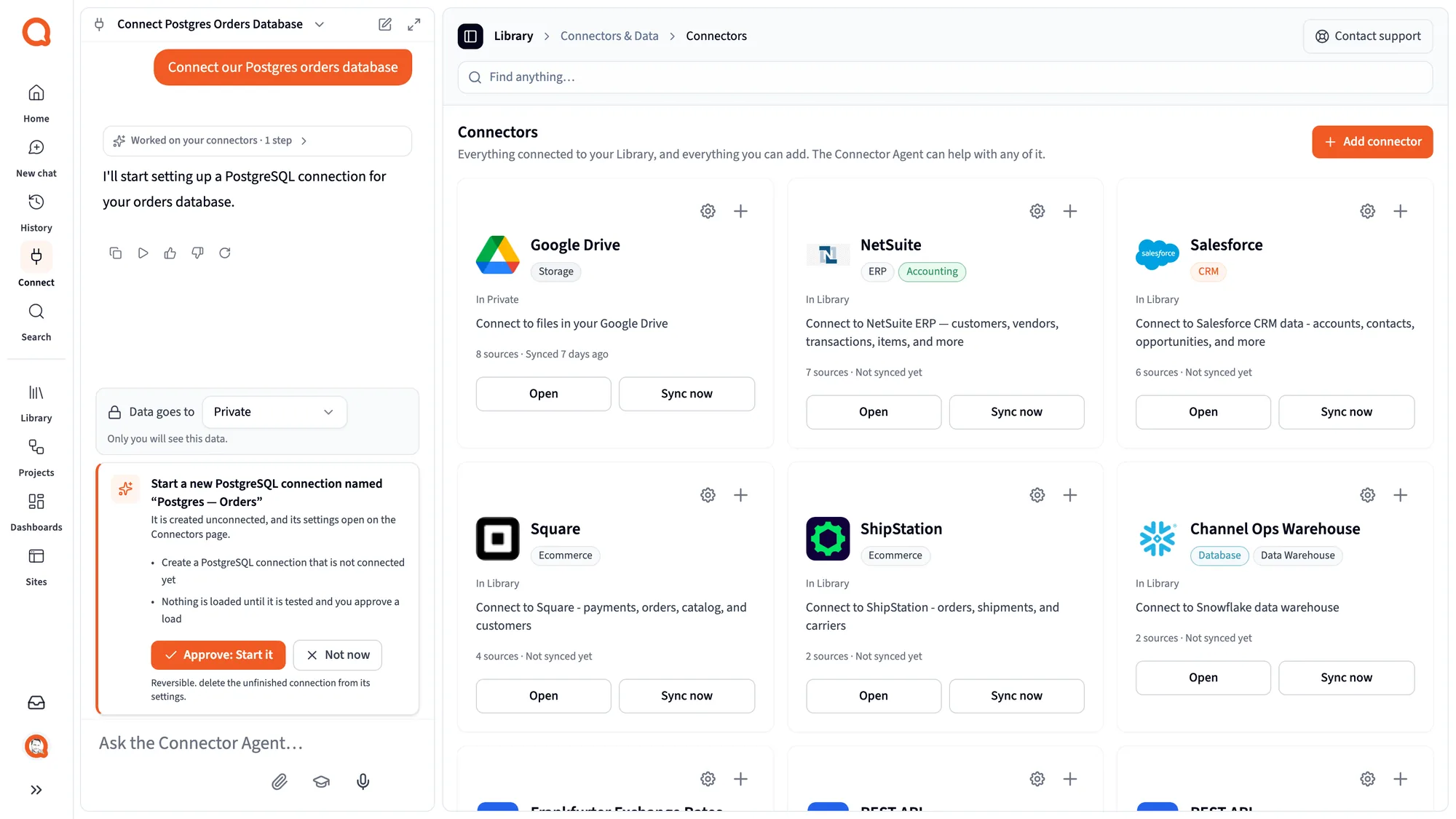
Connector Agent chat waiting on an Approve click before it opens a connection, with a catalog of connector cards (Google Drive, NetSuite, Salesforce, Square, ShipStation, Snowflake) alongside
The Connector Agent asks before it creates a connection or loads a single record.

Salesforce + HubSpot FAQ

Questions about Salesforce, HubSpot and Querri

How do I connect Salesforce and HubSpot to Querri?

Tell the Connector Agent you want both CRMs, or click each tile in the catalog. Sign in to Salesforce and choose objects (twenty standard ones are preselected), then sign in to HubSpot and grant read access. Confirm each first load and how often each side refreshes. Querri never sees either password.

What Salesforce and HubSpot data does Querri sync?

From Salesforce, twenty standard objects such as Lead, Contact, Account, Opportunity, Campaign and CampaignMember, plus custom objects the connected user can query. From HubSpot, contacts, companies, deals, tickets, owners and, when your plan includes them, objects like leads, marketing emails, forms, quotes and custom objects.

How often do Salesforce and HubSpot sync to Querri?

Each side gets its own schedule: incremental runs hourly, daily or weekly for changed records, and a full refresh daily, weekly or monthly, which is also when records deleted at the source drop out. Some HubSpot objects, including forms, marketing emails and owners, update only on a full refresh. A manual sync can run whenever you need it.

Does Querri write to Salesforce or HubSpot?

No. Querri only reads from both systems. It never creates, updates or deletes a lead, contact, deal or any other record, and it never pushes data from HubSpot into Salesforce or back. Every answer is worked out from Querri's scheduled copy, not from the live CRMs.

Do we still need HubSpot's Salesforce integration?

Yes, if you use it. That integration moves leads, contacts and fields between the two CRMs so your teams can work. Querri doesn't move anything; it reads both sides and answers questions across them, such as which MQLs never reached sales or why the two source fields disagree.

How do Salesforce and HubSpot permissions carry over?

Not person by person. The sync reaches only what the Salesforce user and HubSpot account used to connect can reach, so choose them on purpose. After that, Querri's own sharing and row-level access set who sees what, and a rep's row filter applies the same way in chat, dashboards, Claude, ChatGPT and the API.

How does Querri match HubSpot contacts to Salesforce leads and contacts?

At question time, usually by email address, or by company when that's the better key. Querri says how it matched and adds a caveat when a match looks weak, such as two Salesforce records sharing one email. Correct a pairing once in Facts & rules and every answer follows it.

How do I get an MQL-to-closed-won report across HubSpot and Salesforce?

Define an MQL and your pipeline stages once in Facts & rules, then ask for conversion by quarter or source. Querri follows HubSpot MQLs to Salesforce leads, opportunities and closed-won amounts, tracks each step as a KPI, and can send the report every week by email or Excel.

How do I get a list of MQLs that never reached Salesforce?

Ask for it. Querri compares HubSpot contacts in the MQL stage with Salesforce leads and contacts by email and lists the ones with no match, with owner and date. Set a monitor and Querri checks the gap every night, leaving anything unusual in your Inbox.

How do I combine Salesforce, HubSpot and NetSuite data?

Connect NetSuite as a third system. Querri follows a HubSpot source to the Salesforce opportunity and on to NetSuite invoices and payments, so you can rank channels by revenue actually billed. Where an account-to-customer match is uncertain, the answer flags it. QuickBooks works the same way for smaller finance teams.

How do I combine Salesforce, HubSpot and ad spend from Google Sheets?

Connect the spend sheet alongside both CRMs. Querri joins spend by campaign or channel to Salesforce campaigns, campaign members and the opportunities that followed, giving cost per MQL, per opportunity and per closed-won deal. Say once how sheet channel names map to your sources, and every answer uses that mapping.

Which source field does Querri use, HubSpot's or Salesforce's?

The one you tell it to. When a question could reasonably use either, Querri names the field it used and shows the result from the other one too. Set your choice once in Facts & rules, and every answer, dashboard and scheduled report follows it.

Can I build a custom Salesforce + HubSpot funnel dashboard?

Yes. Ask for it in a sentence, or hand Querri a screenshot of the funnel slide from last quarter's review as a starting point. HubSpot MQLs and Salesforce opportunities and wins are counted with the same definitions, you change the layout by asking, and a regional lead can be restricted to their region.

Can I ask ChatGPT or Claude about Salesforce and HubSpot data?

Yes, once Querri is connected to Claude or ChatGPT. Questions are answered from your Library, so MQL, pipeline, source and the rule for matching people mean what your team agreed. Row access in Querri still applies, which is why the number the CMO gets in ChatGPT is the one on the funnel dashboard.

Can I export Salesforce + HubSpot reports to Excel automatically?

Yes. Save the funnel analysis as a project and give it a schedule. Each time the schedule comes round, the project runs again and goes out as a formatted Excel workbook, an email or a deck, split into one copy per region, owner or client if you like. Nobody downloads two CSV exports again.

Does Querri bring over HubSpot associations and pipeline names?

Not today. HubSpot associations, such as which contacts belong to a deal, aren't synced, so links between objects come from properties and from matching. Deals and tickets carry their pipeline and stage as raw IDs rather than labels; tell Querri once what each stage ID means.

Does Querri sync HubSpot form submissions?

No. The HubSpot Forms object brings over form definitions, not individual submissions. Contact properties such as lifecycle stage, lead status and original source do come over, so you can still count MQLs and first-touch sources from the contacts themselves.

Does Querri work with a Salesforce sandbox org?

Not today. The Salesforce sign-in goes to login.salesforce.com, so only production orgs can be connected; test.salesforce.com isn't offered. HubSpot connects through its normal sign-in, and objects your HubSpot plan doesn't include simply don't appear in the list.

Is my Salesforce and HubSpot data secure in Querri?

Yes. Querri holds SOC 2 Type II, HIPAA and ISO 27001:2022 certifications, and your data is never used to train a model. Both connections are made on Salesforce's and HubSpot's own sign-in pages, so no password reaches Querri, and nothing is ever written back to either CRM.


Put marketing and sales on the same funnel.

Connect both CRMs in one conversation. Querri only reads, and neither system changes.