How do I connect Salesforce and Snowflake to Querri?
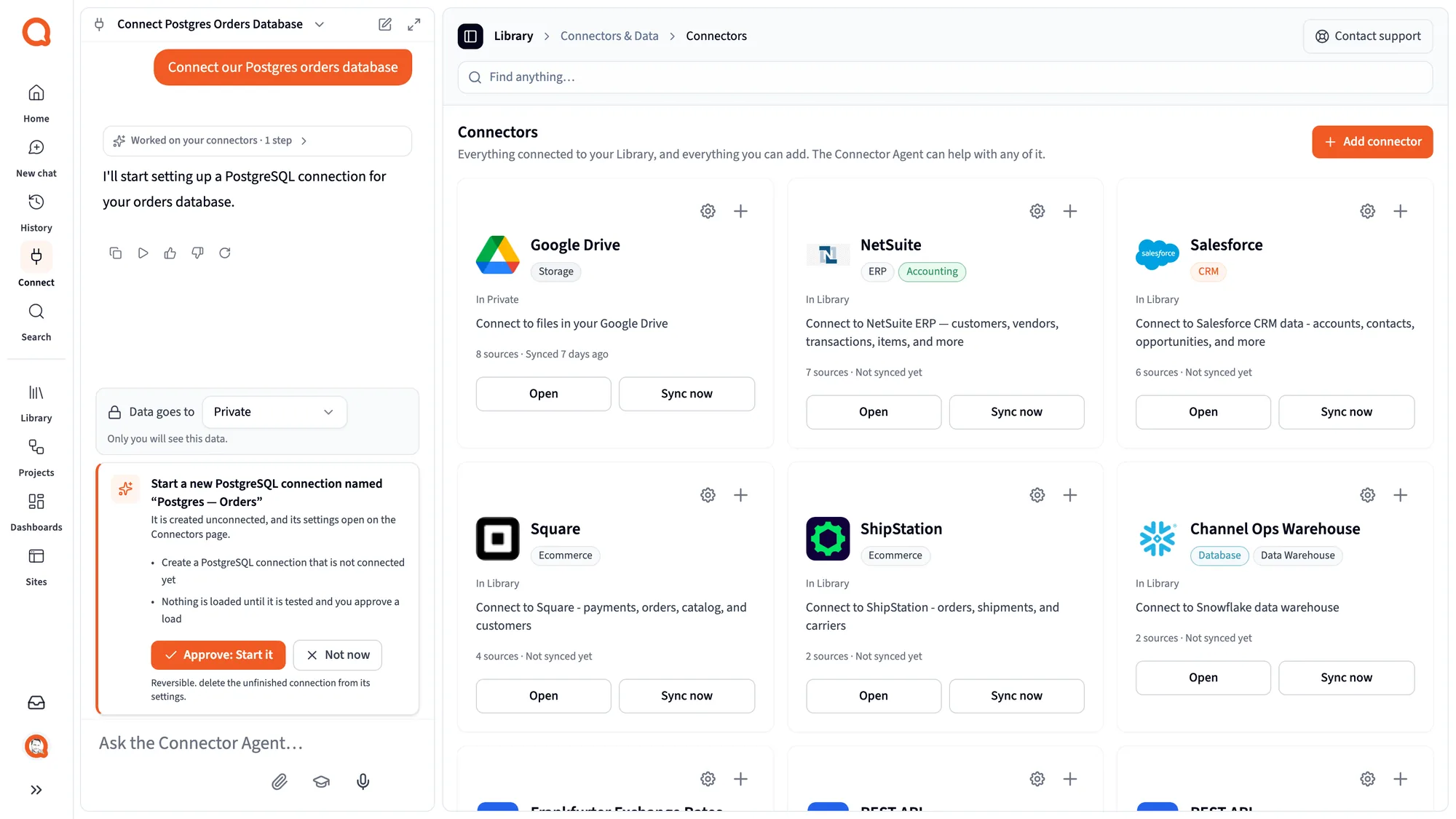
Ask the Connector Agent on the Connect page to connect both. Sign in to Salesforce on its own page, then give Snowflake an account identifier, username and warehouse and either generate a key pair with a setup script or paste a programmatic access token. Pick objects and tables, then approve the load and schedules.
What Salesforce and Snowflake data does Querri sync?
From Salesforce, 20 standard objects such as Account, Opportunity, Contract and Case are preselected, and you can add custom objects the connected user can query. From Snowflake, you take every table and view the role can read or a chosen list, plus custom SQL queries as extra sources.
How often do Salesforce and Snowflake data sync?
Incremental syncs can run hourly, daily or weekly: Salesforce by LastModifiedDate, Snowflake on a cursor column you pick. Full refreshes run daily, weekly or monthly and remove rows deleted at the source. Snowflake custom SQL sources always refresh in full. A manual sync can run at any time.
Does Querri write to Salesforce or Snowflake?
No. Querri only reads your data in both systems and never changes your records there. It doesn't update Salesforce fields, create opportunities or write tables in Snowflake, and the Snowflake setup script grants its role SELECT access only. Querri also doesn't push usage into Salesforce; the two are joined inside Querri instead.
How do Salesforce and Snowflake permissions carry over?
Querri can only sync what the connected Salesforce user and the Snowflake role are allowed to see. Once the data is in Querri, row visibility comes from Querri's sharing settings and per-person row filters, not from Salesforce profiles or Snowflake grants, and those filters apply in chat, dashboards, Claude, ChatGPT and the API.
How do I match Salesforce accounts to product workspaces in Snowflake?
If your product tables store the Salesforce Account ID, Querri joins on it directly. If not, tell Querri the rule once, such as matching on email domain or a mapping table in a spreadsheet, and every answer uses it. Querri says how each account was matched and flags the ones it couldn't place.
How do I get an expansion report from Salesforce and Snowflake?
Connect both, then ask for accounts whose active seats are at or above the seats on their contract and that have no open expansion opportunity. Save it as a project and schedule it, and each account owner gets their own list every week by email or as an Excel workbook.
How do I get a renewal risk report with product usage?
Ask for renewals closing in the next 90 days alongside each account's usage trend from Snowflake. Track usage as a KPI so Querri keeps its history, and let monitors flag renewals whose usage is dropping faster than usual. The at-risk renewals playbook walks through the full setup.
How do I find product-qualified leads that aren't in Salesforce?
Define a product-qualified account in plain words, for example a workspace with 20 or more weekly active users. Querri checks each qualifying workspace against Salesforce leads, contacts and opportunities by domain or account ID, and lists the ones sales has no record of, with how each match was made.
How do I combine Salesforce, Snowflake and HubSpot data?
Connect HubSpot as a third source. Querri matches HubSpot contacts and companies to Salesforce accounts and to product workspaces, so you can follow a campaign through to opportunities and on to how much those customers use the product. Matches Querri isn't sure of are called out in the answer.
How do I combine Salesforce, Snowflake and NetSuite data?
Add NetSuite as a third connection. Querri lines up Salesforce contracts, NetSuite invoices and payments, and usage from Snowflake for the same customer, so you can see who pays for seats they don't use, or who uses more than they're billed for, in one answer.
Can I build a custom Salesforce + Snowflake dashboard?
Yes. Describe an account health or expansion dashboard, or start from a screenshot of one your team already uses. Change it by asking, mix pipeline and renewals with usage on the same screen, and limit each CSM or rep to the accounts they own.
Can I export Salesforce and Snowflake reports to Excel automatically?
Yes. Save the report as a project and give it a weekly or monthly schedule. Querri reruns it on freshly synced data and sends a formatted Excel workbook, or an email, and it can send a separate version to each person with only their accounts in it.
Can I ask ChatGPT or Claude about Salesforce and Snowflake data?
Yes. After a one-time link between Querri and Claude or ChatGPT, the assistant answers from your Querri Library, using your account mapping and your definition of an active user, under each person's own access, so its answer matches your dashboards instead of guessing at warehouse column names.
Does Querri query Snowflake live?
No. Each sync copies your chosen tables and views into Querri, and questions are answered from that copy. Questions don't run against your warehouse each time, though each sync does use your Snowflake warehouse. A custom query can't run longer than 600 seconds, and syncs can be capped at a maximum row count per table.
What doesn't Querri support with Salesforce and Snowflake?
Salesforce sandbox orgs can't connect through the standard sign-in, which goes to login.salesforce.com, and objects that require a filter on every query are skipped. On Snowflake, password and OAuth sign-in aren't offered, PrivateLink and VPN connections aren't available, and custom SQL sources can't sync incrementally.
Do we still need reverse ETL to put usage into Salesforce?
Not for reporting. Querri reads both systems and joins them itself, so dashboards, reports and answers have the full usage history, not just the latest value on an account field. If reps need a usage field inside Salesforce screens, keep that sync; Querri doesn't write anything back.
Is my Salesforce and Snowflake data secure in Querri?
Querri is SOC 2 Type II, HIPAA and ISO 27001:2022 certified, and your data is never used to train a model. Salesforce sign-in happens on Salesforce's page, the Snowflake private key is stored encrypted and never shown, and the Connector Agent only knows whether a credential is set or missing.

 Salesforce + Snowflake